Updated 7 July and 8 July
Eighty-two members of the General Synod have written to the Archbishops of Canterbury and York asking why a fringe event and exhibition space at the July 2026 Synod have been approved. The letter asks the Archbishops to exercise their discretionary powers as Presidents to uphold the Church’s safeguarding guidance and the ethos of the Church of England.
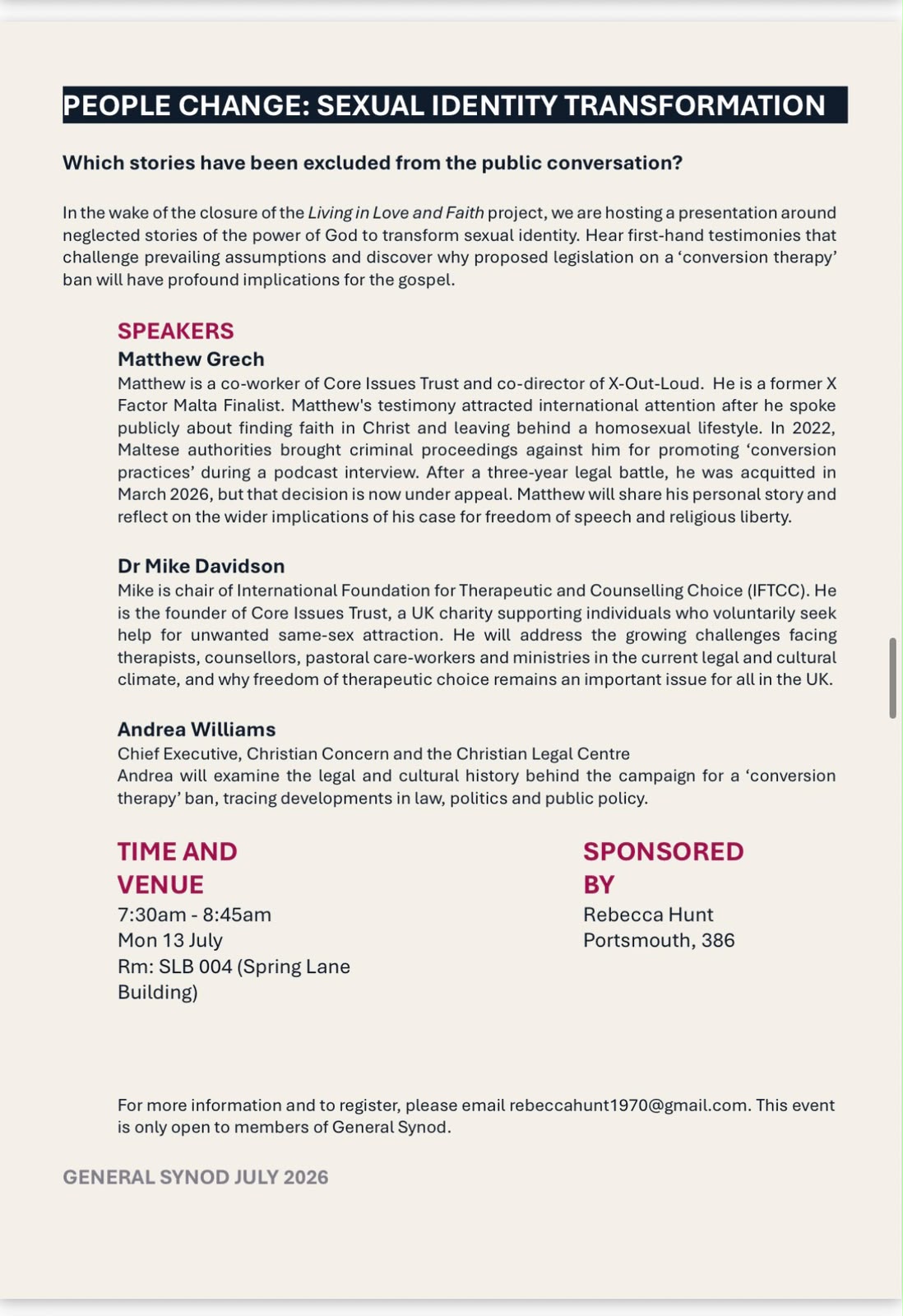
The announcement of the fringe event can be seen here.
The text of the letter is published at Unadulterated Love: Letter to Archbishops objecting to Synod event in support of “Conversion Therapy” and is copied in full below the fold.
Robert Thompson has written a further reflection on this issue, which is published at ViaMedia.News: The Body We Are Becoming: Ecclesiology, Safeguarding and the Common Life of General Synod
Update 7 July
The Telegraph reports:
A Church of England spokesman said: “A General Synod member has applied to host a Synod fringe meeting and related public display on ‘sexual identity transformation’ at the forthcoming General Synod meeting at the University of York. The organiser has made clear both will challenge the principles of a ban on conversion practices.
“Following careful consideration, the Archbishop of Canterbury and the Archbishop of York have informed the Synod member that their fringe meeting, as a private discussion for Synod members and invited guests, may go ahead as planned, but has declined permission for the associated stand and public display.
“In 2017, the General Synod voted, by a large majority, in favour of a ban on conversion practices. A publicly visible display would act as a public statement contrary to that stated position and is not appropriate in the circumstances.”
Update 8 July
In the archbishops’ letter to those who wrote to them about this, they also say:
“The University of York have made certain requests in relation to the meeting. If the meeting is to take place, the organiser will need to meet these requests which concern the name of the event, the display of signage and a disclaimer.”
Letter to the Archbishops of Canterbury and York
Robert Thompson, Vicar of St Mary with All Souls Kilburn and St James’ West Hampstead
Sunday 28th June 2026
Dear Sarah and Stephen,
People Change: Sexual Identity Transformation – Request for the Exercise of the Presidents’ Discretionary Powers under the Fringe Meeting Guidelines
We write as members of the General Synod regarding the approval of the fringe event People Change: Sexual Identity Transformation and the allocation of exhibition space to the same organisation during the forthcoming group of sessions.
At the outset, we wish to be clear about what this letter is, and is not, seeking to do.
We recognise and value the role of the Synod fringe in enabling members to explore difficult questions that may not readily find space within formal debates. A healthy fringe programme contributes to the breadth of Synod’s common life, and we fully accept that it should include a wide range of theological perspectives, including differing convictions on sexuality, marriage and pastoral practice. We are therefore not asking you to adjudicate the theology of this event, nor to restrict legitimate theological debate.
Rather, we are seeking to understand how the decisions to approve both the fringe event and the associated exhibition stand were reached in the light of the Church of England’s safeguarding commitments, the published Fringe Meeting Guidelines, and the vision of General Synod as a body called to “walk together” despite profound disagreement.
Throughout this quinquennium, both of you have consistently encouraged members of General Synod to walk together. We have welcomed that vision. It calls us to remain in relationship with one another, to listen generously and to recognise one another as sibling members of the Body of Christ seeking faithfully to discern God’s will. It seems to us that there is an important distinction between creating space to debate what Christians believe and creating space to debate whether sibling members of Synod should be different people from those whom God has created and called them to be.
For many LGBTQIA+ members of Synod, this is not an abstract theological question. We do not regard our sexual orientation as a defect awaiting transformation. Rather, we believe it is part of the person God has created and called. It has shaped our discipleship, enriched our ministry and, for many of us, deepened our solidarity with others who have experienced exclusion, prejudice and marginalisation. It is therefore difficult to understand why the Church of England should provide not only a fringe platform, but also a continuing presence within the shared public spaces of General Synod, for an organisation whose title appears to place the identity of some sibling members of Synod under scrutiny.
A fringe meeting is an event that members may choose whether or not to attend. An exhibition stand is different. It forms part of the shared environment of Synod and is encountered repeatedly by members throughout the group of sessions. We would therefore be grateful to understand whether different considerations applied to the allocation of exhibition space and, in particular, how the impact upon LGBTQIA+ members of Synod was assessed.
The Fringe Meeting Guidelines expressly reserve to you, as Presidents of the General Synod, the right to refuse a fringe meeting where its subject matter would be contrary to the ethos of the Church of England, may adversely affect its reputation, or would be inconsistent with House of Bishops’ safeguarding guidance. We would therefore be grateful if you could explain how those criteria were applied in relation to both the fringe meeting and the exhibition stand.
Our concern is heightened by the Church’s own safeguarding commitments.
General Synod has previously endorsed the Memorandum of Understanding on Conversion Therapy, recognising the harms associated with conversion practices and supporting legislative action to prohibit them. The House of Bishops’ safeguarding guidance has likewise made clear that ministry should never seek to change or influence a person’s sexual orientation through deliverance ministry or comparable pastoral practice. The recent publication of the Government’s Draft Conversion Practices Bill has further focused public attention on these issues. Whatever differing views may be held about aspects of that legislation, we believe it makes it all the more important that the Church of England is able to explain clearly how decisions of this nature are reached and how they are reconciled with its own safeguarding commitments. We would therefore be grateful to know whether safeguarding assessments were undertaken in relation to both the fringe event and the exhibition stand and, if so, whether they specifically considered the potential psychological and spiritual impact upon LGBTQIA+ members of Synod.
Finally, we believe this experience raises a wider question of governance. The published guidance confers a significant discretion upon the Presidents in determining whether proposed fringe events are compatible with the Church’s safeguarding guidance and the ethos of the Church of England. We would welcome greater transparency regarding the principles by which that discretion is exercised, not simply in relation to this event but for all future fringe meetings and exhibition stands. We therefore respectfully ask:
1. How were the fringe event and exhibition stand assessed against the Church’s published criteria?
2. Were safeguarding assessments undertaken and, if so, what considerations informed those assessments?
3. How was the impact upon LGBTQIA+ members of Synod considered during those processes?
4. What understanding did the approving authority have of the phrase “sexual identity transformation” when considering these applications?
5. How do these decisions sit alongside the Church’s safeguarding commitments concerning conversion practices?
6. Will the Presidents publish the principles by which future fringe meetings and exhibition stands are assessed?
We offer these questions respectfully and in good faith. Our purpose is not to curtail theological debate, but to understand how the Church’s commitments to safeguarding, transparency, mutual flourishing and walking together have been applied in this instance. We hope your response will reassure all members of General Synod that our shared life remains one in which every sibling member is able to participate with equal dignity, belonging and confidence.
For transparency, I have copied this correspondence to those with responsibilities for the governance of General Synod, safeguarding, the bishops in the Diocese of London in whose ministry I share, and those with interest in the Church’s relationship with Parliament and government.
Yours sincerely,
Robert Thompson London 166
On behalf of:
This is a case of world-views clashing at the most fundamental level.
Whether ‘sexual identity ‘ is truly a primary, innate, unchangeable fundamental of every human’s deepest being. Or whether to think and rhetoricise in this way is a culturally subjective facon de penser which late modernity has created in its self absorbed decadence.
Even to raise this question is perhaps to make some people feel ‘unsafe’, so I’d probably better stop there.
I’m very pleased to see this question raised – TA is at its best when there is real debate and difference of opinions and not an echo chamber!
The debate was held years ago and settled. Anybody who thinks sexual orientation is not innate needs to read the literature and listen to gay and lesbian people. The session to be held during Synod is an exercise in prejudice.
Being innate does exclude indefinite mutability but two individuals with the sane innate endowment may be somewhat different in their development. That is not in itself a reason, of course, for deciding that one course of development is The Right One. One would expect that diverse individual developments will, under God’s good providence, make a better world: why else has God made the diversity?
Or perhaps an opportunity to listen to people you disagree with?
There are some very, very nasty members of the General Synod.
Rebecca Hunt (Portsmouth 386) to be held fully accountable for this.
I keep waiting for 666 to come up, but for those interested in
such things 386 is a force to be reckoned with.
“For many LGBTQIA+ members of Synod, this is not an abstract theological question. We do not regard our sexual orientation as a defect awaiting transformation. Rather, we believe it is part of the person God has created and called.” Well, the transgender person definitely thinks that his or her body requires transformation, by surgery cutting off some parts and by hormonal modification in some way. So this statement is clearly not true. Talking to a person who once identified as homosexual but no longer does is clearly disturbing to some people and there is an evident desire to exclude and… Read more »
James, Homosexuality, like Christianity, has both an inner and an outer life, and one needs to consider both when discussing a person’s life. Using Christianity as an analogy. A person may have an “inner disposition”, a deep and profound private inner feeling about their faith. They may also have an outer “identity”, which amounts to what they say and display about themselves and their churchgoing habits in public. Both are relevant. A person might have a profound Christian inner disposition, but keep it secret due to living somewhere like China, and not go to church, and hence have no Christian… Read more »
There’s a poignant exchange in the Queen biopic, Bohemian Rhapsody. Freddie turns to his lover Mary and says fearfully “I think I am bi”. Mary says back, “Freddie you are gay”. It’s certainly true that many people don’t realise their sexual orientation initially because of cultural pressures. I believe it’s very common in women. “ That is totally different from a programme which seeks to deny a person’s inner disposition, and to turn them straight, or to deny their transgenderism.”. For me the operative word here is “programme”. There’s a world of difference between a spiritual director responding pastorally if… Read more »
Thanks Kate, there is some interesting research on the differences in the way male and female people experience homosexually, and that ties in with what you are saying, it can be later in life for women. Why it is that way is an interesting question.
This may be getting off-topic Simon, but I don’t think the “later in life” question is really that mysterious at all.
Males, when aroused, generally get an erection. From a young age, males KNOW what turns them on!
It’s not usually nearly so clear cut for females: a process of discernment, and discovery (and it’s precisely this process of sexual discovery and discernment which, even in Western cultures, is MOST DISCOURAGED for females!)
Simon, The strength of a drive and whether we act upon it is often situational, and also how much we feed our desires.Pornography is ubiquitous today. Do not imagine that being heterosexual is free from stress and difficult it isn’t, even for married people, not least because a woman’s sexual feelings and drives are different from a man’s and men are open to temptations in every way.So are women, but that is not a world I know from within. (There is, for example, more pornography in women’s popular literature that I previously realised.). All Christians, whether single or married, are… Read more »
James, thanks for your thoughtful response. There is quite a bit here I can agree with. Programmes which deny, or seek to change, the reality of a persons homosexuality or transgenderism are a problem for me, but what you are suggesting here accepts the reality of a persons homosexuality (perhaps even as God-given) and then asks how such a give person can live a Christian life. That is a much healthier proposition in my mind. “All Christians, whether single or married, are called to a life of purity and chastity.” I totally agree. I just argue that the best way… Read more »
I find that videos of the latin mass are ubiquitous today. Is it something to do with algorithms?
That’s a very disrespectful way of describing the internationally recognised treatment for a diagnosed medical condition. I don’t think you would talk that way about cancer treatment. Some Christian compassion and respect is appropriate in future, please.
Cutting off healthy breasts or genitalia is not medical treatment, it is a corruption of medicine.It has nothing in common with cancer surgery, in which diseased tissue is removed. The transgender phenomenon undermines the whole “God made me this way” subjectivist claim that lies at the heart of sexual revisionism,
‘Then Jesus asked them, “Which is lawful on the Sabbath: to do good or to do evil, to save life or to kill?” But they remained silent.’ You are seeing policy. Doctrine. I am not arguing whether you are right or wrong. I’m telling you that Jesus doesn’t think in those terms: he sees people and what is best for them. Nobody disagrees with the Sabbath being a rest day. I’m not saying your view is correct, but I am saying that even were it as obvious as resting on the Sabbath, that Jesus would put the need of the… Read more »
The Jesus you are talking about is not the one revealed in the Gospels but a late modern ideological creation.it is true that Jesus knows what is best for others. It is also true thst he offended many people with his frankness. Why do you think he ws crucified?
That is quite a difficult question to answer – but I think that he is not presented to us as always kind, particularly to the scribes and priests. It does seem that this degree of unkindness and insult made them encompass his death. What really happened at ‘the Cleansing of the Temple’? What was the ‘equipment’ that he denounced – military equipment?
Or maybe defence equipment?
Surgery on healthy tissue is not a corrupt practice if it improves the person’s life and makes them happier.
God created us each with a different range of possibilities. What we do within that range is acceptable if harm to others is not implied. There is by contrast no point in exhorting people to move out of that range, ie to attempt the impossible
Surgery on healthy tissue is always wrong. It is the mind thet needs healing, not the healthy (!) body. Many young women, caught up in emotional votices of adolescence, had their breats amputated and rhrn bitterly regretted their decision. Men have done equally bad rhings to rheir genitalia and suffered lifelong problems as a result.
Jesus was circumcised so He clearly disagrees with you.
I’m not sure he had much of a choice as he was only eight days old when the procedure took place.
Gabriel could have told Mary not to allow it and Jesus didn’t object to the practice in His active ministry.
Not willingly!
I think this anodyne statement is where people slow down. “Surgery on healthy tissue is not a corrupt practice if it improves the person’s life and makes them happier.” Healthy tissue that is not in any way in need of surgical removal. Breasts. Male sexual organs. Female sexual organs. God has granted life to physical beings made in his image, male and female he made them. With these unique corporal (not ideational) realities. What kind of surgery on healthy tissue do you have in mind, that is not this foundational? And how would you say that male or female corporal,… Read more »
I didn’t introduce the term here but I would understand it as tissue not identified as specifically diseased, or in a condition threatening death or pain. An awful lot of cosmetic surgery affects tissue which is healthy in this sense and I have no moral objection to that
And what about vasectomies? Should we issue a condemnatory statement on all who’ve had ‘the snip’ (or its female equivalent’? There’s some entertaining explaining to be done on how that’s an acceptable surgical procedure on healthy tissue when (clearly) its only purpose is about carnal pleasures and reckless refusal to be fruitful and multiply…..
Excellent point!
Precisely. Any sexual activity which is not open to the gift of procreation is contrary to the divine purpose. Anglicans have been getting this wrong from1928 at least.
i can’t remember, but I think the 3 prayer book reasons for marriage do not exclude activity which is for mutual comfort and is part of God-given desires.
When we get to a point where cutting off male genitals, female breats, is likened to a vasectomy or circumcision, one can see the ships passing in the night.
Maybe you need to look at your slur, “cutting off.” Transgender women (often) have vaginoplasty. Transgender men (often) have male chest construction. In NEITHER case, is it a “cutting off.” They are reconfigurations, which (in something like 98% of the time—much lower regret rates than MANY kinds of surgeries) offer GREAT RELIEF and comfort to the patients which obtain them. Yes, we’ve all heard from the “regretters”—they are often well-paid to tell and re-tell and re-tell their stories. The 98% on the other hand, have made very happy lives for themselves in their communities. You’ll only see them—if at all—marching… Read more »
Vasectomies are generally reversible, so maybe not be so reckless as you suggest. The same cannot be said about people, particularly young people, who have undergone irreversible surgery, which does sound rather reckless.
“God has granted life to physical beings made in his image, male and female he made them. With these unique corporal (not ideational) realities.” He??? Nothing like reverse engineering an idealized etiological myth, re-tooling it in order to oversimplify biological and psychological data. God created us in the image of the Divine, and we create God in our own image all the time. Remember the original movie, Planet of the Apes? “The Almighty created the ape in his own image. He gave him a soul and a mind. The proper study of apes is apes”. lol.
“Surgery on healthy tissue is not a corrupt practice if it improves the person’s life and makes them happier.”
Breast Augmentation: The placement of silicone or saline implants to increase breast volume, symmetry, or fullness.
Liposuction: The surgical suctioning of localized fat deposits from areas like the abdomen, hips, thighs, or arms to reshape body contours
Facelift (Rhytidectomy): The tightening of underlying facial muscles and removal of excess sagging skin to restore a more youthful jawline and neck profile
Presumably this cosmetic surgery also counts in that statement?
More pertinently, some adolescent cis boys have surgery to remove (what they consider) excess breast tissue. Nobody bats an eyelid at that, nor at girls and women who have breast reduction surgery to help with back pain or self-esteem issues. When it’s trans young people suddenly it’s under intense scrutiny.
Presumably Origen was happier!
Now he too will Trans.
Pronouns: she/her
What is “diseased tissue”? Is it not tissue which threatens life? If a particular visible (to the person at the very least) appendage causes SO MUCH pain as to threaten life itself (via suicidal ideation), and no other therapy can reduce that pain, does it not make sense to remove that (very real) “diseased tissue”? “God made me this way”: Yes, God MAKES some small % of people trans. Like other innate conditions, there are medical options that enable people with this condition to survive and THRIVE… …unless one would prefer those people dead, to thriving. Something about which bathrooms… Read more »
I have always felt sexuality was on a spectrum and people move along that spectrum at times. Some of this depends on the environment I feel sure – so forexample same sex schools, prisons etc show some are clealrly changeable.
As James says there are those who have been married to a person of the opposite sex who now are in same gender relationships. I see no issue with any of this, this is how it is for some people.
“cutting off some parts”
TA Moderation, ‘allo, ‘allo???
Dismissing (and slurring) gender-affirming care as “cutting off some parts” is grotesquely insulting!
At least we now know how safeguarding guidelines are going to be applied – to shut down debate and discussion. Chilling.
‘Debate and discussion’ — about what and about who? Please leave people alone if they are doing you no harm.
Is advocacy of the proposition that prayer can change people’s way of life in a certain respect, even their desires, harming people who have no relevant problem with their way of life?
Are people who are bursting to proclaim something that might be nonsense harmed if their rhetoric is excluded from certain places?
Are people able to ask questions?
It’s tragic that trying to insist that everyone else must be made in our own image has such traction
I couldn’t have put it better myself.
Do you want a church where gay people can be vilified because that’s ‘free speech’?
The State ought to permit free speech even if it gives offence, that is the whole idea, though there may be restrictions to avert violence and disorder. I think John Stuart Mill proved that. The Church has the duty of proclaiming teachings and doctrines and is therefore entitled to exclude from its operations and premises attacks on those teachings. But this has to be done very carefully and clearly. I don’t think it has been done with the proposition that one can change sexual orientation through prayer
Who is doing vilifying here?
What’s the point of ‘debating’ Conversion Therapy? Practicing it can incur a prison sentence of five years, thank goodness
That is not the point, the point is how safeguarding is now being used to ‘shape the body we are becoming’. It’s been on the horizon for a while and is now here and if debate and discussion is being stifled because of safeguarding guidelines so much for English values of tolerance.
Can you respond to Charles Read’s question to you? That concern is also part of the context of this debate. Gay people have a long history of living under the threat of criminal action and actual imprisonment. Can you assure us you do not support that either?
I don’t think I have suggested anything like that so it’s not really worthy of a direct answer. I would expect liberal progressives to step in at this point to say this is a step too far. If ‘shaping the body we are becoming’ is not the subject of debate then the way safeguarding guidelines are being applied by so called liberal progressives needs to be challenged.
A Synod-attached event where the discussion seeks to invalidate other Anglicans for having a different sexual orientation to the majority is not a safeguarding matter, but a moral and ethical one.
Charles Read’s question or mine? But instead of engaging you just stick a vague label on those you disagree with here. Both sides want and need something out of this actually.
Just pointing out that a culture of safeguarding also includes protecting legitimate free speech, something you and others wish to deny,
Well the operative word here is legitimate, but in any case, if you want to debate and discuss the woke mind virus, for example, feel free, but if you wish to deny other people’s identities, kindly desist.
I confess I had to look ‘woke mind virus’ up as I was pretty sure I used the word ‘legitimate’. But having looked it up yes I do believe there is a debate to be had around ‘unity’ and ‘identity’ because liberal progressives seem to be uncomfortable about having a new identity ‘in Christ’ (In Christ we are new creation) and yet this is where our unity comes from.
I don’t know whether I qualify as a liberal progressive, but I would say that if there is not an element of ‘uncomfortability’ in one’s identity in Christ — actually I would use the word suffering — then something is missing. Yes, his yoke is easy and his burden is light, but we are called to take up our crosses and follow him. However, we are certainly not called to increase one another’s suffering, and I consider that those who seek to deny the Christian identity of non-heterosexuals are doing just that. I would also question the legitimacy of ‘unity’… Read more »
Ps to clarify, by ‘denying Christian identity’ I am of course referring to the topic of this discussion, ie so-called conversion therapy, but my primary concern is the denial of the sacraments — of marriage, ordination (if married!) and at times even communion (most grievously).
Yes we do have a problem with language, those who built the Tower of Babel shared the same fate,
Sorry Adrian, does the closing comma indicate that your reply was meant to continue? Otherwise I do not understand what you are trying to say — unless that is your point perhaps?
Where do we deny free speech? Would you say that antisemitism is OK because it is free speech? Do you see the problem?
Where there is a risk of violence and disorder. Opinions that are not OK do not, just for that reason, deserve suppression
Antisemitism is a problem, because God promised Palestine to Isreal.
Well that opens up a can of worms… For now I will just point out that in Judges the Israelites shared the land with others.
Maybe not regarding their presence as legitimate though. However, God later abolished the theological distinction between Jew and Greek
“God promised Palestine to Israel” – incorrect.
Adrian. I have not expressed view on this issue here. So you have no basis for claiming I do not believe in free speech which I find frankly insulting. The freedom speech I believe in (for the record) – is not just for those I happen to agree with. The question you have still yet respond to is whether that is your view too.
is it for absolutely everyone?
is there a right for the Church to deny a platform for those who deny its teaching? I think there is
Who exactly is doing the vilifying, as you seem to know?
If you really do not know, you could read the personal stories of Simon, Ali and Hope in the recently published collection of stories and reflections in ‘Evangelical and Inclusive’.
I didn’t think we had ‘free speech’ in the UK, only ‘freedom of expression’ – might we avoid those Americanisms which can sometimes subvert or otherwise colour our discussions? And for those who might consider this casuistry, is there not a significant difference in these two legal principles? Just wondering…
Hi David. Obviously Adrian does not support imprisoning gay people and has never said he does.
Can you, David, please assure us that you are not, and have never been a member of the Nazi Party of Germany.
By forcing you to answer a deliberately offensive question, I make you look bad. And thus I illustrate what you’re up to in this exchange with Adrian. And hopefully encourage you to try a more open and honest way of discussing ideas.
Why is is obvious? Conservative evangelicals have an ambiguous relationship with this issue party by virtue of their partnership with GAFCON where a number of member churches and individuals support exactly that. On a well known conservative UK blog site some regular contributors support it. So it is not obvious, and that is precisely why LGBT folk and allies reasonably need to ask.
You’re claiming that UK conservative evangelicals might want to imprison gay people because – 1) some contributors to right-wing blogs have suggested doing so, 2) some churches overseas within GAFCON support it. My reservations about that reasoning include – (1) Are any of the right-wing bloggers in question actually conservative evangelical anglicans? (2) Some Iberian catholic churches supported the Franco and Salazar dictatorships – but to the best of my knowledge no-one at the time suggested that British catholics might be fascists, and it would have been offensive if they had. (3) How do you know Adrian is a conservative… Read more »
So no one is vilifying anyone except for those who wish to vilify those who favour freedom of speech. Maybe free speech is allowed on inclusive evangelicals website, on no wait, free speech isn’t allowed there either!
Those who think that homosexual practices are contrary to the will of God do say something that degrades those who do those things and makes them feel rather intimately horrible. That doesn’t prove that this line of thought should be refused public utterance or censored by the State – or even that it is false – but we should as Christians reflect on the Epistle that warns us what dangerous weapons our tongues are. If a non-state religious organisation has decided that it’s official teaching is X it surely has the right, as a matter of private property, to exclude… Read more »
Cheers Adrian. I’m a conservative evangelical who believes that equal marriage, understood within the framework of Christian marriage, can be a great step forward with huge benefits for gay people and the rest of the church. I believe that’s a truly conservative understanding of scripture, read in the context of the dynamic and living church. But it’s a historic change, and getting it right requires careful and kindly thought and much work to explore how it can best be done. And that requires listening to each other – even the people we disagree with, in fact especially them because that… Read more »
Thank you for sharing this. In passing I could wish could be honouring you by addressing you by name. Can I ask, what makes you call yourself conservative rather than say inclusive on this one? Are there other conservatives who share your view on this?
Yes, the rerum novarum nonsense is a bit tiresome. Call me John. On this I reckon I’m conservative and inclusive. Conservative because I’d like equal marriage within the church to faithfully extend Christian marriage to more people, rather than weakening or diluting it. And because the more fully I try to truly understand scripture, the more I’m aware of its revolutionary and conservative nature. Jesus said the spirit would lead the church into truth, and he didn’t put a time limit of AD 100 on that. Working for the kingdom requires creativity and dynamism, sometimes expressing timeless virtues in new… Read more »
Hi John. Thank you for clarifying your position. Yes, on equal marriage I too am inclusive precisely because I am conservative, I have a high view of marriage, not a ‘liberal progressive’/revisionist one (or whatever label some reach for). Your responses to me here highlight the difficulty of labels and names as a way of positioning people and their views. The Inclusive Evangelical network that I am part of includes people who have been told they are no longer evangelicals or biblical. Some are struggling to find churches within this tradition, that they love and the is their home, where… Read more »
Which scripture do you try fully to understand, and what guides your choice?
The bible!
But why?
There are a lot of other scriptures:
The Quran
The Bhagavad Gita
The Granth Sahib
Hesiod’s Theogony
The Book of Mormon
The Talmud
The complete works of Jilly Cooper
Why have you chosen the Bible rather than any of these?
Because he’s a Christian?
I’ve read the Book of Mormon and didn’t find it very convincing. I read parts of the Quran, but connected more with the Bible. And I’ve read the Dalal Lama’s Little Book of Wisdom, which I found helpful: Buddhist ideas of freedom from attachments are similar to those of Ignatius.
Are there any particular Jilly Cooper books you would recommend, or are they best read as a coherent whole?
As you know, all scriptures are self authenticating and self interpreting, so the Corpus Cooperanum must be studied in its entirety.
A newcomer might start with one of the non-fiction works such as ‘Class’ to find a moral and social framework through which lens the other works might be studied, before moving on to one of the name romances such as ‘Imogen’. This would be a good preparation before embarking on the meatier material of the Rutshire Chronicles which should ideally be read as a consecutive whole.
They’re not practising it, just talking about it
Unless you’re attempting to convert a biologically male body into a simulacrum of a biologically female body, or vice versa, presumably?
Some people are born with bodies that are not unequivocally one or the other. It is likely that decisions will be made for them by adults before they are capable of deciding for themselves – what if those decisions turn out to be wrong? Such people get forgotten in these conversations. And yet they are still loved by God.
That attempt does, to a certain extent, work as desired. The pseudo-medical C-therapy, as known hitherto, doesn’t work, so its practice is regarded as something like charlatanism.
Mind you, since I believe that individuals have some freedom to develop their sexuality within the limits set for each, I can’t reject the idea that people may benefit from guidance and prayer in their use of this freedom. But not even prayer can transform people beyond certain points and it seems that God demands that we each live with that according to our condition. Christian advice must be sensitive to that limitation
I suppose the signatories to this letter don’t really expect that the Archbishops will ‘exercise their discretionary powers’ to prohibit some Synod members from gathering with other Synod members to discuss what is after all a topical issue that is much in the news right now. The fallout would be spectacular, not just from those Synod members but from all those who elected them. Presumably the real aim, now that the LLF process has been wound up, is to air this in the comments following the Business Committee Report and in the Questions, and so keep the cauldron bubbling. But… Read more »
I can’t help but agree with Jane on this one, at least in major part. In my view, this should never have been authorised, not least because if an organisation has taken a clear view on something that is to stand as an ‘official’ position, notwithstanding the views of dissenting members, as GS did on conversion therapy, then either it needs to uphold that view or rescind it. Authorising this event is certainly not upholding it. But now it has been, I don’t think an enforced cancellation would be the right thing to do. I, too, do not favour the… Read more »
Private organisations do not have a duty to provide a platform for people who oppose their proclaimed opinions
Indeed. I didn’t say they do in my response to Jane.
Victims of church abuse cry out for care, help and justice. Parishes cry out for priests and help. Black people continually face injustice and discrimination in country and church. Trans people fear attack in society…. and the list could go on and on. And what do 82 members of General Synod do? Write a long, wordy letter because of a fringe meeting at their synod that they don’t like. . My goodness, I as a churchgoer and bi man, am sick and tired of those LGBT people, especially some loud priests, who spend so much energy on internal little squabbles… Read more »
As a trans woman I agree this is much smaller than the terrible way trans women are now being treated by the courts, Government and media. But I also understand that may feel like too big an issue for many people to deal with. If what they do feel capable of addressing is a Synod exhibition then I don’t think they should be criticised for that. Characterising it as “little Synod” and “little squabble” or “silly little infighting” is wrong. That’s like criticising the widow who left two small coins in offering at the Temple. For some people, that is… Read more »
It is certainly is not like criticising the widow with two small coins.That parable relates to generosity and commitment to God, not the extent we can contribute to church meetings.
Are you honestly saying the 80 protestors are not able to address the big issues so choose this in house one? Extraordinary! And a very sad comment on the Synod members.
A misreading, I think, of the bitter verses of Mark 12. There are no words commending the Widow or calling on us to do likewise. Jesus has just accused the greedy religious leadership of ‘devouring widows’ houses’ and he looks on in dismay as the Widow is duped and impoverished right there in front of him. The passage is a sandwich, first the denunciation of priestly greed, then the example of the Widow, then the revelation that the result of all this extortion will be mercilessly destroyed by the judgement of God. It’s not a commendation, it’s a critique
I am weary with the lack of progress in the Church in the sexuality debate, but it is simply incorrect to imply the 80 signatories are not interested in the justice issues you refer to.
Tackling this “internal” issue (which has some malign external forces behind it) is one action – and a necessary one – towards bringing about justice to the marginalised among God’s people.
I did not say the 80 are not interested in such issues. My point is they are expending energy making a mountain out of a mole hill when that energy could be much better used, through letter / protest in the way they are for survivours of clergy abuse, the mothers affected by forced adoption in church homes etc etc. My point is they are in danger of putting their own self interest before greater concerns. But then, I guess, that is a feature of the rather inward looking C of E.
To them this meeting is deeply sinister. I’m not surprised they care about it
I’m saying that not everyone feels able to grapple with the big issues- because they are big. If all they feel capable of giving right now is fighting something small we should still celebrate that gift not highlight how small it is
My father was a semiprofessional footballer in the days when football boots were little more than work boots with studs in the bottom of them. His toenails always seemed to be black and falling away. I’ve had the great privilege of being friends with Robert Thompson for years and love him dearly. However I have no patience with GS as it does the Hokey Cokey over sexuality. Queer people and their allies are walking away from the church in droves; its warm words and yet empty promises are abusive. Of course these unpleasant people and their offensive views shouldn’t be… Read more »
The question as to whether sexual orientation is plastic is, I think, irrelevant.
The issue, I see, is that it is known that presenting material like this causes genuine hurt and harm to many LGBT+ people. For Christians that ought to outweigh any free speech arguments. There is a place for telling people that sexual orientation can be changed through prayer, but an exhibition attended by LGBT+ people wanting to stay calm is not a suitable place.
If this fringe meeting is happening on York University campus it is likely in breach of the university’s own guidance and policies. Probably worth notifying the university authorities, the students union, and the various trade unions represented on campus.
Free speech is protected by law on university campuses. This is not
who the English are.
The Conversion Practices Bill is before Parliament. The English are generally law-abiding. Presumably you’ll not support illegal practices.
I sure there is a lawyer out there who can make sense of that question!
I see. You need a lawyer to explain you should obey the law.
It isn’t law, and is a dreadfully problematic text.
Unfortunately Father David the Conversion Practices bill is very weak and probably will probably be totally ineffective.
No, it isn’t, at least not in this case. I assume you are referring to the Higher Education (Freedom of Speech) Act 2023. It covers staff, “members” (which is a whole world of fun in many older institutions’ statutes), students and visiting speakers, and it’s quite clear in the various codes of practice that in this context “visiting” means “invited by someone entitled to invite them”. Anyone can rent rooms on a university campus; provided you can tolerate what David Lodge described as beds ruined by decades of horseplay and copulation, they’re ideal for holidays, conferences, visiting the Edinburgh Fringe… Read more »
I need to stress that my first reply is addressed to Adrian Clarke. For what it is worth, my view differs from yours. I think you have overlooked subsections (3) and (4) of Part A1, which, incidentally, inserts all these provisions into the Higher Education and Research Act 2017, so that is the primary legislation. Legislation, even in 2023, still isn’t always as user friendly as one might wish.
We’ll find out what it comes to a court case. My belief — and I work in a university and see some of the internal debate — is that if a neo-Nazi organisation phoned up Conferences and asked to hold a summer rally in our halls of residence we could, and would, refuse the booking without engaging the 2023 Act. I also think that conservative evangelicals would do well to be careful what they wish for. If the 2023 Act _does_ mean that York University has to pay attention to the 2023 Act for conference bookings, then the same provisions… Read more »
Thank you. I apologise if my earlier response was over-dogmatic. That it might have appeared so occurred to me and I took the trouble to look up the (official) explanatory note to the act, a separate document, and other sources about the purpose and effect of sub-sections (3) and (4). I didn’t get any assistance from any of them: basically all were factual summaries of the text without any editorial explanation, this in marked contrast to the ‘traditional’ and helpful explanatory notes which used to be appended to an act itself. Of course, I have no idea of the scope… Read more »
The most relevant legislation is actually the Education Act (No. 2) 1986 (Section 43), which requires institutions to ensure that their premises are not denied to groups based on their beliefs or views, and to take reasonably practicable steps to uphold free speech.
Again, I think you are over-interpreting it, although again, it will take court cases to untangle it. EANo2 1986 S.2(1) reads “Every individual and body of persons concerned in the government of any establishment to which this section applies shall take such steps as are reasonably practicable to ensure that freedom of speech within the law is secured for members, students and employees of the establishment and for visiting speakers.“ The emphasis is mine. Members usually means graduates including honorary graduates, but it varies by institution: let’s assume it’s the usual meaning. The claim you are making relies on “someone… Read more »
This discussion seems to be going round in circles. The words you have emphasised appeared in my original post to Adrian Clarke (quoting from the 2023 Act) and what I said there seems an accurate summary: “securing freedom of speech within the law for its staff, members, students and visiting speakers (i.e., all internal to the University)” – my emphasis.
If this has not already been done by the C of E, the University should be asked for a definitive ruling. At present this discussion could be entirely hypothetical.
Yeah, Adrian’s point is perhaps less technical. Some universities may allow fringe events at commercial meetings to be cancelled if they risk offending some attendees. But the CofE meets in York partly to exude the aura of holding an academic meeting, as you say, and for cancelling events to shut people up sits ill at ease with the setting. It would be like the Conservative Party hiring Ashton Colliery for a conference. More robust universities might explain that they sre committed to freedom of speech and robust discussion of ideas for staff and students, and that they sees that as… Read more »
Those are the identical words already quoted (see below, reply to Adrian Clarke) from the 2023 Act, which, in fact, amended section 43. One wonders why the legislation seems so unnecessarily prolix. I think it’s clear that this issue hinges on the code of practice which the University is required to “issue and keep up to date” and that it is the University which alone can decide the matter,
The Higher Education (Freedom of Speech) Act 2023 is a complex piece of legislation, but I think this is probably correct in the present context. Whilst the Act’s primary objective, as applied here to the University, is “securing freedom of speech within the law” for its staff, members, students and visiting speakers (i.e., all internal to the University) there is provision that use of its premises “is not to be denied” to an outside body in relation to that body’s “policy or objectives or the ideas or opinions of any of its members”. Use by the C of E has… Read more »
It’s nice to know that the English are protected from the Church of England, who are not even allowed to discuss Christian Nationalism!
Sorry, I don’t understand your comment at all. Was mine not sufficiently clear? How does anything I have said lead to this statement?
I thought your statement was pretty clear and authoritative. Nothing more needed to be added.
James noted, “The four people that I know who now identify as gay, for example, were all previously married to a person of the opposite sex and raised children with their spouses. At some point the desire for a same-sex relationship evidently became dominant – but it wasn’t always so.” My knowledge of men who married women, had children, and then later in life “came out” as gay is different. These men — many more than four — knew they were same-sex inclined from a young age but felt that they had to get married (and have children) to further… Read more »
dr.primrose
One should note that what you describe can fit exactly into the criteria of “conversion therapy”. A person with an unwanted homosexual disposition is pressured to live out a life denying such a disposition, often on the advice of their minister or other advisor.
And what you have described is an accurate reflection of the eventual outcome of much conversion therapy. They can live that life for a while, but after a decade or so it all breaks down, causing significant emotional trauma not just for the person involved, but spread around their family and friends.
James referred to “cutting off some parts”. Language that is as crude as it is dismissive. I struggle to understand transgenderism – I’m not even sure if there is such a term – but I do know this. A member of my family has transitioned and a deeply unhappy young man has become a happy and fulfilled middle-aged woman. Not my words, but those of her mother – an Evangelical of strong conservative instincts. I can’t begin to imagine the pain involved to both parties in coming out, but rejoice that her mother is now fully accepting of her daughter.
Transgenderism is a perfectly acceptable and valid term. Thank you. And it seems to me that you understand all that needs to be understood.
But the happy endings often don’t turn out happy, do they? The suicide statistics sadly tell another story. I wish there was a universal answer for depression but there isn’t, this side of eternity.
Let me quote something from Reddit. Posted yesterday I’m afab, started having gender dysphoria when I was 15/16 and I’m 21 now. I know I’m a trans man or at least transmasc. I’m also very suicidal and have been thinking about committing so I’m not a burden to my religious family or anyone else who knows me tbh. I have major mental health issues, I just took time off work because i cant focus, I have a drinking issue and to drink whenever i feel depressed which made my bf upset to the point he ignored me which i don’t… Read more »
James, regarding suicide, it may be helpful to quote some detailed academic research on this so we can base our opinions on accurate data. Suicidal ideation comes not from being transgender, but from being transgender in a hostile environment that does not accept the condition as real. Transgender people in a supportive and loving environment can do perfectly well. It is the discrimination and prejudice that is killing people. Cornell University researchers carried out a detailed literature review of 57 articles that assess the effect of gender transition on transgender well-being. They identified 55 studies that consist of primary research… Read more »
It is Pride in London today. One banner showing on a news website reads ‘Love is a horrible thing to hate’
The closing paragraph of Kaleem Hussain’s CT piece, Give prejudice a ‘lounge test’, is opposite here: “Good actors in society cannot afford to remain passive while poisonous myths harden into political common sense. If they do, the cost will be measured not only in coarsened debate, but in damaged communities and vulnerable lives.”
‘apposite’ not ‘opposite’!
Thanks Allan, Since about 1895 various scholars have described how transgenderism and gender variance has been known and documented right across history and right across the world. The reports provide evidence that the vast majority of the various cultures accepted gender variance, and actually valued the gifts that these people brought to their communities because of their transgender dispositions. Transgenderism has been analysed and described by doctors and medical experts in Europe since the 1920s, when the first successful hormonal and surgical treatments were developed. Transgenderism has been shown to have a biological cause, related to brain structure and function,… Read more »
Thank you, Simon.
Simon, you elide a great many points here and I think they need separating out. Your analysis, if I’ve understood it correctly, is that transgenderism has always existed and has previously been viewed positively but for some unaccountable reason there is now a backlash. Unless society mends its ways and embraces transgenderism in its entirety this will lead to a reversal of the rights of other groups (‘it will be the women next’). I want to resist the propensity, so prevalent in ‘inclusive’ circles at the moment, to mash identities and the issues associated with them together into one lump… Read more »
There’s the rub, isn’t it? It is your assumption that trans people are “dissimilar” to cis women or cis gay people. If your assumption starts from denying who trans people understand themselves to be you’ll not be able to find “appropriate shared language”. As for the claim that trans people are unconcerned about the plight of (presumably cis) women and gay people, it sounds remarkably like comfirmation bias. Plus trans people in Britain are under systemic attack not only by a subsection of society but by their own government, which is not the position cis women and gay folk currently… Read more »
From the antithetical viewpoint, your assumption that self-defining ‘trans people’ are not dissimilar to self-defining or other-defined ‘cis people’, denies who some people understand themselves to be.
That is, a woman who understands her womanhood to be defined by her biological identity is now being told, by biological males, among others, that she is wrong.
Biology is biology. “Biological identity” is an oxymoron. A cis woman is fully entitled to feel that her identity is bound up with her biology. She is not entitled to tell other people that they must feel the same. Apart from anything else there is no consistent definition of “biological male” that doesn’t either include some cis women or exclude some cis men.
You’re trying the “you can’t be tolerant unless you accommodate my intolerance” argument and it doesn’t fly.
You’re trying the ‘I am right and you’re wrong and you should know that I’m right and you’re wrong, so my intolerance is valid and yours isn’t’ argument.
Nope. Trans people existing affects how cis people see themselves not one jot. You’re inventing a “both sides” that doesn’t exist.
Well, it’s possible that a ‘trans-woman’ (or male ally) might tell a biological woman that she must – lest she be ‘transphobic’, or ‘bigoted’ – understand, accept and celebrate the ‘transwoman’s’ ‘womanhood’ as identical to her own.
If so, it seems to me that her ‘acceptable’ terms of self-understanding have been dictated to.
Perhaps by a bigoted man.
Trans people can’t help being trans. Bigoted cis people can learn to get over being bigoted (well, I pray they can, since bigotry is a sin!)
Biological identity is transparent fact.
XX chromosomes, uterus, ovaries = female
XY chromosomes, testes, penis = male.
Yes, there are some small number of marginal and ambiguous cases, but these constellate around the 2 clear definitional polarities, and find their descriptions in relation to them. They don’t eviscerate them.
That’s not identity, which is a mental state, those are just biological characteristics. The marginal and ambiguous “cases” are individuals with lived experience who can’t be so blithely waved away.
Trans women are women and share women’s struggles against misogyny and discrimination. Trans women were at the forefront of the Stonewall riots. Trans people have spent years fighting for the rights of other groups.
Well, they’ve certainly spent years fighting other groups for their rights, although I’m not sure that’s what you meant to say. And the other groups continue to fight back. Isn’t it about time that trans people fought for some rights of their own? Do that, and I’ll fight with you.
Fight then to recognise trans women as women, trans men as men and non-binary as non-binary then. That’s the only right we need. Everything else is then automatic.
Thank you, Kate.
Jane, Thanks, as ever, for the care you put into carefully explaining your concerns. That makes it much easier for me to respond. And as ever I wonder if we can agree on many things, as much as disagreeing on others. As Phil Groves said on a different discussion, An answer requires a PhD thesis not a blog, so I will attempt to answer your questions, but it leaves a lot hanging. Reference the first part of your first paragraph, it is my contention that the transgender innate disposition has always existed, although how such a disposition has been interpreted… Read more »
(Continued from previous) In terms of how I see the overlapping history and study of homosexuality and transgenderism, and how it relates to gender issues (and overlaps with your concerns), these are three links to my own published work on YouTube and the web. All three items are very imperfect, not having access to a university or editorial culture to challenge and shape my thoughts and writings. But they are my interpretations of the empirical data. I take the risk of offering them anyway, and would value feedback from anybody. The first is a YouTube extract from a current work… Read more »
Simon, just to say thank you for your response and links to articles which I will read. I value your contributions which are in the best tradition of ‘thinking’ Anglicans.
I suspect you are defining the “struggles of women and gay people” as in “their struggles to oppose the rights of transgender people”? At any rate, it’s telling that you see “transgender people” as EXCLUSIVE to “women and gay people”!
You have never heard? Perhaps there are “none so deaf as those who will not hear”!
Kaleem Hussain warns against remaining “passive while poisonous myths harden into political common sense”. In this case, the myth is the belief that – despite the paucity of evidence – biological males who have transitioned, or who are merely posing as transgender, are entering women‑only spaces in order to carry out assaults. I believe it is entirely reasonable for women to expect access to women‑only spaces such as public toilets, even if the risk of assault is negligible. But spend any time on news media and you quickly see how a click‑bait headline, often only tangentially related to the article… Read more »
The problem is that people want people tidied into neat boxes but people aren’t neat. What is a woman-only space? It seems easy but woman can’t be defined. Quite apart from trans women I think it’s something like 2% of the population is intersex. That’s more common than twins. And intersex people are often mis-assigned. For instance the gender critical lot are trying to bring in testing for the SRY gene but that would give a wrong result for AIS women- who also don’t fit the often-advanced “large gametes” definition. God created a greater diversity than we can easily categorise.… Read more »
Kate, I can’t even disagree with you, for the simple reason that I plain don’t understand what you’re trying to say. There’s no logical co-inherence to your propositions. You state you’re a woman. Or a trans woman. The two categories are identical. Or are they? You also state that the category woman can’t be defined. You don’t know what a woman is. In fact nobody knows, and there’s no way of finding out. However you’re certain you are one. Or are you? I recall your previous posts in which you used to share that you are intersex. On the basis… Read more »
No-one is asking you to relinquish anything, only to stop demanding the right to categorise others based on your own definitions and expect them to conform to them. Categories that are widely accepted but hard to define the boundaries of are incredibly common. “Christian” is one such. Wars have been fought and measureless blood and ink have been spilled without getting any closer to a working definition, yet I would be happy assert that I am one. Categories don’t stop being meaningful simply because there are edge cases. Recall also Diogenes holding up a plucked chicken and crying “behold, a… Read more »
Jane, you and I are differently invested in this conversation: you as a woman, and I as a man with a transgender family member. Yet we meet in the same hope: that we might find a grammar capable of recognising transgender people in their own integrity, not as facsimiles of anyone else.
Allan, thank you. Yes, that’s my hope and I haven’t abandoned it yet. But I’m a logical kind of a gal and I need things to make conceptual sense before I can engage with them. I don’t need to agree with them, I just need them to follow the ordinary laws of joined up thinking. Instead it sometimes feels like we’re watching the slow motion collapse of the rational intellect. If I were the transgender community I’d fire the present set of ‘allies’ who have brought it into disrepute and caused many potential supporters to step away and hire a… Read more »
Jane, thank you for your thoughts and wishes. Always good to hear from you on TA.
Thank you for the piercing clarity of this critique.
Jane, To me Kate’s comments and experiences actually do make sense. It’s just that there are various definitions of “woman” just as there are various definitions of “homosexual” or “Christian”, and the various definitions overlap. I don’t want to speak for Kate, but speaking about a trans woman in a general. Applying research into the causes of transgenderism, it seems to me that you have been born with a congruent brain. You have a woman’s body, and the bit of your brain related to bodily perception and self-perception is also female, so it tells you that you are a woman.… Read more »
Simon, this is a very good description of the dialogue that we know takes place between a gender dysphoric person’s body and their brain. But human identities are not just constructed internally. Because we are social beings they arise and are maintained in dialogue with the identities of others, and it is in this societal domain that the problems are mainly arising. In a therapeutic setting a person may “try on’ different identities to see which ones fit, and they may find one or more that they feel comfortable in. But when they emerge from therapy to take their place… Read more »
‘Dysphoric boys and men are not girls and women, nor vice versa, and society is not going to agree that they are.’
Jane, I do hope you’re right. I believe you are.
But I fear that the draft legislation before parliament is going to make parents/teachers/ministers fear that if they say anything like this to a confused, dysphoric youngster, they will end up on the wrong side of the law.
Even if that isn’t actually the case, the fear that it might just possibly be will be chilling and tyranical.
That sounds a lot like saying you and people who agree with you are going to stamp your feet until trans folk squeeze back into whatever box you designate for them. That’s not going to happen.
The current wave of transphobia will pass, just as the 80s homophobia did, and trans people will be accepted by all but a few, just as gay people are.
Related to my other post, and your reply to Allan below, it may be easier to hear personal stories than to try to sort out the science and biology and medicine. This is the experience of one transgender man living in South Africa. Think how confusing his life must have been until, with support and help, he found his identity. My pronoun, I identify myself as a he. I am a transgender man. Gender identity to me means everything because, from the early age I identified myself as a man or as a boy. Little did I know that I… Read more »
Thank you. My opinion is that a combination of personal stories and an understanding of all the overlapping categories is useful.
Broad brush talk about conversion therapy for ‘gays’ or ‘trans people’ is embarrassingly fatuous.
In a totally different sphere, sometimes people talk about ‘black people’. Who do they mean? Caribbean? West African? East African? North African? Middle Eastern? What class/education?
Homogenous wholes do not exist.
Conversion therapy for gender identity doesn’t work. I had a friend whose parents got her (MTF trans) admitted to a secure mental hospital as a teenager. She was subjected to electroshock treatment to attempt to “cure” her. She was also repeatedly raped. I remember sitting with her years later as some of the memories of what she was subjected to returned. It didn’t work. She remained trans and lived her life as a woman. How trans people are being treated today is on a par with that. Look up V-coding on Wikipedia and pray about how a trans woman is… Read more »
I didn’t know what intersex meant, so had to look it up. It seems there is not a common view.
https://en.wikipedia.org/wiki/Intersex
0.018% to 1.7% seems to be the range of the population which is intersex!
Maybe there should be another fringe event going into extraordinary explanation of all the information such as described in the wiki article. Or a long list of pointed questions, asking exactly what types of therapy are suggested for each type of intersex?
Bore them with a tedious scientific analysis?
The real difficulty is that the Government and the gender critical crowd refuse to accept that intersex people exist. For instance, some campaigners are wanting to test people for the SRY gene before people are allowed in female spaces. The problem is that some women have the SRY gene. I had a friend whom everyone knew as a woman. She had a female birth certificate and attended school as a girl. She had needed hormones for a normal female puberty because she had the SRY gene -her karyotype was 46,XY. – that’s typically male. Only my friend was female but… Read more »
Most often, Intersex people just wish to be left alone—or perhaps, wish they HAD been left alone (since so many have been subjected to superfluous, TORTUROUS procedures as infants and young children).
The quote was me trying to be facetious. A reductio ad absurbum.
‘left alone’ seems a good starting point. Not everybody is Oscar Wilde.
This may be a UK vs US thing . . . but in the US, “transgenderism” or “transgendered” are considered dated, biased terms. Transgender people, transgender orientation: those are the appropriate terms.
Throughout the LLF discussions, one of the frustrations has been the concerted effort to avoid some of the foundational questions. In part this was because for a number of people it wasn’t meant to be an exercise in persuading anyone to change their minds or forge a new consensus, and instead was about finding a way to rub along with our different views (hence when the bishops were asked to provide theological reasoning they came up with an essay on church unity not sexuality and marriage). But in part it was also because a different group wanted to avoid any… Read more »
I find these discussions also very frustrating. The discussions go round and round in circles, without ever acknowledging a common sense view. This is mainly, in my view, because people are treated like little boxes, and real life/people is not like little boxes. There is a spectrum on the homo/heterosexual think. Some are firmly in one or other camp, others are somewhere in between. The number of homosexual people is not, for example, the number who have had a homosexual experience. So, it is natural for some that their sexual activity reflects the environment they are in. Watch gay porn… Read more »
I’m out of this thread. When people are more interested in their dogma than the lives of the people affected, that’s not what Jesus taught. Totally the opposite. No wonder the church is failing when the teaching of Christ has been so thoroughly abandoned.
{{{Kate K}}}
See update added to original post. The archbishops have decided that the meeting may be held but the associated exhibition stand is prohibited.
This response shows the nonsensical nature of this discussion. Pretty much everyone agrees that conversion therapy isn’t right. That is that pseudo medicalised treatments that proport to change people’s sexuality or gender identity are wrong. The problem is that people are claiming that churches teaching traditional doctrine on sexuality and gender are doing this and trying to add restrictions to mainstream Christian teaching on both even when they are clearly not conversion therapy. That’s what’s happened in the State of Victoria for example. Both Christian Concern and The Christian Institute are doing important work to ensure that Biblical doctrine on… Read more »
Whatever our doctrine or dogma, Christ’s painful humiliation and cry for justice is a message for everyone, wherever we are and it’s that message that I don’t think should be suppressed under a’culture of safe guarding. If God played it safe where would we be?
Gareth, I have some sympathy for your statement If Christian groupings were happy to accept a person’s transgenderism or homosexuality as real, as you describe, and limit their activities to discussing how to live out such a life in accordance with gospel values (such as by committing to celibacy), then I would be entirely happy to support it. If that is what is proposed for this Synod meeting I would support that also. But I am not sure that is the case. On the Christian Concern website Andrea Williams says the following: Under this bill, ordinary Christian life could be… Read more »
You’ve put your finger on the world-view clash here, Simon. It’s incommensurable and won’t be settled by compromise or agreeing to disagree.
It will perhaps play out through power and violence.
If the ideology of the state, enshrined in law, compels every parent to self-censor a biblical understanding of anthropology (which humanity has largely held for much of its history), or imprisons them/removes their children/controls their parenting for voicing it, then we will have come to a very dark place. Or a moment of light and liberation, depending on what you believe here.
What exactly is a “Biblical understanding of anthropology”, and what evidence do you have that “humanity has largely held it”?
Apart from anything else, the Bible is not a science textbook, so relying on it for anthropology is likely to be as useful as relying on it for the age of the universe.
The Bible also says “spare the rod and spoil the child”. Does Scotland’s ban on removing the exception that allowed parents to use violence to “discipline” their children mean parents are compelled to self-censor their Biblical understanding of parenting?
Thanks Despondent, it is a world view a clash but I am not so pessimistic. It is possible for people to talk to each other and to find ways of moving. That’s why I value TA. It means I can put my views forward robustly, and offer some education on what science and medicine actually says, but also be exposed to and reflect upon a huge range of other views. Both aspects are important. 30 years ago a common Conservative response to homosexuality was to pray the gay away; to seek to end an unwanted disposition. But there has been… Read more »
I think the answer is straight forward.
Offering guidance to a child isn’t conversion therapy, it’s parenting and certainly shouldn’t be illegal.
Encouraging a child to seek to be comfortable in their own skin is surely the first port of call before suggesting transitioning.
This is particularly true before puberty given that many cases of gender dysphoria resolve following puberty.
From what I understand that much is already the practice suggested by medical authorities.
Gareth, One final response. I agree that “offering guidance” sounds safe. But Andrea wants to offer guidance that the child has only 2 options, male or female in a binary. And one suspects the child will be told this is the God-given intention. But how will the child feel if told this, ever so gently, but the child himself believes that they are different and have some form of intersex, transgender or non-binary condition, and that they are therefore not as God made them. Read my South African testimony above. This way has led to mental illness and even suicide,… Read more »
This is one of those topics where I am wanting to resist going down the rabbit hole. However, here are two examples of information of the type I find helpful when dealing with this particular set of bioethical issues. https://magazine.hms.harvard.edu/articles/body-self https://www.visiblebody.com/blog/beyond-just-xx-or-xy-the-complexities-of-biological-sex Conversion ‘therapy’ is illegal in Canada. “Bill C-4, An Act to amend the Criminal Code (conversion therapy), came into force on January 7, 2022, in Canada and created new Criminal Code offences prohibiting: causing another person to undergo conversion ‘therapy’, regardless of age or consent (section 320.102); removing a child from Canada to subject them to conversion therapy abroad… Read more »
Thanks Ruaridh,
This helpfully shows the complexity, and the reality, of the issue.
But personally I would ague that both articles focus on the intersex body, and avoid the presenting issue here, which is why a number of people persistently claim that their strong innate sense of gender does not match the apparent sex of their body, and since the 1990s research is pointing at that being involved with the intersex brain, a linked but different medical issue.
Best wishes.
Now I really must get off to Dublin.
Ref the intersex brain, this is quite old now, based on post death stories in the 90s, but more recently much reinforced by functional MRI brain imaging
https://youtu.be/8QScpDGqwsQ?si=cWW3JqK4PUdrYomv
Best wishes
Thanks Simon. I find this kind of exchange of sources very helpful. Best wishes for Dublin, I was at St. Patrick’s for Trinity Sunday in 2025. First time there. Really appreciated it.
Thank you.
The archbishops have clearly considered the matter carefully and made a measured repkly, and judgement. Lets hope that is an end to this and that more significant matters than a synod fringe meeting will now occupy the minds of synod members.
And I have made a further update. This will be of interest to those who raised questions about whether the University hosting the meeting would have their own concerns about the event.
Clearly the University did, about “the name of the event and signage”, and one notes with interest the apparent requirement of a ‘disclaimer’ in addition. It’s as well that the Archbishops (apparently) took the matter up with them.
Does this story sound familiar .. In the run up to the most significant week of the year for the religious hierarchy, a mob start kicking up a fuss about some out-of-town guys’ fringe event. The official in charge (Mullally or Cottrell) spots an opportunity to offload the problem onto the University of York, the local potentate. Seeing trouble ahead, York inflict a token punishment on the out-of-town guys, demanding their event is appropriately named and signposted and that a suitable disclaimer is issued. As the problem lies outside their jurisdiction, they hand it back to Mullally/Cottrell. Cottrell/Mullally issue a… Read more »
In cricketing terms you read this as a ‘spinners wicket’. I see little evidence for that. I think the ABs and University have both taken responsibility for what was theirs to do, and responded appropriately.
I’m not a cricketer, but share this view.
‘A mob start kicking up a fuss about some out of town guys fringe event…. ‘ Or some concerned Christians who see conversion therapy as abuse of a very serious type which is soon to become illegal and doubt it has any place at synod?
I know which side of fence I’m on . My son’s husband was subjected to it as a teenager so I may perhaps be biased but don’t get suckered in by the weasel words about ‘voices which are surpressed’of the bullied and brainwashed . Stockholm syndrome??
Sussana, the critical words which you quote were not mine. I think you must have clicked on the wrong ‘reply’ button.
Rowland, I’m sorry – I must have done. I was intending to reply to Rerum Novarum whose words they are .The heat has clearly addled addled my brain
Yes, ‘Agitating’ would have been a better phrase than ‘kicking up a fuss’, which was a poor choice. Nervertheless, I’d like to make three points – 1) Conservative evangelicals were recently criticised on TA for the secrecy of their unofficial ordination process. Now they organise a fringe meeting at synod in the wider view of the church and are criticised for that as well. Are they supposed to be open or not? 2) I intrinsically dislike the idea of not allowing people to say things, as it doesn’t lead to good decision making. And I especially dislike the idea that… Read more »
Hello, the art of reframing is so interesting! There was a large majority in Synod against so called conversion therapy about 10 years ago, and being against it is established C of E policy. I realise Conservative Evangelicals do not like the decision. You then make a comparison of secrecy v openness with the ‘unofficial ordination process’, which as you say caused a lot of discussion in TA . In both cases Conservative Evangelicals are trying to reverse accepted policy – I find it hard see opposing this reframed as agitators trying to curtail your free speech, but we are… Read more »
Hi Susana, I didn’t much like the unofficial ordinations, as it seemed like poor discipline, and a step that could leave people with shaky career paths. But the evangelicals were criticized for excluding the rest of the church from the process; and now they are being criticised for including the church, by holding a meeting in close proximity to synod.
Worth bearing in mind that Leo XIII declared in Apostolicae Curae that Anglican orders (ie the official ones) are “absolutely null and utterly void”…
Susanna and rerum – I think (but don’t know) that it is better to say ‘some evangelicals’.
I do not believe that all evangelicals approve conversion therapy, nor do I believe they all approve of alternative ordinations.
There are some sensible (conservative) evangelicals out there, and they should be supported.
TA has today published GS questions and answers – there are 100 pages of them. Inevitably this very recent matter is close to the end of the queue, but go to page 99, questions 235-237 with the C of E’s responses.
https://www.facebook.com/share/185dkpCpR7/
My letter on the gender conversion bill published in the Church Times this morning: https://www.facebook.com/share/185dkpCpR7/