Updated Friday
The Bishop of Chichester, The Right Reverend Dr John Hind, announced today that he will retire at the end of April 2012.
The diocesan website has this announcement and this background information.
There is an error in the section of the diocesan announcement about how diocesan bishops are appointed. The Crown Nominations Commission now sends only one name to the Prime Minister. Correction: I am advised that the CNC does still send two names to the PM. But my understanding is that they are now always put in order of preference and that the PM has agreed to always pick the first choice. The other name is there in case the first choice declines.
Updated and republished Wednesday morning
A statement from Lambeth Palace
Tuesday 5th July 2011
The announcement of the creation an ‘Anglican Mission in England’ prompts concern for a number of reasons. New mission initiatives are, as such, always good news; and the declared intention of the spokesmen for this new initiative to remain faithful to the structures of the Church of England is welcome.
However, it is not at all clear how the proposed panel of bishops relate to the proper oversight of the diocesan bishops of the Church of England. Nor is there any definition of the issues which AMiE think might justify appeal to such a panel rather than the use of normal procedures. Furthermore, the ordination of three English candidates to the diaconate in Kenya with a view to service in England is problematic. It is not clear what process of recognised scrutiny and formation has taken place and how, in the absence of Letters Dimissory (the relevant formal letters from the sponsoring bishop), they have come to be recommended as candidates for ordination by the authorities of another province.
The issue is one of episcopal collegiality. There needs to be some further discussion of this development between those involved and the diocesan bishops of the Church of England. The Archbishop of Canterbury has had the opportunity to speak with the Archbishop of Kenya about the situation: the good faith and fraternal good intentions of our Kenyan colleagues are not at all in question, but it seems that there were misunderstandings of the precise requirements of English Canon Law and good practice as regards the recommendation of candidates for ordination and deployment in mission. It is hoped that an early opportunity will be found to clarify what this new initiative seeks to achieve if it is truly to serve God’s mission in the most effective and collaborative way.
Update
AMIE has responded. The full text of the response, currently at this URL, is below the fold.
Press Statement Tuesday 5th July 2011
Women and the Church (WATCH)
10/10 Dioceses vote for women bishops
The first ten Dioceses in the Church of England to vote on women bishops have all voted in favour – almost all by an overwhelming majority. They have all also turned down requests for extra provision for opponents, mostly by huge margins.
In every Diocese there have been separate votes of bishops, clergy and lay members. Taking the votes of all the Dioceses together, over 80% of lay members, over 80% of clergy and over 80% of bishops have voted for the proposed law, which also makes provision for those opposed to women being ordained as priests and bishops. Parishes will be allowed to opt for a male bishop and/or a male vicar.
Hilary Cotton, Head of Campaigns for WATCH, said, “Across the country Church members are saying, ‘Please just get on with making women bishops’. They are voting overwhelmingly in support of the legislation that will make that happen, and also creates space within the Church for those who will not accept women bishops. They do not want any more wrangling or delay.”
All 44 Dioceses have to vote on the draft legislation for women bishops by November 2011. It will then face a final vote in General Synod in York 2012 where there will need to be 66% of members of each of the three Houses of Bishops, Clergy and Laity, for it to be approved. It will then proceed to Parliament for final endorsement.
For more detailed figures see http://www.womenandthechurch.org/campaign.htm
10 CommentsUpdated Tuesday evening
Ruth Gledhill has broken a news story in The Times which is behind a paywall. But the story opens this way:
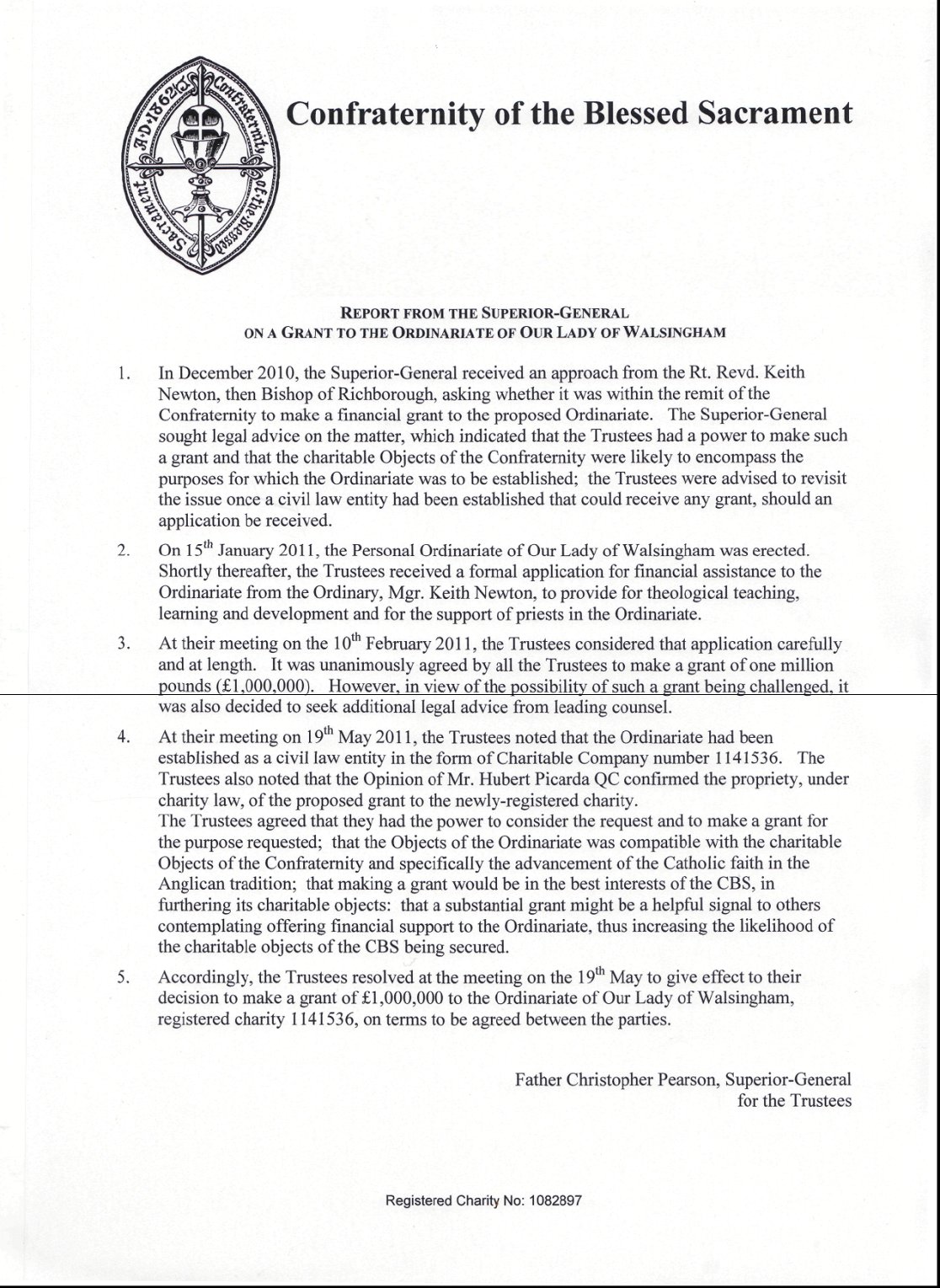
The Charity Commission has been asked to investigate a £1 million grant made to the Ordinariate, a new Roman Catholic organisation for defecting Anglicans, by a 150-year-old Anglican charity.
Trustees of the Confraternity of the Blessed Sacrament, founded in 1862 as part of the High Church revival in the Church of England, voted the grant through a few weeks ago, thus divesting their charity of more than half its total assets of £1.85 million.
The grant has prompted an outcry among Anglo-Catholics who have remained in the Church of England.
Shortly before the grant was made, the confraternity changed its membership rules, allowing Roman Catholics to become members for the first time…
No doubt other media reports on this will appear fairly soon. But meanwhile here is the original letter from the Superior-General of the Confraternity of the Blessed Sacrament, to the membership. Copied in html below the fold.
Update
See The CBS Affair by Peter Bolton which contains more background information.
30 CommentsSavi Hensman has written for Ekklesia about the recent statement by the House of Bishops of the Church of England.
The article is entitled Addressing sexuality truthfully in the Church of England.
16 CommentsThe Church of England is to review its policies on sexuality. As in many other churches, there has been heated debate and deep hurt around this issue in the past. How can this controversial subject be tackled in a way that promotes greater understanding of one another and of God’s purposes?
Returning to the sexuality debate
On 1 July 2011, the Church of England’s House of Bishops issued ‘Civil partnerships and same-sex relationships’. By 2012, it will have reviewed its 2005 pastoral statement on civil partnerships. Until then, no clergy in such relationships will be considered as bishops. In 2013, it will issue a consultation document that examines human sexuality, in particular same-sex relationships, more generally.
Such a review is long overdue – the last major Church of England policy document on the subject, Issues in Human Sexuality, appeared two decades ago; and, even then, many thought it inadequate. (Indeed the main author, John Austin Baker, publicly changed his mind afterwards and eloquently made a theological case for accepting gay and lesbian partnerships.)
Updated Sunday lunchtime
Church Times Ed Thornton House of Bishops will review same-sex relations
Associated Press Robert Barr Church of England bishops to review gay policies
Guardian Riazat Butt Bishops review approach to gay relationships and gay priests
ENS Matthew Davies ENGLAND: Bishops call for church review of civil partnerships, same-sex relationships
BBC Church to review same-sex relationships policy
Sunday Telegraph Jonathan Wynne-Jones Church warned of split if it relaxes teaching on gay relationships
Anglican Mainstream Anglican Mainstream welcomes review of Bishops’ Guidelines on Civil Partnerships
We welcome the review of the Bishops’ Guidelines on Civil Partnerships, which we called for when they were first issued. We therefore are reissuing the statement we made then in 2005 and the letter to the House of Bishops signed by over 1700 church members.
Philip Giddings (Convenor) and Chris Sugden (Secretary) for Anglican Mainstream
‘CIVIL PARTNERSHIPS A PARODY OF MARRIAGE: BISHOPS MUST TAKE ACTION’ say many Anglicans
Civil partnerships are a parody of the marriage relationship which is God’s provision for human flourishing, say many Church of England Clergy and lay leaders. They consider the government’s Civil Partnership Act 2005 is deeply ambiguous about whether these partnerships are marriage or not…
Changing Attitude House of Bishops statement on civil partnerships and same-sex relationships
20 CommentsThirteen years after the Lambeth Conference 1998 launched the listening process the House of Bishops has committed itself to a wider look at the Church of England’s approach to same-sex relationships more generally and will produce a consultation document in 2013.
The bishops intend to draw together material from the listening process which has been undertaken within the Church of England over the recent years and offer proposals on how the continuing discussion within the Church of England about these matters might best be shaped in the light of the listening process.
I feel sorry for Graham James, Bishop of Norwich, to whom fell the lot of speaking on behalf of the House. So the House is going to spend two years producing a consultation document, and only in 2013 will they allow the rest of the Church to engage in ‘continuing discussion’.
The bishops are in disarray. Changing Attitude has been told this by a number of bishops. We know from personal experience that the bishops are in disarray. Some recommend for ministry lesbian and gay people who have contracted civil partnerships (and these people are not celibate). Some license lesbian and gay clergy who are in civil partnerships and some actively encourage them to enter civil partnerships. Other bishops are either ignorant of this practice or naïve…
Included in the statement issued just now by the House of Bishops is the following paragraph (emphasis added):
“Among the matters to be considered in the review of the 2005 Statement there is one of some importance which the House did not address in advance of any experience of civil partnerships. This is whether clergy who have registered civil partnerships should be eligible for nomination to the episcopate. The House has concluded that it would be wrong to pre-empt the outcome of the review and that clergy in civil partnerships should not at present, therefore, be nominated for episcopal appointment. The House’s intention is to complete the review, which will need to take account of the legal analysis set out in GS MISC 992 (Choosing Bishops – the Equality Act) during 2012.
As regular TA readers will be aware, the Church of England recently issued “a note on the Equality Act prepared by the Legal Office in connection with episcopal appointments for members of Crown Nominations Commissions and diocesan bishops and their Advisory Groups”. This is the document numbered GS Misc 992.
In connection with this, I wrote last week to Church House to ask some questions about GS Misc 992. One question was this:
Third, there is the issue of being in a civil partnership as a specific item to be taken into account. See paragraph 29, second bullet, and also see paragraph 20, where this is distinguished ( by the conjunction “or”) from “a requirement related to sexual orientation”.
These wordings suggest that the authors of the opinion believe it is permissible to discriminate against a person who is in a civil partnership even if none of the other items listed in the document are applicable. I am at a loss to understand the legal basis for such a position, unless all married candidates are to be similarly discriminated against.
I received this in reply:
21 CommentsThis was a piece of legal advice and the Legal Office stand by it as an accurate piece of analysis of the Equality Act and its application to the Church. It was produced to help those appointing bishops understand what they are and are not entitled to take into account within the law. In particular the Equality Act is quite explicit in making it clear that religious organisations can, in certain carefully defined circumstances, discriminate on the grounds of someone being in a civil partnership. The note offers no policy or operational advice on what appointment panel should do.
Press release from the Church of England
Civil partnerships and same-sex relationships – a statement by the House of Bishops of the Church of England
The House of Bishops today issued a statement about the continuing debate within the Church of England about same-sex relationships. Speaking on behalf of the House, the Bishop of Norwich, the Rt Revd Graham James, said:
“Contrary to popular perception the House of Bishops has spent very little time over recent years discussing homosexuality. The last substantive engagement with the issue was in 2005 when the House agreed to issue a pastoral statement prepared by a group under my chairmanship on the implications of the introduction of civil partnerships. The House has now agreed that the time has come to commission two new pieces of work.
“First it has asked for a review of the 2005 statement in the light of subsequent developments. The review will include examination of whether priests in civil partnerships should be eligible for appointment as bishops. The 2005 statement was silent on this issue and, while the relevant legal background was analysed in a recently published Legal Office note, the House acknowledges its responsibility to address the policy issue. To avoid pre-empting the outcome of the review the House has concluded that clergy in civil partnerships should not, at present, be nominated for episcopal appointment. The review will be completed in 2012.
“Secondly, the House has committed itself to a wider look at the Church of England’s approach to same-sex relationships more generally in the light of the listening process launched by the Lambeth Conference in 1998. The Bishops will produce a consultation document in 2013. The House’s decision is motivated by a desire to help shape the continuing debate constructively and not by any view about what the outcome should be.”
The statement follows:
A Statement from the House of Bishops of the Church of England
“It is now nearly six years since the House issued its Pastoral Statement prior to the introduction of civil partnerships in December 2005. The preparation of that document was the last occasion when the House devoted substantial time to the issue of same sex relationships. We undertook to keep that Pastoral Statement under review. We have decided that the time has come for a review to take place.
“Over the past five and half years there have been several developments. Consistent with the guidelines in the Pastoral Statement a number of clergy are now in civil partnerships. The General Synod decided to amend the clergy pension scheme to improve the provision for the surviving civil partners of clergy who have died. More recently Parliament has decided that civil partnerships may be registered on religious premises where the relevant religious authority has consented (the necessary regulations are expected this autumn).
“The review will need to take account of this changing scene. The Pastoral Statement was not concerned with clergy alone but with the whole people of God. We recognise that bishops and clergy have found ways of engaging pastorally with those in civil partnerships, both at the time of registration and subsequently. Within the Anglican tradition our theological thinking is formed by a reasoned interpretation of Scripture, within the living tradition of the Church informed by pastoral experience. The House believes there is a theological task to be done to clarify further our understanding of the nature and status of these partnerships.
“These are the background issues for a review of the 2005 Statement. It will be undertaken in the context of the Church of England’s teaching on same sex relations as set out in the General Synod motion of November 1987 and Issues in Human Sexuality (a teaching statement from the House of Bishops in 1991). It will also be consistent with the approach taken by the Anglican Communion in Resolution 1.10 of the Lambeth Conference 1998 and subsequently.
“Among the matters to be considered in the review of the 2005 Statement there is one of some importance which the House did not address in advance of any experience of civil partnerships. This is whether clergy who have registered civil partnerships should be eligible for nomination to the episcopate. The House has concluded that it would be wrong to pre-empt the outcome of the review and that clergy in civil partnerships should not at present, therefore, be nominated for episcopal appointment. The House’s intention is to complete the review, which will need to take account of the legal analysis set out in GS MISC 992 (Choosing Bishops – the Equality Act) during 2012.
“The House has also decided that more work is now needed on the Church of England’s approach to human sexuality more generally. In February 2007, the General Synod passed a motion commending ‘continuing efforts to prevent the diversity of opinion about human sexuality creating further division and impaired fellowship within the Church of England and the Anglican Communion.’
“Alongside the review of the 2005 Pastoral Statement, the House intends, therefore, to draw together material from the listening process which has been undertaken within the Church of England over the recent years in the light of the 1998 Lambeth Conference resolution. The House wishes to offer proposals on how the continuing discussion within the Church of England about these matters might best be shaped in the light of the listening process. Our intention is to produce a further consultation document in 2013.”
The statement has been issued to General Synod members today, as GS Misc 997E. It is available on the Church of England website at http://www.churchofengland.org/media/1289380/gsmisc997.pdf.
TA Footnote: the 2005 pastoral statement on Civil Partnerships is here.
21 CommentsUpdated Friday morning
Savi Hensman has written for Cif belief When is Gafcon going to start listening?
Religious ultra-“conservatives” have launched an Anglican Mission in England (Amie). This is “dedicated to the conversion of England and biblical church planting”.
Leaders of Gafcon (Global Anglican Future Conference) and FCA (Fellowship of Confessing Anglicans) see themselves as championing traditional Anglicanism. Others regard them as out of step with church tradition, and object to their attempts to undermine others in the family of churches making up the Anglican Communion.
In May, a statement was issued by the council of primates (most senior bishops) of Gafcon/FCA, which lamented “the promotion of a shadow gospel that appears to replace a traditional reading of Holy Scriptures and a robust theology of the church with an uncertain faith and a never ending listening process”. Yet for many, the “listening process” on sexuality never truly started…
In this week’s Divine Dispatches Riazat Butt writes about AMiE:
If You Seek Amie then you’ve come to the right place. Amie is of course an acronym for the Anglican Mission in England – not to be confused with Amie – The Associate Member of the Institute of Engineers. And what a misnomer of an acronym it is. What’s that saying? Beware of strangers bearing gifts. Amie states, not at all ominously, that its intention is to support “those who have been alienated so that they can remain within the Anglican family. Churches or individuals may join or affiliate themselves with the Amie for a variety of reasons. Some may be churches in impaired communion with their diocesan bishop who require oversight. Others may be in good relations with their bishop but wish to identify with and support others.”
So, in non-Anglican parlance, this means if you don’t like your bishop you can have another one that fits more neatly with your world view. They don’t even have to be a bishop in the Church of England. I have three words for you – cross-border intervention. I also have four words for you – church within a church. What do the sages at Lambeth Palace and Bishopthorpe have to say about this parking of tanks on the CoE lawn? I’ll tell you – nothing! What should they say? Get off my land, that’s what.
Update
The Church Times has the headline: Group names five bishops ready to defy diocesans.
24 Comments…The three unnamed clerics were ordained in Kenya on 11 June by the Archbishop of Kenya, Dr Eliud Wabukala, who chairs the GAFCON Primates’ Council, formed after the Global Anglican conference in Jerusalem in 2008. All three come from the diocese of Southwark. The diocese said on Wednesday that it had received no request for permission to officiate there.
Dr Williams was in Kenya last week. A Lambeth spokeswoman was unable to say this week whether the two had discussed this development.
The Revd Charles Raven, the director of the Society for the Propagation of Reformed Evangelical Anglican Doctrine, wrote on the organisation’s website on Thursday of last week that the three men had gone to Kenya to be ordained “because the English diocesan bishop concerned had refused to give any assurances that he would uphold biblical teaching on homosexual practice”.
The chairman of the AMiE steering committee is the Revd Paul Perkin, Vicar of St Mark’s, Battersea Rise, and the group’s secretary is Canon Chris Sugden.
Dr Sugden said that the group was awaiting a response from Dr Williams to Dr Wabukala’s request that the three clergy be granted permission to officiate under the Overseas Clergy Measure. The chairman of Reform, the Rt Revd Rod Thomas, said that “episcopal oversight” of the three men “has been delegated to the AMiE bishops”…
Following on from this announcement, the Sunday Times carried an advertisement for a new Communications Director which you can see here. Further information about the post can be found here and then here.
But what has attracted some attention, for example here, and over here, is the sentence in the advertisement that reads as follows:
This is no ordinary Communications Director job. We are looking for somebody who will share our values and whilst not necessarily an Anglican, is a practising Christian (this post is subject to an occupational requirement that the holder be a practising Christian under Part 1 of Schedule 9 to the Equality Act 2010 because of its representational role and its responsibility for maintaining a Christian ethos within the national Church, as one of its senior officers).
Now, this has been assumed by some people to be a reference to Clause 2 of Part 1 of Schedule 9. That clause is the one which contains all the exemptions relating to gender, marital status, sexual orientation and so forth.
However, I do not believe that is what they meant to reference. I believe the intention was to reference Clause 3 of Part 1 of Schedule 9. This reads (scroll down at the previous link):
Other requirements relating to religion or belief
3 A person (A) with an ethos based on religion or belief does not contravene a provision mentioned in paragraph 1(2) by applying in relation to work a requirement to be of a particular religion or belief if A shows that, having regard to that ethos and to the nature or context of the work—(a) it is an occupational requirement,
(b) the application of the requirement is a proportionate means of achieving a legitimate aim, and
(c) the person to whom A applies the requirement does not meet it (or A has reasonable grounds for not being satisfied that the person meets it).
This is the clause that transposes into the Equality Act 2010 the exemption formerly contained in The Employment Equality (Religion or Belief) Regulations 2003. This exemption was, and is, entirely separate and distinct from others which were formerly contained in the Sex Discrimination Act 1975, as amended and The Employment Equality (Sexual Orientation) Regulations 2003. All of these are now bundled into Clause 2.
So, why have other interpretations been put upon this advertisement? I think there are two causes.
The first is the febrile atmosphere which has arisen following the official publication of the (previously leaked) legal advice issued about Choosing Bishops – Equality Act 2010.
The second is the fact that during the passage of the Equality Act, Secretary General William Fittall gave evidence to a parliamentary committee in which he specifically cited this job as an example of a senior post, likely to be held by a lay person, which he considered should fall within the ambit of the Clause 1 exemptions. Here is what he said at the time. The context of his remarks was a Labour government proposal incorporated in the draft bill to modify the wording of the Clause 2 exemption to be more explicit about who was to be included. This was fiercely resisted by the CofE, and was the reason why a large number of bishops turned out to vote in the House of Lords in favour of an amendment which deleted the proposed changes. The amendment passed, and so the scope of the exemption today remains exactly what it was before.
It is therefore understandable that some would now be suspicious. And, if my interpretation of the intention to invoke only Paragraph 3 is correct, it might be helpful if future advertisements were worded more precisely.
The official CofE response to queries on this is as follows:
8 Comments‘The occupational requirement that the postholder be a practising Christian means what it says, neither more nor less. Staff are appointed to senior positions in the national institutions of the Church of England by fair and competitive processes. They have to be able to show that they can serve it in all its diversity and operate its equal opportunities policies. Suggestions that appointments are made in pursuit of a particular cultural or partisan agenda are completely unfounded.’
Two more diocesan synods have voted on the legislation to allow women to be bishops. On the main motion to support the legislation both synods voted in favour in all three houses.
Salisbury
| Main Motion |
For
|
Against
|
Abstentions
|
| Bishops |
1
|
0
|
0
|
| Clergy |
37
|
2
|
1
|
| Laity |
48
|
6
|
1
|
Several following motions all failed. See details in the comments below.
Southwell & Nottingham
| Main Motion |
For
|
Against
|
Abstentions
|
| Bishops |
1
|
0
|
0
|
| Clergy |
31
|
6
|
2
|
| Laity |
39
|
2
|
0
|
At Southwell & Nottingham a following motion seeking greater provision for the opponents of women bishops was defeated (For: 8 Against: 68 Abstained: 4).
WATCH is maintaining a list of all the votes on the main motion.
30 CommentsPress release from Fulcrum:
Fulcrum Statement on Interventionist Anglican Mission in England
Executive Summary
Fulcrum expresses serious concern at the launch of the Anglican Mission to England (AMIE) and calls for immediate dialogue within the entire evangelical constituency over this development, for reasons including:
- A name reflecting breakaway movements in the USA inviting the conclusion that this is the true purpose of the new society
- The creation of a society with a conservative evangelical ‘political’ agenda not simply mission
- The creation of a panel of bishops that signals the intention of offering alternative oversight without collaboration with senior leaders of the Church of England
- Indications that the society will take its own path in the authorisation of ministry, as evidenced by its approval of the recent secret ordinations in Kenya, which is an escalation of the earlier regrettable Southwark ordinations
For the full statement, go to the Fulcrum website.
32 CommentsMargaret Duggan has a detailed preview of next month’s General Synod agenda in the Church Times: Small groups and a ‘big idea’ for Synod in York.
My list of online synod papers is now, I think, complete.
One item of synod business is the order setting parochial fees for 2012 to 2014. As well as the draft order itself there is an explanatory memorandum and a rationale.
GS 1832 The Parochial Fees Order 2011
GS 1832X Explanatory Memorandum
GS Misc 989 2012-2014 Fees Order – Rationale
Amendments to the Order are permissible. Any member who wishes to give notice of an amendment must do so in writing to the Clerk to the Synod not later than 5.30 p.m. on Thursday 7 July 2011.
The Fees Order will only come into effect if it is passed by Synod; if it is not passed the current scale of fees will continue to apply.
There has been some not necessarily totally accurate reporting of these proposals.
Steve Doughty in the Mail Online: End of ‘Ryanair’ fees for church weddings where choirs and organists are extra
John Bingham in the Telegraph: For poorer: cost of church weddings to rise 50pc
According to the remarks of the Archbishop and Primate of the Anglican Church in North America, Robert Duncan, speaking on 21 June:
Our global commitments remain strong and we continue to be seen as “gospel partners” and bearers of “authentic Anglicanism” (South-South Encounter IV) by most of the world’s Anglicans. The GAFCON Provinces accord our Province status as the North American Province and I am seated as a Primate in the Primates Council. I was privileged to be present at Archbishop Ian Earnest’s invitation at the All Africa Bishops Conference (of the Council of Anglican Provinces of Africa) last August in Entebbe and was accorded a seat there for public and state events as one of the archbishops of the provinces. It is the greatest of joys to welcome Archbishop Ian Earnest – Archbishop of the Province of the Indian Ocean and Chairman of CAPA – to this Provincial Council as speaker, observer and friend, and to our College of Bishops as Bible teacher and consultor. It is also a privilege to welcome Fr. Thomas Seville, CR, of the Faith and Order Commission of the Church of England here as participant and observer, in partial response to the action of the General Synod of the Church of England in February 2010 regarding consideration of an appropriate form of recognition or relationship with the Anglican Church in North America.
Mark Harris has commented at length about this, in So, explain again just what the Church of England is up to in America?
19 Comments…Participant and observer….sounds like more than just an exploratory visit. What in the world is the Church of England proposing to do “regarding consideration of an appropriate form of recognition or relationship with the ACNA”?
I presume the Archbishop of Canterbury, not in communion with ACNA as yet, knows that the Archbishop of ACNA is not the Archbishop of a Province of anything, much less a Province of the Anglican Communion. So it must be that in sending Fr. Seville over to participate and observe, the CofE is feeding the optimistic fires of ACNA’s Archbishop for recognition…
Tony Baldry MP, Second Church Estates Commissioner, answered five Written Questions from Diana Johnson MP in the House of Commons yesterday (23 June).
They covered the length of time to appoint and then consecrate new bishops, the ratios of bishops to parishes and the powers of PEVs.
The full text of the questions and answers from Hansard is reproduced below the fold. The not entirely appropriate headings are Hansard’s.
12 CommentsToday the Church Times has this leader: Gay bishops again.
After summarising the non-story aspect of last weekend’s reports, it comments on the content:
In May, our view was a negative one, since the document listed several reasons why the appointment of a gay bishop could be blocked. This week’s positive spin has not changed our opinion. As the leaders of the “gay-led” Metropolitan Community Church in Manchester wrote to Dr Williams this week, “We note that [unlike a gay candidate] heterosexual candidates for bishoprics are not asked to repent of any sexual activity with which the Crown Appointments Commission may be uncomfortable.” More than one serving bishop has said that he would have considered it an impertinence had he been asked about his sexual history.
The legal advice has no more weight now than before it was circulated to Synod members. It was not approved by the Bishops when they discussed it in May, not least because, to many, the brief was not how to remove discrimination within the Church, but how to continue it untroubled by the law.
The earlier report in the Church Times was House of Bishops divided on keeping out homosexuals.
Letters to the editor on the subject in the following two weeks are first here, and then here.
4 CommentsUpdated Friday evening
This press release from GAFCON New Anglican Mission Society announced
The Anglican Mission in England (AMIE) held its inaugural event on Wednesday June 22 during an evangelical ministers’ conference in central London.
AMIE has been established as a society within the Church of England dedicated to the conversion of England and biblical church planting. There is a steering committee and a panel of bishops. The bishops aim to provide effective oversight in collaboration with senior clergy.
The AMIE has been encouraged in this development by the Primates’ Council of the Fellowship of Confessing Anglicans (GAFCON) who said in a communiqué from Nairobi in May 2011: “We remain convinced that from within the Provinces which we represent there are creative ways by which we can support those who have been alienated so that they can remain within the Anglican family.”
The AMIE is determined to remain within the Church of England…
This society is, it appears, a renaming of this one.
Update
There is more information, including a list of names of bishops, in this: The Anglican Mission in England – Seeing the Church of England Again for the First time.
Church of England press release:
The Church of England has today submitted its response to the Government’s consultation on Civil Partnerships in Religious Premises.
A Church of England spokesman said: “Given the decision that Parliament has already taken to amend the Civil Partnership Act 2004 in the Equality Act 2010, the response focuses on the need to assure that the forthcoming regulations continue to provide unfettered freedom for each religious tradition to resolve these matters in accordance with its own convictions and its own internal procedures of governance.
“That means that there needs to be an ‘opting in’ mechanism of the kind that the Government has proposed. In the case of the Church of England that would mean that its churches would not be able to become approved premises for the registration of civil partnerships until and unless the General Synod had first decided as a matter of policy that that should be possible.”
The full text of the submission that addresses the specific questions raised by the consultation is set out below.
Some key passages relating to whether the Church of England will allow its premises to be so used are copied below the fold (emphasis added).
33 CommentsThe Tablet had an article last week by Francis Davis entitled Players in the public square.
Catholic bishops are often overshadowed in the national debate by their Anglican counterparts, as shown in the furore caused by the Archbishop of Canterbury’s critique of the Coalition Government last week. A Catholic academic and political adviser asks why this may be…
A sample of the analysis:
23 Comments…For a start, there are more than 100 Church of England bishops across 43 dioceses compared with 29 Catholic bishops across 19 dioceses in England. Catholic bishops in these dioceses shepherd around 4,000 clergy in England while the Anglican tally is double that number, bringing with them spouses and children whose joys and sorrows have direct consequences for the success of diocesan ministry.
The Anglicans have more than twice the number of schools – 4,820 with more than a million pupils – giving them greater presence in communities and opportunities for encounter. These schools are mainly primaries while the Catholic Church has far more secondary schools. There are 2,000 Catholic schools altogether in England and Wales educating 860,000 children.
I have also selected for closer examination the 19 Church of England bishops whose dioceses most closely compare with their Catholic counterparts. In these dioceses, Catholic bishops are generally older and remain in post longer than the Anglicans. The average Catholic episcopal age is 66 and their average service a decade at the diocesan helm compared to 60 and just over seven years for the Anglicans. Church of England bishops normally retire a decade younger than their Catholic counterparts.
This contrast in institutional reach and episcopal age is mirrored by matters of formation and experience. Each of the 19 Church of England bishops I surveyed had at least one degree from Oxford, Cambridge, London or another leading university. Only nine Catholic bishops in England have degrees from outside Catholic institutions, with some having pursued all their studies from secondary age in a seminary. Four of the current Anglican bishops have published more books between them than all English Catholic bishops combined since the Second Vatican Council. This is not only a question of class, as half of both groups surveyed were schooled in grammar or other state schools…
Updated twice on Monday evening
There has been an outburst of media reports yesterday all based on the release by the Church of England of a legal opinion prepared by the Legal Office, with this title. Many of them are wildly inaccurate.
The document was officially published here, and an html version is now available here.
As the cover note shows, this is published to synod members for information only. No synodical action is planned in respect of it.
I attach for the information of Synod members a copy of a note on the Equality
Act prepared by the Legal Office in connection with episcopal appointments for
members of Crown Nominations Commissions and diocesan bishops and their
Advisory Groups.
The document is identical to the one leaked over three weeks ago to the Guardian and published in full by them. See the links in this report on TA dated 26 May: House of Bishops tied in knots over gay bishops and in particular this link to “legal document”.
Updated paragraph
The regular pre-synod press briefing is scheduled for this morning. There may be more to report following that event. took place this morning. It was confirmed that this document is being issued for information only (due at least in part to having been previously leaked by the Guardian) and that it presages no synodical action and proposes no change from recent past practice in selecting bishops.
Second update
Reform has issued a press statement: Reform calls for legal advice on Bishops’ Appointments to be withdrawn.
37 Comments