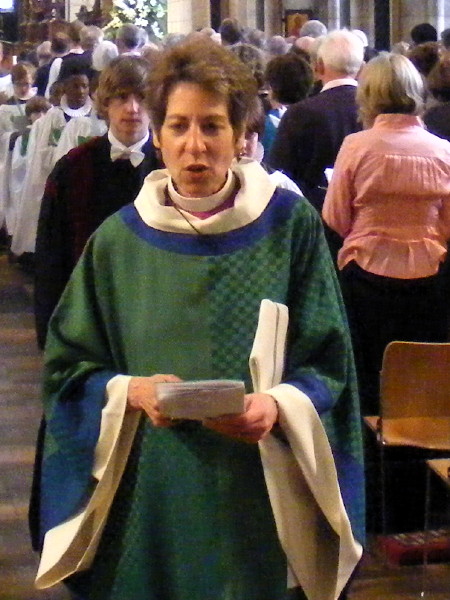
The new Second Church Estates Commissioner took questions in the House of Commons yesterday. The first was about women bishops.
Here is the verbatim Hansard report.
Church Commissioners
The hon. Member for Banbury, representing the Church Commissioners, was asked-
Women Bishops
2. Diana R. Johnson (Kingston upon Hull North) (Lab): What progress the Church of England has made on proposals to enable women to be consecrated as bishops. [3388]
The Second Church Estates Commissioner (Tony Baldry): Before I answer that question, may I pay tribute to my predecessor, the hon. Member for Middlesbrough (Sir Stuart Bell)? He has been the longest serving Second Church Estates Commissioner ever, and he did an excellent job. The legislation to enable women to become bishops reaches the General Synod’s equivalent of Report early next month in York. Depending on what is decided there, the legislation will then go to the 44 diocesan synods, and I understand that the earliest date that the General Synod can take a final decision, and when the matter can eventually come before the House, is 2012.
Diana R. Johnson: I welcome the hon. Gentleman to his new role. Does he not agree that the intervention of the two archbishops, with their proposal on the legislation to enable women to become bishops, will create a two-tier system of bishops? Women will no doubt be on the lower tier, and does that not send out completely the wrong message from the established Church of this country about the role of women bishops?
Tony Baldry: I thank the hon. Lady for her kind words at the beginning of her question. There are clear majorities in the General Synod in favour of women becoming bishops, but, as the proposals by the Archbishops of Canterbury and York yesterday demonstrated, there are still efforts to try to find ways to reconcile those who have deep-held opposition to the measure. Under legislation, it is important that the Church decides the way forward, and we should give it the space to do so. However, it is also very important that the Church hears the voices of this House about how we see those matters, because ultimately the issue will have to come back to this House.
Later there was a second question which referred to women bishops.
12 Comments7. Peter Bottomley (Worthing West) (Con): When the responsibilities of the Second Church Estates Commissioner in respect of this House were last reviewed. [3393]
Tony Baldry: I am beginning to get to grips with the responsibilities of this post, which was established by the Ecclesiastical Commissioners Act 1850. I would say at this stage that I will try to have the same broad approach to answering questions on behalf of the Church as did my predecessor. I hope that I can be a helpful conduit between the Church and this House, and this House and the Church.
Peter Bottomley: My hon. Friend is admirably suited to following the hon. Member for Middlesbrough (Sir Stuart Bell) in this post. Will he pass back to the Synod the fact that we look forward in this House to having bishops chosen on merit, recognising that sex is not merit and that the Synod can throw out proposals that it does not like?
Tony Baldry: As I said in response to an earlier question, it is very important that the General Synod and the Church should hear the voices of this House, and I am sure that they will have heard, and will hear, the voice of my hon. Friend.
WATCH (Women and the Church) Press Statement 22nd June 2010
All bishops are equal but some are more equal than others.
WATCH has studied the outline proposals of the Archbishops’ intervention in the progress of legislation for women bishops. Despite the assurances that all will be well we are not convinced that the issues raised regarding jurisdiction will be resolved equitably when the practical steps of implementation are worked out. Will an “unacceptable” Diocesan bishop be required to share jurisdiction and how? Or will it be at her or his discretion? If the former, we are in effect back to automatic transfer.
The timing of the Archbishops’ intervention is similarly to be questioned. The Revision Committee considered all proposals put to them in great and thoughtful detail. These new proposals could have been made in similar detail to the Revision Committee. This would have enabled their practical consequences to be thoroughly considered before they came to be debated by General Synod. It is important that the Church does not re-create the unforeseen consequences of the Episcopal Ministry Act of Synod in agreeing to proposals that have not been thoroughly explored and explained. We ask; In what way are ‘nominated bishops’ not actually flying bishops with extended jurisdiction? Are we not creating a two-tier episcopacy of ‘acceptable’ and ‘unacceptable’ bishops with all that implies about how the Church continues to view women? Have the Archbishops sought the views of the senior women who must be counted amongst “the full diversity of voices in the Church of England”? Has their support been obtained for these proposals?
WATCH has received many messages that suggest that the Revision Committee has accurately judged the amount of compromise that people are prepared to make. While we would prefer the legislation to be simpler and more straightforward we are willing to support the Revision Committee proposals for the sake of the Church. Let us move forward on that basis.
Notes for Editors
36 CommentsWATCH (Women and the Church) is a voluntary organisation of women and men who are campaigning to see women take their place alongside men without discrimination and at every level in the Church of England. This requires the removal of current legal obstacles to the consecration of women as bishops. WATCH believes that the full equality of women and men in the Church is part of God’s will for all people, and reflects the inclusive heart of the Christian scripture and tradition.
In their announcement yesterday, the Archbishops of Canterbury and York made a serious proposal to amend the legislation before the General Synod to allow Women in the Episcopate.
Not everybody is finding it possible to take their proposal seriously.
As already linked below, Pluralist has written Two for Tea.
DRAFT LEGISLATION ON WOMEN IN THE EPISCOPATE
AMENDMENTS TO BE PROPOSED BY THE ARCHBISHOPS OF ANGLICANISM AND THE NORTH
1. Women are lovely aren’t they and the Revision Committee that has looked into them needs much gratitude. Thank you for your discoveries. However, as Archbishops we would like to overturn all that painstaking and already overturned work and impose our own point of view, and expect the Synod to understand that it is episcopally led. We do not want our ecumenical friend Benedict the 16th to get his way and attract out all the sanctimonious nutters from the Church in England in order to fulfil his ambitions when we need them to fulfil ours, such as passing the Anglican Covenant and introducing a stronger Catholic order of which they would approve. We want these people to think that there is good news for them in this Church…
And an American correspondent has sent this email:
16 CommentsFuture News Stories:
June 21, 2011: Dr Rowan Williams and Dr John Sentamu, former officials of the Church of England which they destroyed through inept leadership, have been hired by Major League Baseball. The two have immediately unveiled a plan for a “co-ordinate Perfect Game Pitcher” – Teams that could not accept that their pitcher did not pitch a perfect game would get a photogenic male model dressed in a team jersey to stand in at a photography session holding a ball with a big red “0” boldly emblazoned on it. Barry Bonds commented “Hey, that’s cheating!”
June 21, 2012: Dr Rowan Williams and Dr John Sentamu, former officials of Major League Baseball, which they destroyed through inept leadership, have been hired by the US Republican National Committee. The two have immediately unveiled a plan for a “co-ordinate President” – States that could not accept Sarah Palin as the legitimate elected national leader would get a unemployed Hollywood actress to attend the opening of ball games and to give commencement speeches. Vermont immediately contracted Ellen DeGeneres leaving California to choose between Whoppi Goldberg and Lady Gaga.
June 21, 2013: Dr Rowan Williams and Dr John Sentamu, former officials of the US Republican National Committee, which they destroyed through inept leadership, have been hired by Apple Computer. They immediately unveiled a plan for a “co-ordinate iPhone” – people who cannot accept that the latest model does not have all the features they personally want would get a small white cardboard box on which they can draw anything they want. The two pre-ordered Binney and Smith’s entire annual production of Crayolas to ship with the new devices.
June 21, 2014: Dr Rowan Williams and Dr John Sentamu, former officials of Apple Computer, which they destroyed through inept leadership, have been hired to run the Winter Olympics. They immediately unveiled a plan for “co-ordinate Gold Medalists” – people who cannot accept that their country, no matter how tropical, cannot produce a champion curling team will be emailed a link to a You Tube video showing the medal presentation of the legit winners, out of focus and grainy as to prevent positive identification of players or uniforms (actually, a normal You Tube video), with their own national anthem dubbed in.
June 21 2015….
The Diocese of El Camino Real reports on the visit of its bishop, Mary Grey-Reeves to the Diocese of Gloucester in England.
Read From Bp. Mary and Bp. Michael, June 21, 2010
Dear Friends,
Some of you may have heard that on a recent visit to England, +Katharine Jefferts Schori was asked to verify her orders of ordination and asked not to wear her miter. As you know, I am here on a partnership visit in the Diocese of Gloucester. Attached is a greeting and explanation from Bishop Michael regarding our own correspondence with Lambeth Palace, hopefully clarifying a policy that has been in place but not enforced. The incident with +Katharine was of course exacerbated by +Rowan’s Pentecost letter and +Katharine’s response. I must say that I have not met anyone here that is happy with +Rowan’s letter and the actions that it announced; but are rather many are embarrassed and upset.
As you will see from an update that Celeste Ventura and Channing Smith will send shortly, we are having a wonderful time in Gloucester being treated very well and shown great hospitality. There are no major issues regarding the wearing of my miter or being a woman bishop, although of course there are those who do not approve of women’s ordination. It is a very live issue here and there are lots of feelings and emotions as the Church of England approaches another vote, hopefully towards women in the episcopate, in just a few weeks.
In the meanwhile, I send greetings from everyone participating on this triangular partnership and ask your continued prayers. I will send another update at the end of the week after my return late on Wednesday night.
With love and blessings,
+MaryA message from Michael Perham, Bishop of Gloucester
Dear Sisters and Brothers of the Diocese of El Camino Real
I greet you in the name of our Lord Jesus Christ, rejoicing as always in our partnership, drawing together your diocese, the Diocese of Western Tanganyika and my own.
It has been a great joy to have Bishop Mary with us these last few days, sharing in our partnership meeting, speaking to our Diocesan Synod, preaching in the Cathedral and visiting parishes. It will be a particular joy when, on the last day of the partnership gathering, she presides at the Eucharist in the Lady Chapel of our Cathedral.
People here in the Diocese of Gloucester share my respect and affection for Bishop Mary. Once again having her here has been a delight and an encouragement to us all. Her graciousness is a wonderful gift to our partnership and companion relationship and I believe the partnership is a gift to our troubled Anglican Communion.
I am attaching a note I have written to try to explain some of the difficulties we have run into in England these last few days in relation to the ministry of visiting bishops. The difficulties have felt to be a long way away from the happy acceptance of one another here.
+Michael
The note mentioned is copied here below the fold.
And for good measure, there is a picture at The Three-Legged Stool, see Comments from ECR and Gloucester on recent events.
8 CommentsFrom 10 Downing Street:
The Queen has approved the nomination of the Right Reverend James Henry Langstaff, MA, Suffragan Bishop of Lynn, for election as Bishop of Rochester in succession to the Right Reverend Michael James Nazir-Ali, BA, MLitt, PhD on his resignation on the 31st August 2009.
Read the government press release.
From the Diocese of Rochester, there is only a PDF file, available here.
The new Church of England Bishop of Rochester will be the Right Reverend James Langstaff, currently the Suffragan Bishop of Lynn in the Diocese of Norwich. In addition, he is now the Bishop designate of Rochester.
Bishop James (53) will become the 107th Bishop of Rochester later this year. He succeeds the Right Reverend Dr Michael Nazir-Ali, who retired in September 2009.
Following a media facility, Bishop James will spend the day touring the diocese to visit some of his future colleagues and parishioners. His day will begin at Bishop Justus school in the London borough of Bromley, which is part of the Diocese of Rochester. Here, he will be introduced to staff and pupils before moving on the meet members of his clergy at Chevening. After lunch and a further media facility, Bishop James will meet his staff at Bishopscourt and the Diocesan Office in Rochester. His day will conclude at Rochester Cathedral where he will meet Cathedral staff prior to joining future colleagues and members of the public for Evensong at Rochester Cathedral…
From the Diocese of Norwich: Bishop of Lynn to be next Bishop of Rochester
9 CommentsThe General Synod of the Church of England will meet in York from 9 to 13 July 2010. The following press release was issued a short time ago.
See our item below for links to online Synod papers.
Full agenda published for July General Synod sessions at York University
21 June 2010
Key debates centre on women bishops’ legislation, while other subjects include clergy pensions, clergy terms of service, relations with the Church of Scotland, the status of deaneries and resources for Fresh Expressions in sessions of the Church of England’s ‘parliament,’ the General Synod, to be held in York from July 9th to 13th.
This is the last Synod before the five-yearly elections to and inauguration of the new Synod in November. More than half of the time available at these Sessions has been allocated to the key Revision Stage of the women bishops’ legislation.
Women Bishops
In February 2009, Synod agreed that draft legislation to allow women to be consecrated as bishops should be referred for revision in committee. The Revision Committee completed its work in April, and its report has been published.
The draft legislation continues to make provision for those who in conscience cannot receive the ministry of women as bishops, by providing for certain functions to be undertaken by a male bishop under a diocesan scheme made in accordance with a national code of practice.
After a ‘take note’ debate on the Revision Committee’s report, the Synod is scheduled to embark on the Revision Stage. This provides Synod with its last chance to amend the substance of the legislation before it is referred formally to dioceses, and then returns to Synod for Final Approval, probably in February 2012. Synod members need to submit their amendments for this Synod by June 30.
Other legislative business includes two pieces of legislation as part of the preparations for the introduction of ‘common tenure’ for clergy in 2011, including provision for maternity, paternity, parental and adoption leave and time off work to care for dependents for those holding office under the common tenure arrangements.
Clergy Pensions
Synod agreed in February to make certain changes to the clergy pensions scheme, including increasing the pension age for future service and increasing the accrual period for future service. This was subject to statutory consultation with scheme members.
Separately, the Synod carried a Private Member’s Motion from the Reverend Mark Bratton which asked for changes to the clergy pensions rules to remove the remaining differences between pension benefits for surviving civil partners and surviving spouses.
At this Synod, the Archbishops’ Council is reporting back on the consultation exercise and making recommendations about changes to the clergy pensions scheme. Synod will then be asked to formally approve the resulting amendments to the scheme rules.
Relations with the Church of Scotland
The report Our Fellowship in the Gospel is the fruit of informal conversations between the two churches. It sets out ways in which the Church of England and the (Presbyterian) Church of Scotland can consult and co-operate as established churches. The Church of Scotland welcomed the report and its recommendations at its recent General Assembly and it now comes before the General Synod for endorsement.
Diocesan Synod Motion – Deaneries
The motion from the Coventry Diocesan Synod asks that the case for conferring incorporated status on deanery synods should be considered by the Archbishops’ Council. The motion also asks that deanery synods should be specifically enabled to promote the deanery in the Church’s mission.
Private Member’s Motion – Fresh Expressions
Synod received a presentation on Fresh Expression from Bishop Graham Cray in February. Richard Moy’s Private Member’s Motion asks the Fresh Expressions team, in consultation with the Liturgical Commission, to produce an on-line library of visual and video resources for worship.
Synod’s other business
Synod will receive a Presidential Address from the Archbishop of York. There will also be a special address from one of the ecumenical guests – the Archbishop of Estonia, The Most Rev Andres Poder.
There will be the one item of liturgical business: the Further Revision Stage and Final Approval of the Additional Weekday Lectionary and Amendments to the Calendar, Lectionary and Collects.
Synod will be asked to agree the setting up of the new Faith and Order Commission, in succession to three bodies: the Doctrine Commission, the Faith and Order Advisory Group and the House of Bishops’ Theological Group. This represents a streamlining and concentration of the Church of England’s theological resources at national level.
Following the Synod’s rejection in July 2009 of the Archbishops’ Council’s proposals for overhauling its committee structure, Synod will debate the Council’s revised proposals, produced after consultation with the bodies concerned, which essentially entail a reduction in the size of the bodies.
Synod will receive presentations of the Annual Reports of the Archbishops’ Council, and the Church Commissioners.
There will also be a closing Eucharist, at which the Archbishop of Canterbury will preach, as well as the customary Sunday morning Eucharist in York Minster, at which the Archbishop of York will preach.
As this is the last Synod of the quinquennium, there will be a number of farewells.
Communicating Synod
Parishioners can keep in touch with the General Synod while it meets. Background papers and other information will be posted on the Church of England website ahead of the General Synod sessions. A live feed will be available courtesy of Premier Radio, and audio files of debates, along with updates on the days’ proceedings, will be posted during the sessions.
9 CommentsThe Archbishops of Canterbury and York have jointly issued the statement below, outlining amendments that they will propose to the draft legislation to enable women to become bishops in the Church of England.
General Synod Draft Legislation: Women in the Episcopate
Monday 21 June 2010
The Archbishops of Canterbury and York have signalled their intention to propose jointly in due course an amendment to the draft legislation to enable women to become bishops in the Church of England due to be debated at General Synod in July. This note explains their reasoning.
DRAFT LEGISLATION ON WOMEN IN THE EPISCOPATE
AMENDMENTS TO BE PROPOSED BY THE ARCHBISHOPS OF CANTERBURY AND YORK
1. We owe a great debt of gratitude to the Revision Committee for their dedicated and painstaking work. We wish, however – after much consideration, and after discussion in the House of Bishops – to offer legislative amendments to the Draft Measure which we believe might provide a way forward for the Church of England. We want as many people as possible to feel that there is good news for them in this process, and we hope that what we are suggesting may help secure the broadest degree of support for the legislation without further delaying the process of scrutiny and decision.
2. Successive General Synod debates have produced clear majorities in favour of admitting women to the episcopate in the Church of England. At the same time, a number of motions have also shown a widespread desire to proceed in a way that will maintain the highest possible degree of communion within the Church of England between those who differ on the substantive point, reflecting the 1998 Lambeth Conference Resolution that ‘those who dissent from as well as those who assent to the ordination of women to the Priesthood and episcopate are both loyal Anglicans’.
3 The issue that has proved most difficult to resolve in securing these two objectives has been that of ‘jurisdiction’. Once women become bishops, it will be possible to maintain something like the present ‘mixed economy’ in the Church of England only if there is provision for someone other than the diocesan bishop to provide episcopal oversight for those who are unable to accept the new situation. The need for such provision is widely accepted. But what is still much debated is what should be the basis in law for the authority exercised by a bishop in this kind of ministry.
4. The various approaches so far explored have all taken for granted that there is a simple choice between either deriving this authority from the diocesan by way of delegation or removing some part of the diocesan’s jurisdiction so as to confer it on a bishop who then exercises authority (‘ordinary jurisdiction’) in his own right.
5. The amendments we intend to propose involve neither delegation nor depriving a diocesan of any part of his or her jurisdiction. Instead we seek to give effect to the idea of a ‘co-ordinate’ jurisdiction.
6. What this would mean is that:
the jurisdiction of the diocesan bishop – whether male or female – remains intact; he or she would remain the bishop of the whole area of the diocese and would be legally entitled to exercise any episcopal function in any parish of the diocese;
7. The amendments needed to achieve all this will be brief and will not involve a radical rewriting of the draft legislation. They are likely to be confined to Clauses 2 and 5 of the Draft Measure and are consistent with its overall structure. They would not require a further Revision Committee stage.
8. Thus if they were passed – and subject to decisions reached by General Synod on amendments tabled by other members – the way would still be clear to refer the legislation to diocesan synods if the Revision Stage is successfully completed in July. As the recent statement from the House of Bishops makes clear, the Archbishops and most of the House are persuaded that delay would not be wise or helpful.
9. Since the amendments would not divest the diocesan bishop of any jurisdiction, they would involve no change in the Church of England’s understanding of the episcopate. But for those seeking ministry under this provision from a nominated male bishop, there would no longer be the difficulty that this authority was derived in law from an act of delegation by an individual diocesan.
10. An arrangement whereby two people have jurisdiction in relation to the same subject matter would not be unique. For example, the High Court and the Charity Commission each has jurisdiction to make schemes for the reorganisation of charities. Many courts and other bodies have overlapping jurisdictions.
11. Such situations are often described as ‘concurrent’ jurisdiction – though this should not be understood in the sense of two different courts acting at the same time in relation to the same things, simply as meaning two authorities possessing jurisdictions that exist side by side. We prefer the term ‘co-ordinate’ as less likely to give rise to confusion.
12. Where there are cases of concurrent jurisdiction in the law, procedural rules and rules of practice have had to be developed to avoid two authorities acting at the same time on the same matters. Similarly, our amendments will require the Code of Practice to give guidance on arrangements for co-ordinating the exercise of ministry as between the diocesan bishop and the nominated bishop under the diocesan scheme. The diocesan retains the freedom to amend the diocesan scheme from time to time after consultation with the diocesan synod.
13. Since 1994, the Church of England has managed to operate a practical polity that reflects continuing differences over the question of the priestly ministry of women. This has been possible not only because of the framework created by General Synod through the 1993 Measure and the Act of Synod but also because a great many people on all sides have wanted to make it work.
14. We are convinced that the small but significant changes we are proposing will make it easier for the statutory framework and Code of Practice emerging from the legislative process to create a climate in which mutual trust and common flourishing across the Church of England can be nourished, in a situation where for the first time, all orders of ordained ministry are open to women and men alike.
15. We believe that the amendments secure two crucial things:
1. that women ordained to the episcopate will enjoy exactly the same legal rights as men within the structures of the Church of England and that there will be no derogation of the rights of any diocesan bishop, male or female; and
2. that those who request oversight from a nominated bishop under a diocesan scheme will be able to recognise in them an episcopal authority received from the whole Church rather than through delegation or transfer from an individual diocesan.
16. It will be for General Synod to reach a view on these proposals, as on each of the many amendments offered by Synod members. We commend our suggestions to you for prayer and reflection, in the hope that we may emerge from the July Group of Sessions with a sense that the full diversity of voices in the Church of England has been duly heard and attended to.
+Rowan Cantuar: +Sentamu Ebor:
20 June 2010
30 CommentsMany papers for next month’s meeting of General Synod are now online. The list below will be updated as the remainder become available. Papers are also listed when they are known to exist but are not yet online.
Updated 21, 22, 28 June
Agenda
GS 1777 Full Agenda
Outline agenda
Papers for debate
GS 1708-09Y Revision Committee Report Women in the Episcopate
GS 1708A draft Women in the Episcopate Measure
GS 1709A Amending Canon No. 30
GS 1708 AX Explanatory Memorandum
GS 1724Z Additional Weekday Lectionary and Amendments to Calendar, Lectionary and Collects – further report of the Revision Committee
[which refers to GS 1724A Additional Weekday Lectionary and Amendments to Calendar, Lectionary and Collects (a paper from February 2010)]
GS 1778 Business Committee Report
GS 1779 Term of office of elected members of the Archbishops’ Council
GS 1780 Clergy Pensions: Report from the Archbishops’ Council
GS 1781 Archbishops’ Council 2011 Budget
GS 1782 Faith and Order Commission of the General Synod of the Church of England
GS 1783 Draft Ecclesiastical Offices (Terms of Service) (Amendment) Regulations 2010
GS 1783X Explanatory Memorandum
GS 1784 Ecclesiastical Offices (Terms of Service) Directions 2010
GS 1784X Explanatory Memorandum
GS 1785 The Church of England Funded Pensions Scheme (Cessation of Contracting Out etc) (Amendment) Rules 2010
GS 1786 The Church of England Funded Pensions Scheme (Retirement Age etc) (Amendment) Rules 2010
GS 1787 The Church of England Funded Pensions Scheme (Accrual Rate) (Amendment) Rules 2010
GS 1788 The Church of England Pensions (Health and Disability) (Amendment) Rules 2010
GS 1789 The Church of England Funded Pensions Scheme (Civil Partners’ Benefits) (Amendment) Rules 2010
GS 1790 The Church of England Pensions (Miscellaneous Provisions) (Amendment) Rules 2010
GS 1791 The Church of England Pensions (Amendment) Regulations 2010
GS 1785-91X Explanatory Memorandum
GS 1792 Our Fellowship in the Gospel
GS 1793 Review of Constitutions: Report from the Archbishops’ Council
GS 1794 Archbishops’ Council: Annual Report
GS 1796 Legal Officers (Annual Fees) Order 2010
GS 1797 Ecclesiastical Judges, Legal Officers and Others (Fees)
GS 1796-97X Explanatory Memorandum
GS 1798 Parochial Fees
GS 1798X Explanatory Memorandum
Diocesan Synod Motions
GS 1773A and GS 1773B (Coventry) Deanery Synods
GS 1799A and GS 1799B (Bath and Wells) Clergy Job Sharing
GS 1800A and GS 1800B (Ripon and Leeds)
Private Member’s Motion
GS 1795A and GS 1795B Fresh Expressions
There are several miscellaneous papers issued to synod members, and these are listed here below the fold.
0 CommentsSome more items in the “mitregate” saga.
Maggi Dawn (whose earlier post Mitregate: the latest church row was linked previously on TA has written two further articles: first, Mitregate (2): “should I go or should I stay, now?”
…My own mailbox this week has had a stream of comments from women who have just been, or are about to be, ordained as priests or deacons. They are disappointed and dismayed as everyone else who sees this whole charade as a massive PR blunder. But there is a personal element too. It swings straight back at them: with one hand the Church has welcomed their giving up of their time, their careers and their economic security in order to serve, while with the other hand, in the very month that they take their orders, it has smacked them down again. You can serve, the Church seems to say, but never dare to forget you are second class citizens.
At one level this whole affair has been a lot of nonsense – as the Presiding Bishop herself said, “It is bizarre; it is beyond bizarre“. But I don’t mind admitting that the onslaught of mockery from those outside the church and disappointment from inside has had me seriously considering hanging up my own cassock.
And also, Mitregate 3:
I feel sure that the Mitregate story will blow over sometime in the next 24 hours. It’s just a small incident, of course – it’s just a hat, it’s just one misunderstanding, it’s not what we are really all about, and it really deserves a good lampooning of the kind Spitting Image used to do so well. For the true picture, you could do no better than to hear or read the marvellous sermon KJS preached at Southwark last weekend. What I regret about this story, though, is that it’s one of a long series of events that make the Church appear out of touch and absorbed in petty details that don’t matter that much.
Many have asked, “What was Lambeth thinking?”. I may be wrong, but my guess is that it was the timing of her visit – so close to our imminent Synod debate on women bishops in England – that made those in Lambeth anxious not to be seen to be forcing the issue. Perhaps this isn’t surprising given that the history of England* has always inclined towards change by degree. We didn’t make the long journey from feudalism to democracy without a war or two, but once France had her revolution we followed with two centuries of political reform, one tiny step at a time. Whether the anxiety for less bloodshed left us with more frustration is hard to say, but it seems that culturally we carved a path we still follow: change comes slowly, with every miniscule step analysed and considered. The seventeenth century proverb (later adapted by Longfellow) could have been written for the Church of England: “God’s mill grinds slow, but sure.”
Kelvin Holdsworth has provided a Scottish perspective in his article Mitregate:
…The short version is that the Presiding Bishop of the US based Episcopal Church was inhibited from wearing a mitre or carrying a pastoral staff whilst visiting Southwark Cathedral last Sunday. I suspect this is because the Church of Englandshire does not recognise that women can become bishops yet and so inhibit women who have been made bishops from acting as bishop or appearing as bishops when in England. It is a kind of small-mindedness that we don’t indulge in up here. Either Bishop Katharine is a bishop or she isn’t. If she is, she gets treated with respect as a bishop or she isn’t and we don’t have to bother about her at all. (It was the same years ago for Bishop Penny from New Zealand who was able to act as a bishop in Scotland even before we had made any decision about women and the Episcopatate but she could not do so in England).
I remember that +Gene Robinson was banned from wearing Episcopal regalia when in England two years ago for similar reasons. However, I could not remember whether he had worn one a titfer liturgically when he came here. It made me look back at the video of that service and I found that he did indeed wear a mitre. Seems to me that making headgear the cause of controversy is displacement activity.
Presumably the no-mitre on +Katharine rule was instigated in order to appease a certain kind of Evangelical lobby group. (Which again, I don’t think we really have up here either, thank God). Oh how sweet the irony that they become the first bible-believing fundamentalists to insist that a woman not wear a hat in public worship…
And it appears that Kenneth Kearon made a comment about this last week in Maryland.
But this Canadian church website has a video which everyone should watch. (h/t SueM)
16 CommentsJonathan Petre in the Mail on Sunday reports that Archbishops risk ‘bloodbath’ over women priests by letting opponents of reform remain in the clergy.
23 CommentsThe Archbishops of Canterbury and York are to make a dramatic intervention in the long-running row over women bishops this week by demanding that opponents of female clergy are not driven out of the Church.
Dr Rowan Williams and Dr John Sentamu are so concerned thousands of traditionalist churchgoers will quit when women become bishops that they are to risk the wrath of liberals by calling for major reforms in Church legislation.
Sources said their statement will spell out a legal formula that will give traditionalist clergy and parishes the right to reject the authority of a woman bishop…
The Advisory Committee of Communion Partners has issued A Response to the Pentecost Pastoral Letter from the Archbishop of Canterbury.
(To discover who exactly the signatories are, scroll to the bottom.)
I failed to link earlier to the statement from the Chicago Consultation which doesn’t seem to have made it yet to the consultation’s own website. So I have copied it here below the fold.
Another statement comes from The Associated Parishes for Liturgy and Mission. That one is here: look for The Convent Station Statement on the changing ethos of the Anglican Communion Sunday, June 13, 2010
Andrew Goddard has written at Fulcrum: Reflections on the Archbishop of Canterbury’s Pentecost Letter: A pathway for Anglican spiritual renewal?
8 CommentsWe linked earlier to a report in the Sunday Telegraph: Divorced bishops to be permitted for first time by Church of England, and a report from the Press Association that the House of Bishops was preparing a a statement setting out its approach to these issues.
This report has now been issued: GS Misc 960 – Marriage after divorce and the ordained ministry – A statement from the House of Bishops. We have put a webpage version here.
The statement outlines current practice when considering the ordination as deacon or priest of someone who has divorced and married again and has a former spouse still living, or who is married to a someone who is divorced and who has a former spouse still living. It then says that the House of Bishops have agreed to adopt what is basically the same procedures for potential diocesan or suffragan bishops.
Also available are two background papers, prepared for the House of Bishops, on the legal and theological issues.
Divorce and Episcopal and Appointments: the Legal Position prepared by The Rt Worshipful Charles George QC (Dean of the Arches and Auditor), Sir Anthony Hammond KCB QC (Standing Counsel), Stephen Slack (Chief Legal Adviser) and The Reverend Alexander McGregor (Deputy Legal Adviser) (webpage version)
Note on Divorce as a Disqualification for the Episcopate by Professor Oliver O’Donovan (webpage version)
Updated yet further Thursday afternoon
An audio recording of the Presiding Bishop’s sermon is now available on the cathedral website, along with the text.
Go to this page.
Also, in the afternoon, the Dean of Southwark made comments about the morning event in his sermon, text here.
This morning there is some comment about the event in the Diary column of the Guardian. Read that over here.
Updates
ENS reports from the TEC Executive Council meeting now proceeding in Maryland, that Lambeth Palace tells presiding bishop not to wear symbol of office.
In the week before her visit, the presiding bishop said, Lambeth pressured her office to provide evidence of her ordination to each order of ministry.
“This is apparently a requirement of one of their canons about the ministry of clergy from overseas,” she said.
The presiding bishop said both the ordination and mitre issues put the Very Rev. Colin Slee, Southwark’s dean, “in a very awkward position.”
She called the requirements “nonsense” and said, “It is bizarre; it is beyond bizarre.”
A commenter on another thread has linked to a picture showing the Presiding Bishop carrying her mitre.
The full text of the Overseas and Other Clergy (Ministry and Ordination) Measure 1967 can be found here, and further context can be found at this TA article from February 2005 (scroll down to Question 56 and follow the links).
A comment from the thread below has been republished in this article at Episcopal Café:
jdd commenting on the story that the Archbishop of Canterbury gave the Presiding Bishop permission to preach and preside at Southwark Cathedral on the condition that she not cover her hair…
As to precedents:
Presiding Bishop Frank Griswold wore a mitre at Southwark Cathedral in 2006, see Griswold wore mitre at Southwark.
Presiding Bishop Katharine Jefferts Schori wore a mitre when she preached at Salisbury Cathedral in 2008, see Salisbury diocese welcomes Presiding Bishop, Sudanese bishops for pre-Lambeth hospitality initiative. See this picture.
Ruth Gledhill has written about this on her blog, see Bishop crossed in mitre row. Another picture there too.
The story in The Times is headlined Female US bishop forced to carry mitre in ‘snub’ by Lambeth Palace, but that is behind a paywall.
94 CommentsWATCH has issued the following statement.
33 CommentsMOVING FORWARD ON WOMEN BISHOPS – CALL TO ACTION!
WATCH supports the draft legislation proposed by the Revision Committee as a framework for moving forward without further delay. But this represents a significant compromise.
The ideal
WATCH has always campaigned for the simplest possible legislation for women bishops, that is, a Single Clause Measure. This is the only way of having women bishops without discrimination. A Single Clause Measure would have brought women in the Church of England under the protection of the Equality Act. It would also have put us in step with all other Anglican Provinces that have consecrated women as bishops. Most importantly it would have signaled that the Church now values women as much as men. What is being proposed falls short of this ideal.The current proposals
The draft legislation provides for the consecration of women as bishops with special arrangements for those with conscientious difficulties by way of delegation from the diocesan bishop under a statutory Code of Practice. This is the approach that Synod approved after lengthy debate in July 2008.Under the proposals, each diocesan bishop would be required to draw up a Scheme in her or his diocese that takes account of a national Code of Practice and provides local arrangements for the performance of certain Episcopal functions in relation to parishes with conscientious difficulties.
In addition such parishes would be able to request, when there is a vacancy, that only a male incumbent or priest-in-charge be appointed.
A compromise for WATCH
It is a significant compromise for WATCH to consider supporting anything short of a Single Clause Measure. However, the Revision Committee has listened to all viewpoints and investigated the practical possibilities with great care. Their lengthy report is a testament to the enormous patience and generosity of their process.The Revision Committee’s proposals
- Allow for the consecration of women as bishops
- Maintain the integrity of the church and the episcopate
- Make provision for those who are opposed to women becoming bishops
There seems to be a consensus emerging across the moderate mainstream that this is a good basis for moving forward.
All these factors lead us to believe that WATCH should support the proposals at Synod. However, this is a compromise so that we can move ahead with women bishops NOW and be as inclusive as we can without compromising the integrity of the episcopate or of women.
Statement from WATCH (Women and the Church) in response to the Bishop of Durham’s recent comments appealing for further delay in consecrating women as bishops
1 CommentThe Bishop of Durham has suggested to his Diocesan Synod (21 May 2010 at http://www.ntwrightpage.com/Wright_Diocesan_Address_May_2010.htm) that the Church of England should delay moving forward with the proposed legislation to allow women to be bishops and engage in further theological debate.
WATCH welcomes the Bishop of Durham’s clear support for the ordination of women, but takes issue with his call for delay. As Bishop Tom himself said in his address, the move to the ordination of women ‘has been debated and decided by the whole church meeting in solemn conclave’. Bishop Tom has himself long argued that ordaining women is right according to the Bible.
ENS has published the full text of the sermon preached at Southwark Cathedral this morning. See Presiding bishop preaches at Southwark Cathedral in London. The text is copied here, below the fold.
23 CommentsUpdated again Friday afternoon
Two items from the Swanwick conference:
Bishop Katharine calls on Anglicans to ‘speak truth to power’
The presiding bishop of The Episcopal Church in the US has called on Anglicans to help defeat injustice and human suffering.
Speaking at the USPG Annual Conference yesterday, Bishop Katharine Jefferts Schori said ‘missional partnerships, whether Anglican, Christian or inter faith’ were essential for building a worldwide ‘community of peace and justice’.
Thabo Makgoba Addressing Anglican Differences – Spirit and Culture at the Foot of the Cross
‘Jesus Christ is the standard for discerning the path between authentic cultural expression and flawed syncretism, between ensuring we do not quench the Spirit and yet properly testing what we believe may be the Spirit’s leading’ said Archbishop Thabo Makgoba. He was addressing the USPG Annual Conference in Swanwick, England, on ‘Mission Realities for Southern African Anglicans – and their Wider Implications’.
Follow the link above and scroll down for the full text of his address. Here is one extract:
I am convinced that in our current situation within the Communion neither have we done, nor are we continuing to do, enough of this sort of listening to one another. We do not understand one another and one another’s contexts well enough, and we are not sufficiently sensitive to one another in the way we act. Autonomy has gone too far. I do not mean that we should seek a greater uniformity – I hope it is clear I am saying nothing of the sort. But we risk acting in ways that are so independent of one another that it becomes hard for us, and for outsiders, to recognise either a committed interdependent mutuality or a common Christian, Anglican, DNA running through our appropriately contextualised and differentiated ways of being.
Bishop Katharine, what I am going to say next is painful to me, and I fear it may also be to you – but I would rather say it to your face, than behind your back. And I shall be ready to hear from you also, for I cannot preach listening without doing listening. It sometimes seems to me that, though many have failed to listen adequately to the Spirit at work within The Episcopal Church, at the same time within your Province there has not been enough listening to the rest of the Anglican Communion. I had hoped that those of your Bishops who were at the Lambeth Conference would have grasped how sore and tender our common life is. I had hoped that even those who, after long reflection, are convinced that there is a case for the consecration of individuals in same sex partnerships, might nonetheless have seen how unhelpful it would be to the rest of us, for you to proceed as you have done.
There are times when it seems that your Province, or some within it, despite voicing concern for the rest of us, can nonetheless act in ways that communicate a measure of uncaring at the consequent difficulties for us. And such apparent lack of care for us increases the distress we feel. Much as we understand that you are in all sincerity attempting to discern the best way forward within your own mission context, we ask you to be sensitive to the rest of us.
Let me immediately add that, if there were certain others here, I would speak to them equally frankly. Cross border visitations and other moratoria violations have undermined not only your polity, but wider attempts to handle disagreements in a godly way before the face of the watching world. I will also add that, outside the scope of the moratoria, there are too many other shameful and painful ways that ‘gracious restraint’ has not been exercised by various different individuals and groups from all manner of perspectives. These too destructively exacerbate our attempts to live truly as a Communion, and contribute to the way that disagreements over human sexuality and its handling have come to dominate the life of the Anglican Communion to a disproportionate and debilitating extent. When I am interviewed, when I participate in radio phone-ins, no matter what the ostensible topic, again and again I find myself derailed by questions on this. I have to say this undermines our witness; dissipates energies that ought to be spent on the true priorities of mission; and distorts the focus and agenda of the Communion’s common life to an increasingly detrimental degree.
Updates
ENS has a report, ‘Witnessing to Christ Today’: Presiding bishop, Southern Africa primate address USPG conference.
This has links to videos as well:
Video: Presiding bishop addresses USPG on ‘Witnessing to Christ Today’
[Episcopal News Service] Presiding Bishop Katharine Jefferts Schori delivers a keynote address June 9 on the theme “Witnessing to Christ Today,” during the annual meeting of USPG-Anglicans in World Mission in Swanwick, England.
Video: Archbishop of Cape Town Thabo Makgoba addresses USPG conference
[Episcopal News Service] Archbishop of Cape Town Thabo Makgoba delivers a keynote address June 10 as part of the USPG-Anglicans in World Mission annual conference. Makgoba speaks on the theme “Mission Realities for Southern African Anglicans — and their wider implications.
Video: USPG panel tackles issues concerning mission, Anglican identity, human sexuality, environment
[Episcopal News Service] Archbishop of Cape Town Thabo Makgoba and Episcopal Church Presiding Bishop Katharine Jefferts Schori join the Rev. Mark Oxbrow, international director of the Faith2Share network, for a panel discussion June 9 that focuses on issues of local and global mission, Anglican identity, human sexuality and environmental concerns. The discussion was held during the USPG-Anglicans in World Mission annual conference in Swanwick, England.
Colin Coward reports, Thabo Makgoba and Katharine Jefferts Schori model the possibility of creative dialogue at the USPG Conference.
8 CommentsThe Most Reverend Katharine Jefferts Schori is currently visiting the UK. Three items in her itinerary are:
Continued from here.
Simple Massing Priest has The end of authentic Anglicanism.
Colin Coward has What the Archbishop of Canterbury and the Secretary General should really be doing.
An earlier news report published by ENS by Neale Adams CANADA: Hiltz supports Episcopal Church, echoes objections to proposed sanctions
Associated Press Anglicans cut Episcopalians from ecumenical bodies
Religion News Service Episcopalians Booted from Anglican Bodies Over Gay Bishops
Anglican Journal Facing the consequences: Anglican Communion takes action against The Episcopal Church (previously linked in our Canadian synod coverage)
3 CommentsJonathan Wynne-Jones reports for the Sunday Telegraph Divorced bishops to be permitted for first time by Church of England.
Divorced clergy are to be allowed to become Church of England bishops for the first time in a move which has been condemned by traditionalists.
Critics described the change in Church rules as “utterly unacceptable” and warned it would undermine the biblical teaching that marriage is for life.
Conservative and liberal bishops have been deeply divided over the issue, which they have been secretly discussing for months.
While Dr Rowan Williams, the Archbishop of Canterbury, supported relaxing the rules, John Sentamu, the Archbishop of York, is understood to have fiercely argued against a change.
But The Sunday Telegraph has learnt that the change was agreed at a meeting of the House of Bishops in May.
The Church is set to issue a statement announcing the new policy next month after legal advice made clear that there is no obstacle to a divorcee, or a priest married to a divorcee, being consecrated.
It means that a number of clergy who have been rejected in the past by the Crown Nominations Commission, the body responsible for appointing bishops, will now be put forward for consideration.
The first beneficiary of the change could be the Rev Nick Holtam, vicar of St Martin in the Fields in London, whose supporters want to propose as the next Bishop of Southwark.
Despite having gained a reputation as an accomplished preacher and a formidable fund-raiser, having masterminded his church’s £36 million renovation appeal, conservatives had warned that his name would be blocked because his wife of 29 years had a brief marriage as a teenager.
Senior figures in the diocese of Southwark were angered by the prospect of not being able to appoint a man they saw as an outstanding candidate for the post. They have welcomed the change in the Church’s position…
…Under current rules, trainee clergy who are divorced, or are married to a divorcee, are required to obtain permission – known as a faculty – before they can be ordained, but priests with such a personal history are currently blocked from becoming bishops.
Now the moratorium is to be dropped in favour of clergy being considered for promotion on a case-by-case basis, a Church spokesman said…
The Press Association has what appears to be the full quote from the CofE spokesman:
23 Comments“The House had asked previously for clarification of the relevant legal background and, in the light of that, has now agreed that a statement setting out its approach to these issues should be prepared.
“It is expected that the statement, addressing the relevant legal and theological issues, will be available in July when the General Synod meets.
“There is no legal obstacle to persons who have remarried after divorce, or are married to spouses remarried after divorce, becoming bishops. The agreed policy is to pursue a discretionary approach on a case-by-case basis. It is a clarification in an area where there has previously been some uncertainty both about the legal background and the policy.”