General Synod: preparing for Wednesday morning
Judith Maltby has written for Comment is free Women bishops now.
The Church of England cannot justify continued discrimination against its female members…
…A number of cross-party parliamentarians in both houses are making it clear that they will not vote into the law any measure from General Synod which discriminates against women. Imagine: lawmakers who do not want discrimination against women enshrined in the law of the land. Who do these people think that they are? Where is their sense of right and wrong?
A recent Church of England report suggested that the Labour government was had lost its moral compass. Might one suggest that the moral compass of these parliamentarians is working rather better than the Church of England’s? Could it be time to take the plank out of our own eye?
Religious Intelligence has Church of England’s treatment of women “shameful”, General Synod is told by Judy West.
..The Rev Dr Threlfall-Holmes, General Synod member for Durham and Newcastle Universities, said: “It is shameful that the Church of England still treats women as a problem to be solved.
“The draft legislation coming before Synod on Wednesday was always going to be a compromise between gender equality and the desire in the church to ‘protect’ those who disagree with the ordination of women. So in that sense what we have before us is about what was to be expected.
“But we will need to be very careful not to be misled into setting up a separate ‘church within a church’ in a misguided attempt to secure unity.”
The Northumberland Gazette has Church ‘tone’ on women bishops criticised.
5 Comments…Dr Miranda Threlfall-Holmes criticised the “tone” of legislation on women bishops to be debated on Wednesday by the General Synod, the Church’s national assembly.
She said: “I think it is a shame that we continue to give more emphasis to the people who are a very vocal minority that disagree than to the huge majority who just want to get on with it.
“It is sending a very negative impression…
General Synod – Voice of the Church in Public Life
The last item of business this afternoon was a debate on a diocesan synod motion about the voice of the church in public life.
The Revd Canon David Felix (Chester) moved on behalf of the Chester Diocesan Synod:
That this Synod, mindful of the questions raised in public debate about the role of the Church in civic society, invite the Divisions of the Archbishops’ Council to report to the General Synod, before the end of the quinquennium, on their work:
(a) to foster clearer understanding of the Christian faith among the institutions and organisations of society; and
(b) to reinforce the claims of the Church to take its place in public life in Britain.
The Revd Canon Pete Spiers (Liverpool) moved as an amendment:
Leave out everything after “civic society” and insert:
“and believing that the most effective way to communicate the role of Christian faith in public life is through the witness and service of Christian men and women in their daily lives:
(a) affirm the work of the House of Bishops and the divisions of the Archbishops’ Council in fostering the understanding of the Christian faith among institutions and organisations in society;
(b) request the Business Committee to consider how the issues raised in Moral, But No Compass might best be debated; and
(c) urge the members of this Synod actively to promote public engagement in their dioceses and parishes to reinforce the values of the Christian faith.”.
This amendment was carried on a show of hands.
The substantive motion therefore became:
That this Synod, mindful of the questions raised in public debate about the role of the Church in civic society and believing that the most effective way to communicate the role of Christian faith in public life is through the witness and service of Christian men and women in their daily lives:
(a) affirm the work of the House of Bishops and the divisions of the Archbishops’ Council in fostering the understanding of the Christian faith among institutions and organisations in society;
(b) request the Business Committee to consider how the issues raised in Moral, But No Compass might best be debated; and
(c) urge the members of this Synod actively to promote public engagement in their dioceses and parishes to reinforce the values of the Christian faith.
The motion was carried overwhelmingly on a show of hands.


Canon Felix (left) and Canon Spiers (right) speaking during the debate
0 CommentsGeneral Synod – reports on day two
We will update this page as new reports appear.
The official summary of the morning’s business is at General Synod – Summary of Business Conducted on Tuesday 10th February 2009 AM.
The official summary of the afternoon’s business is at General Synod – Summary of Business Conducted on Tuesday 10th February 2009 PM.
We have already linked to the Archbishop of Canterbury’s presidential address and referred to the debate on BNP membership.
Riazat Butt in The Guardian Church of England votes to ban BNP clergy
BBC Synod votes in favour of BNP ban
Avril Ormsby at Reuters Church of England bans far-right party membership
Ruth Gledhill in the Times Credit crunch is ‘doomsday’ scenario says CoE finance chief
Martin Beckford in the Telegraph Church of England investment chief warns of financial crisis ‘doomsday machine’
Justin Brett Anatomy of a Debate: Part 1
Dave Walker General Synod Day 2
Ruth Gledhill General Synod Feb 09: Day Two and Britain heading for ‘doomsday’ says C of E finance chief
Colin Coward General Synod Day 2 – Archbishop of Canterbury Presidential Address
ENS Matthew Davies Archbishop of Canterbury spotlights challenges, priorities of ‘imperfect’ communion (includes link to video of the Presidential Address)
Daily Mail Steve Doughty Church of England votes to ban vicars from belonging to BNP
George Pitcher Church’s BNP ban is silly and pointless
Savi Hensman Choosing Christianity over racism
5 CommentsGeneral Synod: Membership of Organisations which contradict the duty to promote race equality
Updated Thursday to add the voting figures on one amendment.
This afternoon General Synod debated a private member’s motion about membership of organisations which contradict the duty to promote race equality. It was proposed by Ms Vasantha Gnanadoss of the diocese of Southwark. This is her motion:
That this Synod, noting that in 2004 the Association of Chief Police Officers adopted a policy whereby
“no member of the Police Service, whether police officer or police staff, may be a member of an organization whose constitution, aims, objectives or pronouncements contradict the general duty to promote race equality” and “this specifically includes the British National Party”,
request the House of Bishops to formulate and implement a comparable policy for the Church of England, to apply to clergy, ordinands, and such employed lay persons as have duties that require them to represent or speak on behalf of the Church.
The motion was carried by 322 votes to 13 with 20 recorded abstentions.
Background Papers
GS Misc 903A from Vasantha Gnanadoss
GS Misc 903B from the Secretary General
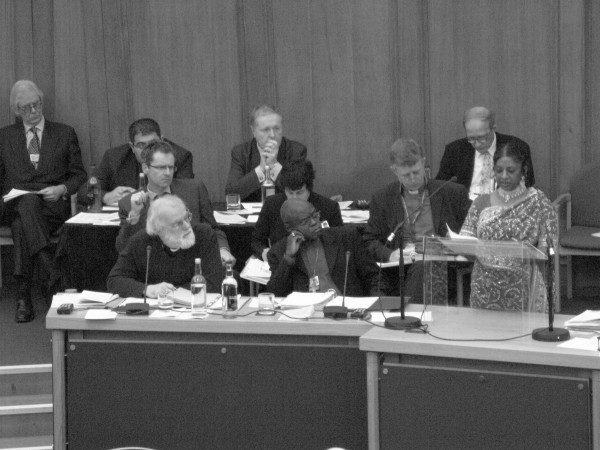
Ms Gnanadoss addressing the Synod
During the debate three amendments were moved but all were defeated.
Mr Justin Brett (Oxford) moved:
Leave out all the words after “That this Synod” and insert “affirm that membership of any organisation whose constitution, aims, objectives or pronouncements contradict the promotion of race equality is incompatible with the Apostolic Christian faith.”.
The Ven Norman Russell (Archdeacon of Berkshire) moved:
For the words “noting that in 2004” to “British National Party” substitute “recognising that every human being is made in the image of God”.
Leave out “comparable”; and
At the end insert “, which makes clear that racism has no place in the life of the Church.”.
Mr Tim Hind (Bath & Wells) moved:
Leave out “clergy, ordinands, and such employed lay persons as have duties that” and insert “persons whose duties”.
The voting on Tim Hind’s amendment was 166 in favour, 177 against and 11 recorded abstentions. The other two amendments were each defeated on a show of hands.
11 CommentsGeneral Synod – Archbishop of Canterbury's Presidential Address
The Archbishop of Canterbury gave his Presidential Address to General Synod this afternoon. Read it online here.
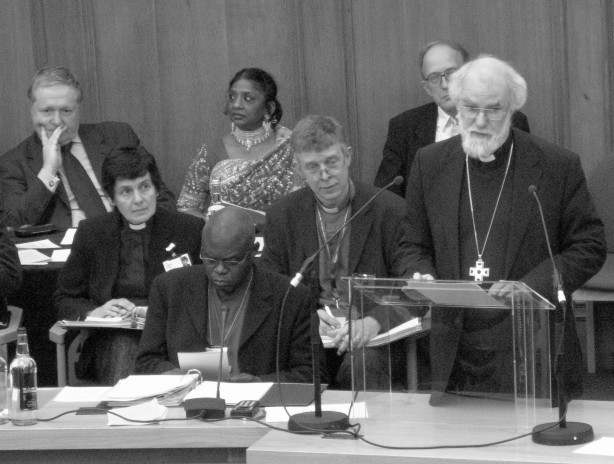
The Archbishop addressing the Synod
3 CommentsGeneral Synod – reports on day one
Updated again Tuesday evening
The official summary is at General Synod – Summary of Business Conducted on Monday 9th February 2009 PM.
This includes links to audio recordings of all the sessions. (When I tried, only one of them was working properly. Dave Walker had a similar problem with the live feed.)
There is also a link to the text of the speech by Cardinal Murphy-O’Connor. The press release from his office about this speech is here.
The Questions session is pretty difficult to understand on the audio, as the Questions, which are submitted in advance, and are available to everybody on the floor as a printed document, are not read out. It’s unclear why this document is not routinely made available beforehand on the web. The prepared Answers, which are read out, are not available in written form to those on the floor, but are available to the Press Gallery!
As the summary linked above says
46 written questions were submitted by members of the Synod. The text of these questions, alongside the written responses, will be available here within the next week.
For more colourful reporting of the afternoon, try some of these:
Ruth Gledhill General Synod Feb 2009: Day One and Times Online Cardinal Murphy-O’Connor: All churches “impoverished” by Anglican divisions
Martin Beckford Telegraph General Synod Day 1: Key Church of England meeting starts with debate on Catholic church and Cardinal Murphy-O’Connor calls on Anglicans to work with Roman Catholics against secular society.
Also George Pitcher Cardinal Murphy-O’Connor: United we stand and Damian Thompson Cardinal’s General Synod speech uses the loaded phrase ‘Ecclesial Community’ – meaning ‘not a Church’
BBC Cardinal ‘regrets’ CofE divisions
Justin Brett So what do you actually do at Synod, then?
Andrew Brown Is the Church of England together enough to split?
Tuesday updates
Comment is free Giles Fraser A week of terrible headlines
Unfortunately, during this synod, the Christian spirit is likely to be overshadowed by infighting and obscurantism…
Guardian Riazat Butt Calls for ecclesial unity amid homosexuality row (scroll down for this)
The Diocese of Lichfield has reports of two items in Questions, here, and here.
5 CommentsGeneral Synod – Weekend advance press reports
General Synod opened at 3 pm today. The following reports appeared over the weekend and earlier today.
Jonathan Wynne-Jones in the Telegraph Historic plans to introduce women bishops rejected by key traditionalist leaders
BBC Synod to discuss women bishops
Trevor Timpson at the BBC Waiting for the women bishops
Ruth Gledhill and Sean O’Neill in The Times Bishops resist moves to outlaw BNP membership
Ekklesia has Bishop backs ban on Church racism
Also at Ekklesia Church of England Synod to tackle key economic and social issues
George Pitcher in his Telegraph blog writes Will the General Synod ban golliwogs?
and Anglicans at their best when they’re boring
The Times also has Four decades of rule: How the General Synod works
11 Commentskeeping in touch with General Synod
Updated Tuesday morning
Thinking Anglicans is not the only place on the internet for learning what happens this week at General Synod.
The official GS website pages start here.
The unofficial General Synod Blog can be found here.
Premier Christian Radio will have a live audio feed of sessions.
The Church Times Blog is here.
We will add to this list any other sources that we learn about during the week.
2 CommentsCofE website wants user feedback
The Church of England website wants feedback from users.
See the press release What are you surfing for?
The Church of England is increasingly using a range of new media in order to enhance its web presence. So, the webmasters of the national Church of England web-site, recognising the need to engage directly with visitors to the site, have launched an on-line survey to gather visitors’ views.
It is available now at http://www.survey.bris.ac.uk/cofe/cofeweb and will be there until the end of March…
The site was designed by ILRT Bristol and launched in 2004.
TA readers are strongly encouraged to respond to the survey.
5 CommentsReview of Constitutions
Update Friday evening This cartoon by David Walker may assist those who are unfamiliar with the inner workings of Church House Westminster.
An interesting piece of business will start a process of consultation at General Synod on Tuesday of next week. This is a review of the constitutions of “bodies answerable to the Synod through the Archbishops’ Council”. These are
Board of Education
Committee for Minority Ethnic Anglican Concerns
Council for Christian Unity
Finance Committee
Committee for Ministry of and among Deaf and Disabled People
Deployment, Remuneration and Conditions of Service Committee
Ministry Council
Mission and Public Affairs Council
The proposals for consultation are in a paper (GS 1714 Review of Constitutions) available here as a PDF, and also here as a web page. In summary it is proposed to abolish the boards and replace them by a “lead person” and a “report and review” group elected by Synod and meeting once a year in July.
Glyn Paflin wrote about the proposals in the Church Times in a subscriber-only article last week. This is now generally available online: Newly ‘streamlined’ Council would shed old-style boards
The full procedure to be followed is described in the two paragraphs from the report of the business committee copied below the fold.
2 CommentsDioceses Commission begins review of structures
The Church of England issued the press release below recently. There is some general information about the Dioceses Commission part way down this page.
Dioceses Commission begins review of structures
29 January 2009Further provisions of the Dioceses, Pastoral and Mission Measure 2007 come into force on 1 February. The Measure makes it a duty of the Dioceses Commission to review the provincial and diocesan structure of the Church of England, including the size, boundaries and number of provinces and dioceses, and arrangements for episcopal ministry. It will also have the power to draw up reorganization schemes.
The Commission, chaired by Dr Priscilla Chadwick, consulted diocesan bishops as to what its priorities should be and drew up an initial work programme in the light of comments and suggestions.
The Commission will begin by examining the apparent anomaly whereby seven parishes wholly or partly within the area of the City of Peterborough unitary authority, with more than one third of the City’s population, are in the Diocese of Ely rather than that of Peterborough.
In the autumn of 2009, the Commission will commence a review of the boundaries of the five Yorkshire dioceses (Bradford, Ripon and Leeds, Sheffield, Wakefield and York). The aim will be to establish whether the shape and boundaries of the existing dioceses tend to facilitate the Church’s mission to the people and communities of Yorkshire or whether different boundaries would enable the Church to relate to them more effectively. The Commission has no agenda to reduce or increase the number of dioceses, but rather to ensure the best configuration to the communities that the dioceses serve, which could involve merging existing dioceses and/or creating new ones.
“The Commission is embarking on its review work with an open mind and a willingness to think radically, as well as an awareness of the need to be realistic,” said Dr Chadwick. “We have every confidence that the bishops and dioceses concerned will engage with the process in the same spirit.”
The Commission has a responsibility to consult widely. Its first step will be to seek the insights of the diocesan bishops, archdeacons and diocesan secretaries of the dioceses under review. It will then consult other leading clergy and laypeople of the dioceses, and representatives of any deaneries and parishes that might be affected by changes. Proposals for change will normally need the agreement of the diocesan synods concerned before going to the General Synod for decision. The Commission sees its role as one of helping the bishops, clergy and people of the Church of England in the areas concerned to come to a view as to how the Church can best be structured for mission in the 21st century.
Notes
In identifying the local communities to which the Church needs to relate, the Commission will look at how diocesan boundaries correlate with the boundaries of counties and unitary/metropolitan authorities and which configurations might best further the Church’s mission. It will also have in mind other factors. Among these are:
- the sense of local identity resulting from history and shared culture,
- contemporary communities reflecting the places between which people travel for work, shopping, leisure, education and health services,
- road and rail communication routes, and
- the accessibility and distance of cathedral cities by car and public transport from all parts of the diocese.
Two sections of Part II of the Measure remain to be brought into force at a later date: section 12 (which will place diocesan bishops under a duty to keep provision of episcopal ministry under review) and the related section 17 (which will enable the Commission, when a suffragan see falls vacant, to require that the approval of the General Synod would be needed before the see could be filled). The Commission’s present expectation is that these provisions will be brought into force towards the end of 2009.
One consequence of the start of the Commission’s work is that the General Synod’s business committee has decided to park* this diocesan synod motion from Bradford “for the moment while the new Dioceses Commission, recently established at the initiative of the Synod, is having its initial meetings to consider the first phase of its programme of work”.
That this Synod request the Archbishops’ Council to formulate proposals for reductions in the numbers of episcopal and senior clergy posts, taking into account reductions for the number of stipendiary clergy since 1979; and submit a report with recommendations to the General Synod within three years.
* Note: Diocesan Synod motions are normally taken in order of receipt, but can be “parked” by the Business Committee if it makes sense to delay their consideration until some other related business has been completed.
2 CommentsGeneral Synod – more press reports
Here is a follow-up to our first round-up of press reports on the agenda for next month’s meeting of the Church of England General Synod.
First, two subscriber-only items by Bill Bowder in last week’s Church Times are now generally available.
Synod to discuss ban on BNP membership
Diocesan motion expresses concerns after Eweida case
Synod will be debating the Financial Crisis and the Recession on 12 February. A report on what effect the crisis might have on the Church itself was sent to synod members a few days ago. The Church’s own finances will be debated by the synod in July.
Martin Beckford in the Telegraph Church of England calls for increased donations as recession hits finances
Bill Bowder in the Church Times Parishes hit for millions by crunch
The Church Times also has Leader: reasons to spend fatly in the lean years
The paper GS Misc 913 Financial Prospects for the Church of England is available here as a PDF, and also here as a web page.
One item on the synod agenda next month is a private member’s motion on church water bills. There have been several press reports on this topic recently.
Martin Beckford in the Telegraph Churches, Scout troops and sports clubs celebrate as water firm freezes ‘rain tax’
and ‘Rain tax’ means churches pay many times more than neighbouring businesses
Three items at the BBC
Churches fight drain on finances
Church begins ‘rain tax’ protest
Ministers fight church ‘rain tax’
Election of Church Commissioners
This press release was issued by the Church of England yesterday.
Elections to the Church Commissioners
28 January 2009In its current round of quinquennial elections to the Church Commissioners, the General Synod has appointed three clerical and four lay members.
They are:
House of Clergy
The Revd Canon Bob Baker
The Revd Jeremy Crocker (St Albans)
The Revd Stephen Trott (Peterborough)House of Laity
April Alexander (Southwark)
Peter Bruinvels (Guildford)
Gavin Oldham (Oxford)
Jacob Vince (Chichester)Note
Four members of the House of Bishops and two Deans were duly nominated for election as Commissioners. In both cases this was the number required and it was announced in December that the following therefore stood elected to serve as Church Commissioners from 1 January 2009 – 31 December 2013:
The Rt Revd David Urquhart, Bishop of Birmingham
The Rt Revd Mike Hill, Bishop of Bristol
The Rt Revd Dr Peter Forster, Bishop of Chester
The Rt Revd and Rt Hon Dr Richard Chartres, Bishop of LondonThe Very Revd Adrian Newman, Dean of Rochester
The Very Revd Dr Christopher Hardwick, Dean of Truro
The other Church Commissioners are
The Archbishop of Canterbury (chairman)
The Archbishop of York
The three Church Estates Commissioners (appointed by Her Majesty)
Andreas Whittam Smith, First Church Estates Commissioner
Sir Stuart Bell MP, Second Church Estates Commissioner
T E H Walker, Third Church Estates Commissioner
Three people nominated by Her Majesty
R H Powers
Canon J A Spence
J Wythe
Three people nominated by the Archbishops
P Harrison QC
Peter Parker
Nicholas Sykes
Three people Nominated by the Archbishops of Canterbury and York after consultation with the Lord Mayors of the Cities of London and York and the Vice-Chancellors of Oxford and Cambridge Universities
B Carroll
Sir Robert Finch
Revd Rachel E Harrison
Ex Officio
The First Lord of the Treasury
The Lord President of the Council
The Secretary of State for the Home Department
The Secretary of State for Culture, Media and Sport
The Speaker of the House of Commons
The Speaker of the House of Lords
Bishop Henry Scriven
Updated again Saturday morning
There have been several confusing reports about Bishop Henry Scriven’s status as a bishop.
ENS reported Presiding Bishop accepts two bishops’ voluntary renunciation of orders.
Religious Intelligence reported US Presiding Bishop deposes Church of England Bishop
…On Oct 16, Bishop Scriven wrote to Bishop Schori to inform her that he was returning to the Britain to take up the post of director of South American ministry for SAMS-CMS. Ordained in the Church of England, Bishop Scriven was consecrated in 1995 as Suffragan Bishop of the Diocese of Gibraltar in Europe by Archbishop George Carey. In 2002, Bishop Scriven became the Assistant Bishop of Pittsburgh in the Episcopal Church. Following Pittsburgh Bishop Robert Duncan’s deposition from office as Bishop of Pittsburgh on Sept 19, Bishop Scriven’s position in the US church was terminated.
In his letter, Bishop Scriven informed Bishop Schori he was returning to the UK to take up the SAMS-CMS post and had been appointed an Honorary Assistant Bishop and would be under the jurisdiction of the Bishop of Oxford.
In her response of Nov 12, Bishop Schori acknowledged that Bishop Scriven was now a Bishop of the Church of England, and said she would “release you from your orders in this Church” for reasons “not effecting moral character.” Bishop Schori added that she believed “that subtlety was lost on some of our Communion partners” over her understanding of canon law, as her action would not undo the “indelible” mark of ordination, but was a housekeeping action that would end his licence to serve in the US Church.
However, before Bishop Schori’s tenure as Presiding Bishop, bishops who left the US church to serve in other provinces were not released from their orders, but transferred to other churches…
The Episcopal Diocese of Pittsburgh has issued a statement:
An article that appeared on Episcopal Life Online on January 23, 2009 reported that Bishop Henry Scriven, the former Assistant Bishop for the Episcopal Diocese of Pittsburgh, had renounced his orders and that the Presiding Bishop of the Episcopal Church, Katharine Jefferts Schori, had accepted that renunciation. Although the article may suggest otherwise, the Standing Committee understands that this action was not in any sense a disciplinary action or an action taken because of Bishop Scriven’s support for the attempt to realign the Diocese with the Anglican Province of the Southern Cone.
Before he relocated to England, Bishop Scriven had submitted his resignation as a member of the House of Bishops of the Episcopal Church, inasmuch as he was planning to return to England and serve as Assistant to the Bishop of Oxford. In order to permit that, the Canons required that he be released from his orders in the Episcopal Church for reasons not affecting his moral character, which is what occurred. This is a routine way of permitting Bishop Scriven to continue his ministry. Orders in the Church themselves are indelible, but licensing is required to exercise them.
The Standing Committee gives thanks for the gracious way in which Bishop Scriven exercised his ministry in the Episcopal Church while he served here as Assistant Bishop and we hope he and his wife Catherine will visit us in the future.
Friday morning update
The Church Times has a report by Pat Ashworth ‘Really weird’, but Scriven bears no ill will on orders.
…Bishop Scriven described the letter he received in November releasing him from his orders as “really weird”. He retained it but did not respond to it. The promised certificate releasing Bishop Scriven from his orders did not reach him personally, “though, to be fair, she might have tried as I was wandering round the world,” he said on Wednesday.
The correspondence is now in the public domain. “I had no desire to publish these letters until the thing was announced but was then very happy for them to be released,” Bishop Scriven said. “Hers was a very gracious letter but I was kind of boggled by the language really. It’s two nations divided by the same language, it seems to me. I bear no ill will, and I think it’s a storm in a teacup really…
There is a further report from ENS which notes PITTSBURGH: Standing Committee acknowledges Scriven’s service to diocese.
The Anglican Communion Institute has published Is The Renunciation of Orders Routine?
Saturday update
Andrew Carey has also weighed in, see A dangerous move by the Americans.
8 CommentsGeneral Synod agenda – press reports
The Church Times has published a detailed report by Margaret Duggan on next month’s General Synod Agenda Financial crisis and ARCIC report feature on Synod agenda
One item was picked up by the secular press.
The Guardian Church of England may ban clergy from joining BNP
Martin Beckford in the Telegraph Vicars could be banned from membership of British National Party
And then there are two reports on an item that will not be debated this time because of a lack of interest from synod members:
Martin Beckford in the Telegraph Fix date of Easter to prevent ‘confusion and disruption’ over holidays, says clergyman
Steve Doughty in the Mail Church of England clerics want Easter date fixed for every year
CofE and the Covenant
The Church of England General Synod will be considering the Covenant again in February.
The two relevant documents are:
GS 1716 Anglican Covenant available here as a PDF, and also here as a web page.
GS Misc 910 The Governance of the Church of England and the Anglican Communion by Colin Podmore, available here as a PDF, and also here as a web page.
Last November, Mr Justin Brett asked a (written, electronic) Question, which is reported here:
Mr Justin Brett (Oxford) to ask the Secretary General:
Q2. What research has been undertaken to establish the effect of the Church of England’s participation in an Anglican Communion Covenant upon the relationship between the Church of England and the Crown, given the Queen’s position as Supreme Governor of the Church of England, and the consequent tension between her prerogative and the potential demands of a disciplinary process within the proposed Covenant?
Mr William Fittall to reply as Secretary General:
A. The Church of England response of 19 December 2007 to the initial draft Covenant noted on page 13 that ‘it would be unlawful for the General Synod to delegate its decision making powers to the primates, and that this therefore means that it could not sign up to a Covenant which purported to give the primates of the Communion the ability to give ‘direction’ about the course of action that the Church of England should take.’ The same would be true in relation to delegation to any other body of the Anglican Communion. Since as a matter of law the Church of England could not submit itself to any such external power of direction, any separate possible difficulties in relation to the Royal Prerogative could not in practice arise.
There is no reference in the new report to the point raised in this Q and A.
The report indicates that the House of Bishops believes the process of adoption of the Covenant should not involve the passing of any Measure or Canon, but rather the passing of a Synod resolution which should then be formally declared to be an Act of Synod. It also considers that such a resolution would most likely be both Article 7 and Article 8 business, and thus would require referral to the dioceses.
The Church of England’s earlier response to the (then) draft Covenant can be found here. The full text is available in html here.
The Church Times reported last year’s debate: Anglican Covenant: New Covenant draft welcomed more warmly.
The voting result at that time was reported here.
9 CommentsGeneral Synod Papers
Updated Tuesday 27 January and Thursday 29 January
Most papers for next month’s meeting of General Synod are now online. Links will be added to the list below as the remainder become available.
Agenda
Monday
Tuesday
Wednesday
Thursday
Friday
Special Agenda I – Legislative Business
Papers for debates
The scheduled day for debate is appended.
GS 1642B Draft Amending Canon No. 28 [Tuesday]
GS 1642C Petition for Her Majesty’s Royal Assent and Licence [Tuesday]
GS 1642Z Report by the House of Bishops
GS 1683B Draft Church of England (Miscellaneous Provisions) Measure [Tuesday]
GS 1683Z and Report by the Steering Committee
GS 1692A Draft Vacancies in Suffragan Sees and Other Ecclesiastical Offices Measure [Thursday]
GS 1693A Draft Crown Benefices (Parish Representatives) Measure [Thursday]
GS 1692-3Y Report by the Revision Committee
GS 1699 Revised Forty-Third Report of the Standing Orders Committee [Wednesday]
First Notice Paper
GS 1707 Women in the Episcopate [Wednesday]
GS 1708 Draft Bishops and Priests (Consecration and Ordination of Women) Measure [Wednesday]
GS 1709 Draft Amending Canon No. 30 [Wednesday]
GS 1710 Illustrative Code of Practice
GS 1708-10X Explanatory Memorandum
GS 1712 Report by the Business Committee [Monday]
GS 1713 Church as Communion [Monday]
GS 1714 Review of Constitutions [Tuesday]
GS 1715 Ecclesiastical Fees (Amendment) Measure [Tuesday]
GS 1715X Explanatory Memorandum
GS 1716 Anglican Covenant [Thursday]
GS 1717 Church of England Funded Pensions Scheme (Debt Apportionment) (Amendment) Rules 2008 [Thursday]
GS 1717X Explanatory Memorandum
GS 1718 Church of England Funded Pensions Scheme (Exclusion of ineligible Persons) (Amendment) Rules 2008 [Thursday]
GS 1718X Explanatory Memorandum
GS 1719 Implications of the Financial Crisis and the Recession [Thursday]
GS 1720 Inter Faith: Presence and Engagement [Thursday]
GS Misc 898 revised and GS Misc 898A Revised Diocesan Synod Motion: Voice of the Church in Public Life [Tuesday]
GS Misc 903A and GS Misc 903B Private Member’s Motion: Membership of Organisations which Contradict the Duty to Promote Race Equality [Tuesday]
GS Misc 904A and GS Misc 904B Private Member’s Motion: Church Water Bills [Wednesday]
GS Misc 905A and GS Misc 905B Uniqueness of Christ in Multi-Faith Britain [Wednesday]
GS Misc 906A and GS Misc 906B Diocesan Synod Motion: Human Trafficking [Wednesday]
GS Misc 907A and GS Misc 907B Diocesan Synod Motion: The Future of Church of England Retreat Houses [Thursday]
GS Misc 908A and GS Misc 908B Diocesan Synod Motion: Justice and Asylum Seekers [Friday]
GS Misc 909A and GS Misc 909B Diocesan Synod Motion: Climate Change and the Church’s property [Friday]
GS Misc 911A and GS Misc 911B Eucharistic Worship for Young People [contingency business]
Other papers circulated to members of the General Synod
GS Misc 900 The 36th Report of the Central Stipends Authority 2008
GS Misc 902 Update on Forecast Archbishops’ Council Expenditure 2008
GS Misc 910 The Governance of the Church of England and the Anglican Communion
GS Misc 912 Moral, But No Compass A Report to the C of E from the Von Hugel Institute Background paper from the Rt Revd Stephen Lowe, Bishop for Urban Life and Faith
GS Misc 913 Financial Prospects for the Church of England
GS Misc 914 Activities of the Archbishops’ Council
GS Misc 915 Reflections on how Decisions are Made
A Church of England Approach to the Unique Significance of Jesus Christ A paper prepared by Dr Martin Davie for the Theological Group of the House of Bishops
8 CommentsAre senior CofE bishops conservatives?
Andrew Brown thinks they are. Read his blog article, The conservatives take over the asylum, and the comments there.
The items to which this refers are:
21 CommentsGeneral Synod – February 2009
The General Synod of the Church of England will meet in London from 9 to 13 February 2009. The following press release was issued a short time ago.
NEWS from the Church of England
PR06.09
19/1/09
General Synod: February 2009
Key debates on the international financial crisis, women bishops, the Anglican Covenant, human trafficking, asylum, Anglican-Roman Catholic relations and inter faith relations
Major debates concerning the Church’s ministry and relations with other Churches, the financial crisis and the Church’s engagement with wider society will be on the agenda at the General Synod when it meets at Church House, Westminster from Monday to Friday, 9-13 February. The Synod will be debating a considerable amount of legislative business, including the first consideration stage of the draft women bishops legislation.
The International Financial Crisis
The Synod agenda provides opportunities for members to reflect on the international financial crisis and the recession. On the Tuesday afternoon, Andreas Whittam Smith (First Church Estates Commissioner) will facilitate presentations from and engage in dialogue with Lord Griffiths of Fforestfach and the Rt Revd Peter Selby. This will be an opportunity for the Synod to hear about and discuss with the two speakers the reasons for the crisis and its wider implications.
Brian Griffiths has been Vice Chairman of Goldman Sachs International since 1991 and a member of the Board since 2007. He was from 1984 to 1990 Head of Mrs Thatcher’s Policy Unit at No 10 Downing Street. He is the author of a number of books and. since 1997, has been Chairman of the Lambeth Fund. Peter Selby was, until 2007, Bishop of Worcester and a member of the Church Commissioners’ Assets Committee. He has been a member of the Doctrine Commission and has written on the subject of faith and economics.
On the Thursday afternoon there will be a debate, introduced by the Archbishop of York, examining the challenges and opportunities for the Church’s mission and ministry in communities that the international financial crisis and recession presents.
Women Bishops
Last July, the Synod agreed that draft legislation be prepared, including special arrangements for those who would not be able to receive the ministry of women as bishops (or priests) in a statutory national code of practice. The Women Bishops Legislative Drafting Group (chaired by the Bishop of Manchester) has completed its work on this basis and the Synod will be giving First Consideration to the draft legislation required to admit women to the episcopate.
It will not be possible to move amendments to the draft legislation at this Group of Sessions; the issue before the Synod will be whether to agree that the draft Measure and draft Amending Canon be referred for consideration by a Revision Committee. (See PR103/08 at http://www.cofe.anglican.org/news/pr10308.html.)
Anglican Covenant
The Churches of the Anglican Communion were asked in March 2008 if they were able, in principle, to commit to the Covenant process and to say if there were any elements which in their view would need extensive change in order to make viable the process of adoption by their Synods. The General Synod will consider a take note motion, moved by the Bishop of Rochester on behalf of the House of Bishops, on a report from the House, to which is attached a draft Church of England response to these questions. The draft response welcomes the direction of travel of the Covenant while flagging up a number of points which still require attention.
Anglican-Roman Catholic Relations
The Synod will be addressed on its first day by Cardinal Cormac Murphy-O’Connor, the Archbishop of Westminster. His address, together with an introduction by the Archbishop of Canterbury, will provide an opportunity for the Synod to reflect on relations between the Church of England and the Roman Catholic Church. This will lead to a debate, requested by the Synod, on the report by the Second Anglican-Roman Catholic International Commission on Church as Communion.
Inter Faith Relations
The Synod will consider a Private Member’s Motion from Mr Paul Eddy, which asks the House of Bishops to report to the Synod on their understanding of the uniqueness of Christ in a multi-faith society and to offer examples of good practice in sharing the gospel of salvation through Christ alone with people of other faiths and of none.
The Synod will also be considering the inter faith and engagement programme which it launched in July 2005 when it also set up a task group, chaired by the Bishop of Bradford. This second debate provides the Synod with an opportunity to take note of what has been achieved so far and the work that is proposed for the next phase of the Presence and Engagement programme
The Church in Public Life
There are three Diocesan Synod Motions particularly concerned with the Church’s engagement in wider society. The first, from Chester, is wide ranging in its concern about the role of the Church in civic society and asks the divisions of the Archbishops’ Council to report to the Synod on their work to foster a clearer understanding of the Christian faith among the institutions and organizations of society, and to reinforce the claims of the Church to take its place in public life.
The second motion, which has been passed in identical terms by the Newcastle and Winchester Diocesan Synods, urges the Church of England to deplore the continuing evil of human trafficking, to support the work of those who seek to end human trafficking and to rescue those trapped in it, and also to support the implementation of the UK Action Plan on Tackling Human Trafficking, particularly in relation to the 2012 Olympics. The debate will be preceded by a presentation which will include an invited speaker from the United Kingdom Human Trafficking Centre.
The motion from the Southwell and Nottingham Diocesan Synod asks the Synod to call on the Government to ensure that the treatment of asylum seekers is just and compassionate. In particular, it calls for the conferring of a right to work on all asylum seekers, and the declaration of an amnesty for legacy cases that predate the Government’s New Asylum Model. It also asks the Government to find a practical and humane remedy to the situation of refused asylum seekers who are unable to return to their country of origin because of personal safety, health or family reasons.
A Private Member’s Motion from Ms Vasantha Gnanadoss asks the House of Bishops to formulate and implement a policy for the Church of England under which clergy, ordinands and such employed lay persons as have duties that require them to speak on behalf of the Church should not be a member of an organization whose constitution, aims, objectives or pronouncements contradict the duty to promote race equality.
Property Issues for the Church
Three motions explore different aspects of the Church’s property and resources.
The Private Member’s Motion from Mr Martin Dales expresses concern about the effect on many parish churches of the sudden and very large rises in water charges for churches in some areas. It asks the Government to remind OFWAT of its obligations to ensure that the water companies adhere to the guidance given in 2000 by the Secretary of State for the Environment not to treat all non-household customers (including places of worship) as if they were businesses.
The Worcester Diocesan Synod Motion calls on the Archbishops’ Council to conduct an urgent review of the Endowments and Glebe Measure and other church legislation, with a view to enabling diocesan bodies and PCCs, in disposing of land, to give weight to environmental as well as financial considerations, particularly in relation to cutting carbon emissions.
A motion passed in the same terms by both the Leicester and Peterborough Diocesan Synods asks the Archbishops’ Council to review and make recommendations for the future sustainability of the Church of England retreat houses, and encourages church bodies to make full use of these resources.
Other Business
The Archbishop of Canterbury will give a Presidential Address, which will include a reflection on the recent Lambeth Conference.
A report from the Standing Orders Committee proposes some adjustments to the Synod’s procedures. There will also be a presentation on some proposed changes to the constitution of bodies answerable to the Synod through the Archbishops’ Council.
Communicating Synod
Parishioners can keep in touch with the General Synod while it meets. Background papers and other information will be posted on the Church of England website (www.cofe.anglican.org) ahead of the General Synod sessions. Audio files of debates, along with updates on the days’ proceedings will be posted during the sessions.
ends
17 Commentsfrom the National Archives
Last week, the Church Times had a feature about theNational Archives at Kew, and the government documents that reveal the relationship between the state and the Church of England in the 20th century.
First, see Treasures buried in the archive by A.D. Harvey.
Then, read the full text of a 1960 memorandum from David Stephens, the Prime Minister’s appointments secretary, to Harold Macmillan about the filling of vacant sees.
A quiet word about the next archbishop.
3 Comments