General Synod on BBC TV
The BBC Parliament Channel will show recordings of last week’s General Synod sessions on Friday 20 February. A schedule is available here.
BBC Parliament is shown on UK digital terrestrial television (Freeview) channel 81, on digital cable and on satellite at channel 504, as well as on the broadband media player. More information here.
0 CommentsGeneral Synod – further reports
Updated Tuesday
The Church Times has two articles available without subscription. (There will be many more in the next two weeks as detailed reports become available to non-subscribers.)
Approval of women bishops clears its latest hurdle
Also, the Church Times blogger Dave Walker has some “behind the scenes” pictures.
Justin Brett now blogging as The Dodgy Liberal has written here about the debate on the Uniqueness of Christ last Wednesday.
Martin Beckford wrote at the Telegraph Synod: The temple of money and the altar of multi-faith dialogue.
George Pitcher at the Telegraph wrote Whittam Smith predicts Armageddon.
Tuesday updates
Justin Brett wrote a further article, see Synodical Ruminations Part 1 (Covenant) and see also the MCU document produced for this debate, at Briefing Paper for General Synod Members February 2009 (PDF).
And also another one on Synodical Ruminations Part 2 (BNP Etc.)
1 Commentmore about Jenny and Jasmine
In my Saturday roundup of opinion pieces I included the article that Archbishop Sentamu wrote in the Daily Mail. One of the cases that he referred to there was the case of Jenny Cain and her daughter. The Telegraph reported this under the headline Primary school receptionist ‘facing sack’ after daughter talks about Jesus to classmate.
This case has given rise to criticism of the school, for example, according to the Telegraph:
John Sentamu said it was an “affront to the sensibility” of Christians everywhere that Jennie Cain is being investigated for alleged professional misconduct after she sent a private email to 10 friends asking for prayer.
And there was also Christian school receptionist row: More bishops speak out in support of Jennie Cain.
George Pitcher followed up with an opinion piece headed Christians need protection in law.
Other reports of the incident give a rather different picture. See for example:
Exeter Express & Echo Girl, 5, told off at school for talking of God followed the next day by Parents back head’s stance in storm over ‘go to hell’ comment
BBC School row over pupil’s God talk
Ekklesia School defends stance on girl who told classmate she would “go to hell”
Simon Barrow has written this comment article at Ekklesia Scaring the hell out of kids?
29 Comments… Perhaps those Christians who object to the school wanting to maintain a non-threatening environment should ask themselves how they would feel if a son of theirs ended up crying after being told by an atheist pupil that religious people are nuts and should be locked up? Or if their daughter was upset by a Muslim telling her she would suffer eternally for not believing in Allah and his Messenger?
In both these cases, there would be an outcry if the school did nothing, or if it said that that their kids would have to put up with being frightened, because trying to stop this would amount to “not showing respect for beliefs”…
General Synod – reports on day five
The official report of Friday morning’s business is at General Synod – Summary of Business Conducted on Friday 13th February 2009 AM.
Press reports:
BBC Church call for asylum law change
Martin Beckford Telegraph Church of England General Synod calls asylum seeker amnesty
Ruth Gledhill General Synod Feb 09 Day Five
Nottingham Evening Post City priest’s call for asylum seeker rights
Alastair Cutting Asylum and Sanctuary
We will update this as more reports are published.
0 CommentsGeneral Synod – Asylum Seekers and Climate Change
The final morning (Friday) of Synod was devoted to two diocesan synod motions.
The first, from Southwell & Nottingham, was about Justice and Asylum Seekers. The Revd Ruth Worsley moved the motion:
That this Synod, continuing to affirm scriptural teaching about care for the vulnerable, welcome for strangers and foreigners, and the Church’s calling to reach out to the marginalized and persecuted, call upon Her Majesty’s Government:
(a) to ensure that the treatment of asylum seekers is just and compassionate, and to that end to consider:
(i) conferring a right to work on all asylum seekers, and
(ii) declaring an amnesty for so called ‘legacy cases’ that predate the Government’s New Asylum Model;(b) to find a practical and humane remedy to the intolerable situation of destitute ‘refused’ asylum seekers who are unable to return to their country of origin because of personal safety, health or family reasons.
This was amended, by changing some of the wording, and adding (iii) and (c) so that the substantive motion became
That this Synod, continuing to affirm scriptural teaching about care for vulnerable people, welcome for strangers and foreigners, and the Church’s calling to reach out to the marginalized and persecuted, call upon Her Majesty’s Government:
(a) to ensure that the treatment of asylum seekers is just and compassionate, and to that end to:
(i) confer a right to work on all asylum seekers,
(ii) declare an amnesty for so called ‘legacy cases’ that predate the Government’s New Asylum Model, and
(iii) bring to an end the practice of detaining children and families in Immigration Removal Centres;(b) to find a practical and humane remedy to the intolerable situation of destitute ‘refused’ asylum seekers who are unable to return to their country of origin because of personal safety, health or family reasons;
(c) to investigate and report publicly on the quality of the legal services provided to asylum seekers.
The amended motion was then carried by 242 votes to one against (with one recorded abstention).
The second motion, from Worcester, was about Climate Change and the Church’s Property Transactions and was proposed by the Bishop of Dudley:
That this Synod call on the Archbishops’ Council to conduct an urgent review of the Endowments and Glebe Measure and other relevant Church legislation, with a view to bringing forward at the earliest possible opportunity any amendments needed to enable diocesan bodies and PCCs lawfully to dispose of land on terms which give proper weight to environmental considerations as well as financial ones, and so enable the Church to give a stronger moral lead in achieving Her Majesty’s Government’s objectives in cutting carbon emissions.
After debate this motion was defeated. 83 members voted for the motion and 98 against. There were 18 recorded abstentions.
0 CommentsGeneral Synod – Retreat Houses
The final business at Synod this (Thursday) afternoon was a diocesan synod motion on the future of Church of England retreat houses.
The Ven Richard Atkinson (Leicester) moved on behalf of the Leicester Diocesan Synod:
That this Synod
(a) celebrate the contribution of the Diocesan Retreat Houses to the Retreat Movement, and to the mission of the Church and the spiritual well-being of the nation;
(b )in the light of the closure of several Diocesan Retreat Houses, invite the Archbishops’ Council to review and to make recommendations for the future sustainability and development of the remaining Diocesan Retreat Houses; and
(c) encourage the Archbishops’ Council and the other National Church Institutions, Dioceses, regional training partnerships and parishes to make full use of the Diocesan Retreat Houses for retreat, prayer, study, conferences and creative thinking for the future.
Mr Brian Newey (Oxford) moved as an amendment:
Leave out paragraph (b).
This amendment was carried on a show of hands so that the substantive motion became
That this Synod
(a) celebrate the contribution of the Diocesan Retreat Houses to the Retreat Movement, and to the mission of the Church and the spiritual well-being of the nation; and
(b) encourage the Archbishops’ Council and the other National Church Institutions, Dioceses, regional training partnerships and parishes to make full use of the Diocesan Retreat Houses for retreat, prayer, study, conferences and creative thinking for the future.
At the end of the debate the amended motion was carried nem con on a show of hands.
Background papers
from the Diocese of Leicester and the Diocese of Peterborough (GS Misc 907A)
by the Secretary General (GS Misc 907B)
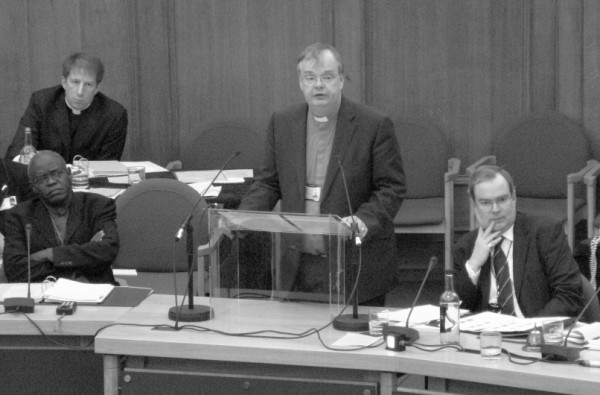
The Ven Richard Atkinson proposing the motion
0 CommentsGeneral Synod – reports on day four
Updated Friday morning
The official summary of the morning’s business is at General Synod – Summary of Business Conducted on Thursday 12th February 2009 AM
And for the afternoon, there is General Synod – Summary of Business Conducted on Thursday 12th February 2009 PM
Martin Beckford in the Telegraph Workers who lose jobs will escape ‘Crackberry culture’
Ruth Gledhill in the Times Bishop of London says that redundancy is good for the soul
Avril Ormsby at Reuters ‘We are all to blame for financial crisis’ – archbishop
BBC Church leaders focus on recession
Further updates
ENS In England, Anglican covenant debate reveals mixed expectations by Matthew Davies
Ekklesia Global economy hits poorest hardest, archbishop tells Synod
Ruth Gledhill General Synod Feb 09 Day Four
Justin Brett In Praise of the Tom Wright Sound-Bite
Alastair Cutting A jar, an empty cupboard, and kissing the hand of the Queen
7 CommentsGeneral Synod – Inter Faith: Presence and Engagement
The second item of business this afternoon (Thursday) was a debate on the report Inter Faith: Presence and Engagement (GS 1720)
The motion, proposed by the Bishop of Bradford, was “That the Synod do take note of this report”. The motion was passed on a show of hands.
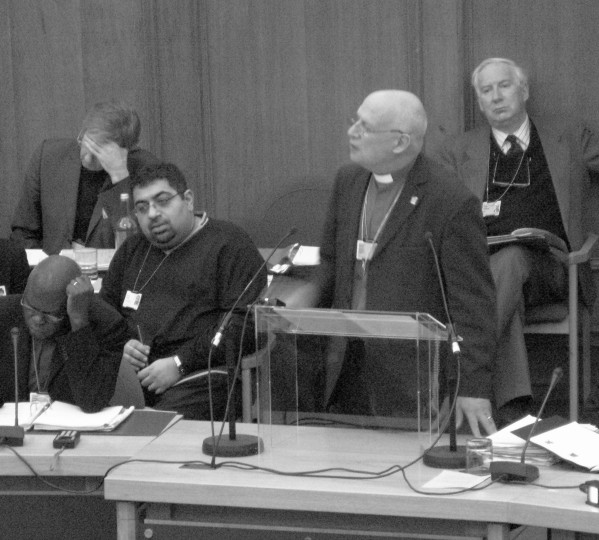
The Bishop of Bradford introducing the debate
1 CommentGeneral Synod – Financial Crisis and the Recession
This afternoon (Thursday) Synod debated the report Implications of the financial crisis and the recession (GS 1719). Also relevant is the paper by Andreas Whittam Smith that we linked to here.
The Archbishop of York moved:
That the Synod do take note of this Report
The Archbishop’s speech is here.
The motion was carried.
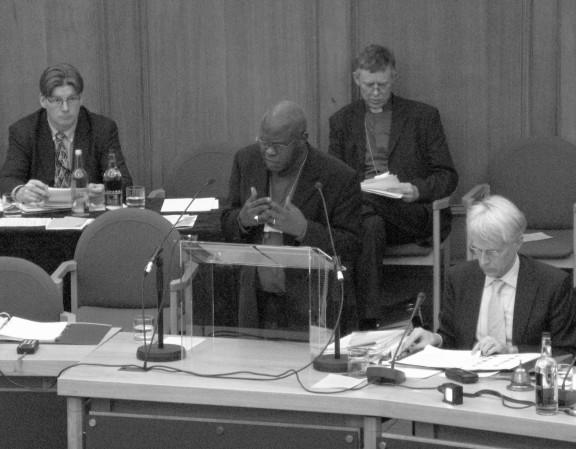
The Archbishop of York speaking in the debate
0 CommentsCredit Crunch explained
Updated Thursday lunchtime
An extremely useful paper written by Andreas Whittam Smith provided for the debate held on Tuesday is now available on the CofE website.
See GS Misc 916 THE INTERNATIONAL FINANCIAL CRISIS AND THE RECESSION.
Update We have now added this paper as a webpage.
1 CommentGeneral Synod – Human Trafficking
The final item of business on Wednesday evening was a Diocesan Synod motion from Newcastle on Human Trafficking.
The Revd Canon Michael Webb (Newcastle) moved:
That this Synod, in celebrating the centenary of the death of Josephine Butler, who is remembered in the Calendar on May 30th:
(a) recognize and deplore the continuing evil of human trafficking, especially of children and young people;
(b) urge the Church of England to support the work of those who seek to end the traffic and rescue those trapped in it; and
(c) support the vigorous implementation of the UK Action Plan on Tackling Human Trafficking and, in particular, call on HM Government to ensure that effective measures are in place to prevent sex workers being trafficked into Britain during the 2012 Olympics.
The following amendment was moved by Canon Ann Turner (Europe) and carried on a show of hands.
At the end insert as a new paragraph:
(..) request the Archbishops’ Council to explore the possibility of affiliating to the United Kingdom Human Trafficking Centre in order to combat this traffic as an urgent priority.”.
This made the Substantive motion into:
That this Synod, in celebrating the centenary of the death of Josephine Butler, who is remembered in the Calendar on May 30th:
(a) recognize and deplore the continuing evil of human trafficking, especially of children and young people;
(b) urge the Church of England to support the work of those who seek to end the traffic and rescue those trapped in it;
(c) support the vigorous implementation of the UK Action Plan on Tackling Human Trafficking and, in particular, call on HM Government to ensure that effective measures are in place to prevent sex workers being trafficked into Britain during the 2012 Olympics; and
(d) request the Archbishops’ Council to explore the possibility of affiliating to the United Kingdom Human Trafficking Centre in order to combat this traffic as an urgent priority.
The motion was carried on a show of hands.
There was a second proposed amendment, moved by the Revd Mark Sowerby (Ripon & Leeds).
After paragraph (a) insert as a new paragraph:
“(b) recognize and deplore the male abuse of women, which is the root cause of this evil trade;”.
It was defeated by 95 votes to 114 with 12 recorded abstentions.
Background papers
by the Dioceses of Newcastle and Winchester, and the Diocese in Europe (GS Misc 906A)
from the Mission and Public Affairs Division (GS Misc 906B)
General Synod – Uniqueness of Christ in Multi-Faith Britain
The second item of Wednesday afternoon was a private member’s motion on the uniqueness of Christ in multi-faith Britain.
Mr Paul Eddy (Winchester) moved:
That this Synod request the House of Bishops to report to the Synod on their understanding of the uniqueness of Christ in Britain’s multi-faith society, and offer examples and commendations of good practice in sharing the gospel of salvation through Christ alone with people of other faiths and of none.
The Revd Christopher Strain (Salisbury) moved as an amendment:
After “That this Synod” insert:
“warmly welcome Dr Martin Davie’s background paper ‘The witness of Scripture, the Fathers and the historic formularies to the uniqueness of Christ’ attached to GS Misc 905B and”.
This amendment was carried on a show of hands.
This made the substantive motion:
That this Synod warmly welcome Dr Martin Davie’s background paper ‘The witness of Scripture, the Fathers and the historic formularies to the uniqueness of Christ’ attached to GS Misc 905B and request the House of Bishops to report to the Synod on their understanding of the uniqueness of Christ in Britain’s multi-faith society, and offer examples and commendations of good practice in sharing the gospel of salvation through Christ alone with people of other faiths and of none.
The motion was carried by 283 votes to 8 with 10 recorded abstentions.
Background papers
background note from the Secretary General (GS Misc 905B) to which is attached a paper from Dr Martin Davie
A Church of England Approach to the Unique Significance of Jesus Christ A paper prepared by Dr Martin Davie for the Theological Group of the House of Bishops
During the debate the following two amendments were defeated.
The Revd Canon Simon Bessant (Sheffield) moved as an amendment:
Leave out all the words after “That this Synod” and insert:
“remembering its resolution of 6 July 2002, affirm:
(a) the process started by Presence & Engagement (GS 1577); and
(b) that all Christians should seek to witness faithfully to Christ and His Gospel to all, whilst also building strong friendships and partnerships with other faith communities in seeking peace, justice and the common good throughout society;
and ask that Ministry Division and the Mission & Public Affairs Division report on progress on this matter.”.
The 2002 resolution is copied below the fold. This amendment was lost on a show of hands.
The Revd Canon Andrew Dow (Gloucester) moved as an amendment:
Leave out all the words after “That this Synod” and insert:
“, recognising the uniqueness of Jesus Christ as the only Saviour as a foundational tenet of the Apostolic Christian Faith, request the House of Bishops to commission a report for Synod giving details of current Church of England based evangelistic ministry among those of other faiths, providing guidelines for this particular outreach, and highlighting examples of good practice.”.
This amendment was lost on a show of hands.
11 CommentsGeneral Synod – Church Water Bills
The first item of business this afternoon (Wednesday) was a private member’s motion about Church Water Bills.
Martin Dales (York) moved:
That this Synod, concerned about the effect on many parishes of sudden, massive rises in water charges for churches, request HM Government to remind OFWAT of its obligations to ensure that the water companies adhere to the clear guidance given by the Secretary of State for the Environment in 2000, which states that “there are many non-household users who are not businesses … including places of worship … and it would be inappropriate to charge all non-household customers as if they were businesses”.
The motion was carried by votes 282 to nil with three recorded abstentions.
The amendment below was proposed by Timothy Cox (Blackburn) but was defeated on a show of hands.
Leave out all the words after “concerned about the” and insert:
“devastating impact of massive rises in the sewerage charges for places of worship, charities, not-for-profit clubs and voluntary organisations, request HM Government to issue new guidance to OFWAT and the water companies to:
(a) treat not-for-profit organisations, charities, places of worship, community halls etc differently from businesses and provide concessionary rates for surface and foul water drainage for these bodies; and
(b) spread the cost of highways drainage solely upon for-profit organisations.”.
Background papers
from Martin Dales (GS Misc 904A)
by the Secretary General (GS Misc 904B)
General Synod – Women Bishops legislation
Updated Thursday at 13.00 GMT to include the Archbishop of Canterbury’s contribution to the debate
After a service of Holy Communion the Synod spent the rest of Wednesday morning debating the proposed legislation to permit the ordination of women as bishops.
The draft legislation was prepared on the basis of the motion passed at Synod in July 2008. (See the end of our July item here for the text of the motion.)
There were two motions before Synod, both proposed by the Bishop of Manchester (the Rt Revd Nigel McCulloch):
That the Measure entitled “Bishops and Priests (Consecration and Ordination of Women) Measure” be considered for revision in committee.
This motion was carried by 281 votes to 114 with 13 recorded abstentions. A request for a vote by houses was unsuccessful as fewer than 25 members wanted this.
That the Amending Canon entitled “Amending Canon No 30” be considered for revision in committee.
This motion was also carried – by 309 votes to 79 with 14 recorded abstentions
Both votes were taken electronically and voting lists will be available later (and we will publish them).
Archbishop of Canterbury’s speech
These are the papers for the debates.
Women in the Episcopate (GS 1707)
Draft Bishops and Priests (Consecration and Ordination of Women) Measure (GS 1708)
Draft Amending Canon No. 30 (GS 1709)
Illustrative Code of Practice (GS 1710)
Explanatory Memorandum (GS 1708-10X)

The Bishop of Manchester addressing the Synod
9 CommentsGeneral Synod – reports on day three
Revised Thursday 00.30 GMT and 12.55 GMT
The official summary of the morning’s business is at General Synod – Summary of Business Conducted on Wednesday 11th February 2009 PM.
The official summary of the afternoon’s business is at General Synod – Summary of Business Conducted on Wednesday 11th February 2009 AM.
Ruth Gledhill and Alastair Cutting (or Justin Brett) and Peter Ould have been blogging during the morning debate.
General Synod Feb 09: Day Three
and
Women Bishops: Blogging It Live
and
Live Blogging Synod
Guardian Riazat Butt Church of England will not see first female bishops until 2014
BBC Women bishops pass first hurdle
Religious Intelligence Toby Cohen General Synod vote sees women bishops take a step closer
Dave Walker has a cartoon about it, here. He also posted this.
Matthew Davies ENS Church of England inches closer to approving women bishops
Reuters Avril Ormsby Synod avoids cataclysm over women bishops
Water Bills
The same three bloggers are here, here, and here.
Martin Beckford Church ‘raintax’ is crippling parishes, admits head of Ofwat
Not actually a report from synod, but relevant is this Guardian report, Minister orders water companies to review huge ‘rainwater tax’ bills by Jenny Percival.
Waste water cartoon by Dave Walker
Ruth Gledhill The Times Churches face closure over water bills
Uniqueness of Christ
Peter Ould blogged here.
Ruth Gledhill The Times Anglicans called on to convert non-Christian believers
Martin Beckford Telegraph Christianity in decline because of political correctness
Later reports:
Guardian Riazat Butt Church throws open female bishops dispute and a sidebar, Women in the church
Church Times blog Dave Walker Video and news links from General Synod Day 4
Martin Beckford A new anti-atheist bus slogan coined at General Synod
2 CommentsGeneral Synod: preparing for Wednesday morning
Judith Maltby has written for Comment is free Women bishops now.
The Church of England cannot justify continued discrimination against its female members…
…A number of cross-party parliamentarians in both houses are making it clear that they will not vote into the law any measure from General Synod which discriminates against women. Imagine: lawmakers who do not want discrimination against women enshrined in the law of the land. Who do these people think that they are? Where is their sense of right and wrong?
A recent Church of England report suggested that the Labour government was had lost its moral compass. Might one suggest that the moral compass of these parliamentarians is working rather better than the Church of England’s? Could it be time to take the plank out of our own eye?
Religious Intelligence has Church of England’s treatment of women “shameful”, General Synod is told by Judy West.
..The Rev Dr Threlfall-Holmes, General Synod member for Durham and Newcastle Universities, said: “It is shameful that the Church of England still treats women as a problem to be solved.
“The draft legislation coming before Synod on Wednesday was always going to be a compromise between gender equality and the desire in the church to ‘protect’ those who disagree with the ordination of women. So in that sense what we have before us is about what was to be expected.
“But we will need to be very careful not to be misled into setting up a separate ‘church within a church’ in a misguided attempt to secure unity.”
The Northumberland Gazette has Church ‘tone’ on women bishops criticised.
5 Comments…Dr Miranda Threlfall-Holmes criticised the “tone” of legislation on women bishops to be debated on Wednesday by the General Synod, the Church’s national assembly.
She said: “I think it is a shame that we continue to give more emphasis to the people who are a very vocal minority that disagree than to the huge majority who just want to get on with it.
“It is sending a very negative impression…
General Synod – Voice of the Church in Public Life
The last item of business this afternoon was a debate on a diocesan synod motion about the voice of the church in public life.
The Revd Canon David Felix (Chester) moved on behalf of the Chester Diocesan Synod:
That this Synod, mindful of the questions raised in public debate about the role of the Church in civic society, invite the Divisions of the Archbishops’ Council to report to the General Synod, before the end of the quinquennium, on their work:
(a) to foster clearer understanding of the Christian faith among the institutions and organisations of society; and
(b) to reinforce the claims of the Church to take its place in public life in Britain.
The Revd Canon Pete Spiers (Liverpool) moved as an amendment:
Leave out everything after “civic society” and insert:
“and believing that the most effective way to communicate the role of Christian faith in public life is through the witness and service of Christian men and women in their daily lives:
(a) affirm the work of the House of Bishops and the divisions of the Archbishops’ Council in fostering the understanding of the Christian faith among institutions and organisations in society;
(b) request the Business Committee to consider how the issues raised in Moral, But No Compass might best be debated; and
(c) urge the members of this Synod actively to promote public engagement in their dioceses and parishes to reinforce the values of the Christian faith.”.
This amendment was carried on a show of hands.
The substantive motion therefore became:
That this Synod, mindful of the questions raised in public debate about the role of the Church in civic society and believing that the most effective way to communicate the role of Christian faith in public life is through the witness and service of Christian men and women in their daily lives:
(a) affirm the work of the House of Bishops and the divisions of the Archbishops’ Council in fostering the understanding of the Christian faith among institutions and organisations in society;
(b) request the Business Committee to consider how the issues raised in Moral, But No Compass might best be debated; and
(c) urge the members of this Synod actively to promote public engagement in their dioceses and parishes to reinforce the values of the Christian faith.
The motion was carried overwhelmingly on a show of hands.


Canon Felix (left) and Canon Spiers (right) speaking during the debate
0 CommentsGeneral Synod – reports on day two
We will update this page as new reports appear.
The official summary of the morning’s business is at General Synod – Summary of Business Conducted on Tuesday 10th February 2009 AM.
The official summary of the afternoon’s business is at General Synod – Summary of Business Conducted on Tuesday 10th February 2009 PM.
We have already linked to the Archbishop of Canterbury’s presidential address and referred to the debate on BNP membership.
Riazat Butt in The Guardian Church of England votes to ban BNP clergy
BBC Synod votes in favour of BNP ban
Avril Ormsby at Reuters Church of England bans far-right party membership
Ruth Gledhill in the Times Credit crunch is ‘doomsday’ scenario says CoE finance chief
Martin Beckford in the Telegraph Church of England investment chief warns of financial crisis ‘doomsday machine’
Justin Brett Anatomy of a Debate: Part 1
Dave Walker General Synod Day 2
Ruth Gledhill General Synod Feb 09: Day Two and Britain heading for ‘doomsday’ says C of E finance chief
Colin Coward General Synod Day 2 – Archbishop of Canterbury Presidential Address
ENS Matthew Davies Archbishop of Canterbury spotlights challenges, priorities of ‘imperfect’ communion (includes link to video of the Presidential Address)
Daily Mail Steve Doughty Church of England votes to ban vicars from belonging to BNP
George Pitcher Church’s BNP ban is silly and pointless
Savi Hensman Choosing Christianity over racism
5 CommentsGeneral Synod: Membership of Organisations which contradict the duty to promote race equality
Updated Thursday to add the voting figures on one amendment.
This afternoon General Synod debated a private member’s motion about membership of organisations which contradict the duty to promote race equality. It was proposed by Ms Vasantha Gnanadoss of the diocese of Southwark. This is her motion:
That this Synod, noting that in 2004 the Association of Chief Police Officers adopted a policy whereby
“no member of the Police Service, whether police officer or police staff, may be a member of an organization whose constitution, aims, objectives or pronouncements contradict the general duty to promote race equality” and “this specifically includes the British National Party”,
request the House of Bishops to formulate and implement a comparable policy for the Church of England, to apply to clergy, ordinands, and such employed lay persons as have duties that require them to represent or speak on behalf of the Church.
The motion was carried by 322 votes to 13 with 20 recorded abstentions.
Background Papers
GS Misc 903A from Vasantha Gnanadoss
GS Misc 903B from the Secretary General
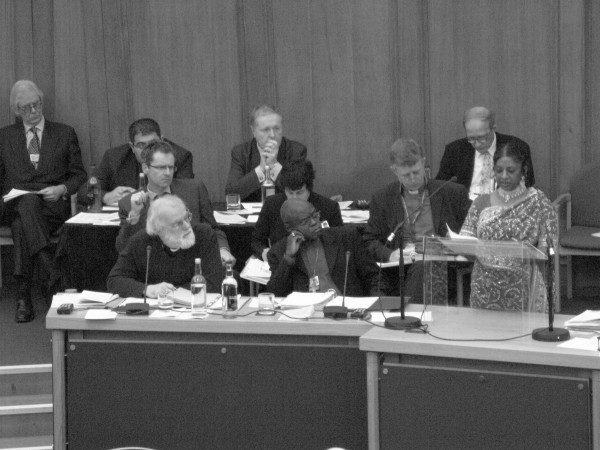
Ms Gnanadoss addressing the Synod
During the debate three amendments were moved but all were defeated.
Mr Justin Brett (Oxford) moved:
Leave out all the words after “That this Synod” and insert “affirm that membership of any organisation whose constitution, aims, objectives or pronouncements contradict the promotion of race equality is incompatible with the Apostolic Christian faith.”.
The Ven Norman Russell (Archdeacon of Berkshire) moved:
For the words “noting that in 2004” to “British National Party” substitute “recognising that every human being is made in the image of God”.
Leave out “comparable”; and
At the end insert “, which makes clear that racism has no place in the life of the Church.”.
Mr Tim Hind (Bath & Wells) moved:
Leave out “clergy, ordinands, and such employed lay persons as have duties that” and insert “persons whose duties”.
The voting on Tim Hind’s amendment was 166 in favour, 177 against and 11 recorded abstentions. The other two amendments were each defeated on a show of hands.
11 CommentsGeneral Synod – Archbishop of Canterbury's Presidential Address
The Archbishop of Canterbury gave his Presidential Address to General Synod this afternoon. Read it online here.
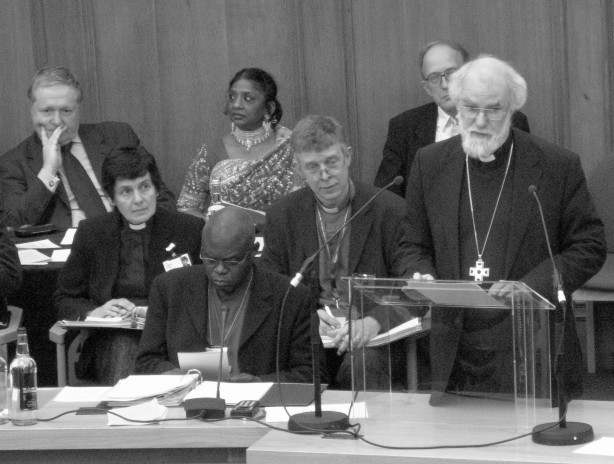
The Archbishop addressing the Synod
3 Comments