Updated again Monday morning
Ruth Gledhill reports in The Times about an article to be published on Saturday by Rowan Williams.
Her blog entry: Archbishop of Canterbury: ‘Stop humiliating our MPs.’
Her preview article, with video: Archbishop of Canterbury Dr Rowan Williams: humiliation of MPs must stop
Here is the article itself: Enough humiliation. We must move on by Rowan Williams.
Updates Saturday
The Independent has a leader agreeing with the archbishop, The pursuit of MPs is becoming a witch-hunt.
The Telegraph has an article headlined MPs’ expenses: politicians and church leaders defend Telegraph’s investigation which reports the opinions others, including Lord Carey and the Bishop of Rochester, and opening with:
There was strong opposition to a call from Dr Rowan Williams, the Archbishop of Canterbury, for an end to the “systematic humiliation” of MPs, which he claimed was undermining democracy…
Ekklesia has published Poll challenges Archbishop’s idea that expenses scandal is bad for democracy and You’re missing the point, archbishop told over scandal-hit MPs. And also Public backs independent candidates to challenge failing system.
Update Monday morning
George Pitcher has some interesting comments about all this, in the Telegraph. See MPs’ expenses: Things the Archbishops never told us.
13 Comments…unbeknown to either of us, as we were talking a column by his successor to the See of Canterbury, Dr Rowan Williams, was being put to bed by The Times, along with the headline: “Archbishop appeals for end to MPs’ humiliation”.
When I relayed the headline to Lord Carey later, he said he was “surprised that Rowan is taking this approach”. So, presumably, was Dr Williams. Because actually he had said nothing of the sort.
Reports are now available (PDF files) concerning
Download these and earlier reports from this page.
See earlier article with some background.
19 CommentsUpdated Wednesday
Monday 18 May 2009
Canonry of St Paul’s CathedralThe Queen has approved that the Reverend Canon Giles Anthony Fraser, MA, PhD, Team Rector of St Mary’s Putney, in the diocese of Southwark and Honorary Canon of Sefwi-Wiawso, Ghana, be appointed to a Residentiary Canonry of St Paul’s Cathedral in succession to the Reverend Canon Edmund John Newell, BSc (Econ), DPhil, MA, FRHistS.
Notes for the Editors
The Reverend Dr Fraser (aged 45), was educated first at Newcastle University and then at Oxford University. He studied for his PhD at Lancaster University. He trained for the ministry at Ripon College. His first curacy was at Streetly, in the Lichfield diocese from 1993 to 1997. From 1997 to 2000 he was a curate at St Mary Virgin with St Cross and St Peter, in Oxford diocese, and was also Chaplain at Wadham College Oxford. From 2000 to 2004 he was Vicar at St Mary’s Putney in the diocese of Southwark before becoming Team Rector in 2004. Since 2009 he has been Honorary Canon at Sefwi-Wiawso in Ghana.
Dr Fraser is married to Sally and they have three children. His interests are golf and cooking.
And from the Diocese of London:
Giles Fraser becomes Canon Chancellor at St Paul’s
18/05/09The Revd Dr Giles Fraser, currently Vicar of Putney in the Diocese of Southwark, is to be the next Canon Chancellor of St Paul’s Cathedral.
As Canon Chancellor, Dr Fraser will oversee the work of the St Paul’s Institute for ethics, and its ambitious, outward-facing programme. He will play a full part in the life of the cathedral and will contribute to its overall mission as a place of prayer, pilgrimage and debate.
Dr Fraser (45) was educated at Newcastle and Oxford before being ordained into the Oxford Diocese in 1993. He worked as a parish priest and chaplain in Oxford until 2000 when he moved to Putney in south London.
In recent years, he has developed a reputation for facing difficult issues head on in his weekly column in the Church Times and as a regular presenter on BBC Radio 4’s Thought for the Day. He is the author and co-author of several books.
A passionate Anglican, he is regarded as a priest with a rare ability to identify those issues which non church goers find off-putting and to engage in debate with them.
The Bishop of London, Dr Richard Chartres said:
“The St Paul’s Institute is one of the most exciting aspects of the developing ministry of St Paul’s Cathedral. Giles Fraser brings imagination, energy and wide experience to this crucial educational task.”
The Dean of St Paul’s Cathedral, Rt Revd Graeme Knowles said that he was delighted that Dr Fraser is to join the team at St Paul’s:
“This appointment will add a new dimension to the life of the cathedral and we look forward to working collaboratively with Giles as the newest member of Chapter.”
Dr Fraser said:
“I am hugely excited about working at St Paul’s. The church in general, and St Paul’s in particular, has a significant role in public debate. I am looking forward to joining a great team and playing my part in such an exciting place.”
Dr Fraser is expected to leave Putney during the summer and be ready for his new ministry at St Paul’s later this autumn.
Update
This event is now reported on the website of the cathedral itself, but because the news items there do not appear in date order (newest item should be at the top – the new item is in fact undated!) it is easily missed:
Giles Fraser becomes Canon Chancellor
45 CommentsThe Revd Dr Giles Fraser, currently Vicar of Putney in the Diocese of Southwark, is to be the next Canon Chancellor of St Paul’s Cathedral.
St Paul’s is run by the Dean and Chapter which includes men and women as Residentiary canons with various portfolios. They represent the whole working life of one of the world’s best known Cathedral churches.
As Canon Chancellor, Dr Fraser will fulfil the role of Residentiary Canon overseeing the work of the St Paul’s Institute for ethics, and its ambitious, outward-facing programme. He will play a full part in the life of the cathedral and will contribute to its overall mission as a place of prayer, pilgrimage and debate…
The Equality Bill 2008-2009 had a second reading in the House of Commons on Monday. The Hansard record of that debate starts here.
The full text of the bill can be found in two PDF files, here, and here. For html formatted versions go here.
For background papers, this page is very useful.
See earlier article for my report in the Church Times on the Church of England’s criticism of the bill’s definition of the phrase “for the purposes of organised religion”.
The Mission and Public Affairs Council of the CofE issued a parliamentary briefing in advance of Monday’s debate. A PDF version is now on the Church Times website. An html version can be found here.
6 CommentsThe following article appears in this week’s Church Times.
(Reproduced with permision.)
Church criticises Equality Bill definition
THE Archbishops’ Council is unhappy that the new Equality Bill, which had its second reading in the House of Commons on Monday, has changed the scope of an existing exemption in employment law relating to sexual orientation. It has added a definition of the phrase “for the purposes of organised religion” without prior consultation.
The new definition says that the exemption applies only when “the employment wholly or mainly involves (a) leading or assisting in the observation of liturgical or ritualistic practices of the religion, or (b) promoting or explaining the doctrine of the religion (whether to followers of the religion or to others).”
Previously there had been no such definition, but it was widely believed that the exemption had been intended to have a very narrow scope, and primarily applied to clergy. The employment tribunal ruling on the case of John Reaney v. the Hereford Diocesan Board of Finance (Comment, 27 July, 2007) took a different view.
An Archbishops’ Council spokesman said: “This definition . . . was inserted in the Bill without our receiving any prior consultation or warning. It represents a substantial narrowing of the exemption.”
Referring to such posts of secretary general of the Archbishops’ Council or a diocesan secretary as examples of “senior posts representing the Church”, the spokesman said: “That could mean, for example, that the Church would not be able to decline to employ someone in a such a role on the grounds that that person’s previous marriage had ended in divorce as a result of his or her own adultery.
“We shall be raising the issue with the Government, and are likely to support the tabling of amendments that would preserve the status quo.”
Other parts of the exemption are preserved. As now, the discrimination must also be shown to be either: a proportionate way of complying with the doctrines of the religion; or a proportionate means of avoiding conflict with the strongly held religious convictions of a significant number of the religion’s followers.
When it does apply, however, any of the following six distinct requirements (combining an earlier list relating to sex discrimination with the sexual-orientation clause) can still be imposed: to be of a particular sex; not to be a transsexual person; not to be married or a civil partner; not to be married to, or the civil partner of, a person who has a living former spouse or civil partner; relating to circumstances in which a marriage or civil partnership came to an end; related to sexual orientation.
The Archbishops’ Council’s Mission and Public Affairs Council says that the Church “supports the broad objectives of the Bill”, but it has issued a four-page briefing to MPs that details seven areas of concern. One of these is that the law should not be formulated in ways that improperly restrict the freedom of religion, belief, and conscience guaranteed by Article 9 of the European Convention on Human Rights.
The briefing says: “There is therefore potential for conflict when different protected characteristics give rise to claims of discrimination, harassment or victimisation. . . Guidance will be needed on how to resolve such conflicts, without leaving them to the adjudication of the courts, and that guidance must be religiously literate.”
20 CommentsUpdated Thursday evening
From this press release, Further update on the Clergy Pensions Scheme – Recession forces contribution increase.
“However the Pensions Board judged that on the basis of what is now known it could not responsibly leave the existing funding in place until 2011 when any changes to the contribution rate resulting from the next formal valuation would be implemented. The Board has therefore decided that the contribution rate will need to be increased from its current 39.7% to 45% of the pensionable stipend with effect from 1 January 2010.
Read the whole statement.
Update
Dave Walker knows how the problem can be solved.
7 CommentsLucy Winkett Telegraph As the bad news gets worse, the Good News keeps getting better
Rowan Williams Mail on Sunday Archbishop on Easter – Article for the Mail on Sunday.
Rowan Williams Lambeth Palace The Archbishop’s Easter Sermon
John Sentamu Sunday Times New life, new spirit
Giles Fraser Guardian The merciful crucifixion
Jane Williams Cif Belief God’s life is inexhaustible
Jonathan Bartley CifBelief Easter and anarchy
30 CommentsThe Bishop of Manchester, Nigel McCulloch, has sent a message of support to the Exceeding Expectations Initiative, which is a project in Manchester aimed at tackling homophobic bullying in schools. Here is the full text of his statement:
23 Comments“Bullying, of whatever kind, is always completely unacceptable. At its worst it leads to atrocities such as the Nazis’ persecution and extermination of people on the grounds of their race, religion or sexuality.
That is why faith schools must, as many do, lead the way in combating bullying – and not least the bullying of lesbian, gay and bisexual people, be they young or old.
I am very sad about the homophobic attitudes of some people. The exclusion, intolerance, prejudice, hatred and fear that homophobia feeds must be eradicated from our society – as I have strongly and publicly said on many occasions.
It is vital that the Church does as much as possible to keep dialogue going between all God’s people. That means everyone – whoever, whatever, wherever we are – including of course the gay community.
So much that goes wrong in our sad and divided world is because we do not listen or try to understand each other. Bullies never want to listen or understand – and so, in the end, damage themselves and their own quality of life.
Unfortunately, in the process, all of us who belong to a society in which bullies are allowed to flourish become sufferers. And, as projects such as Exceeding Expectations have shown, in its efforts to get rid of homophobic bullying in our schools, the children who are bullied can be deeply scarred for life.
That is why school staff should know how to challenge homophobic remarks – including the use of the word “gay” as a term of abuse. Teachers may need specific advice about this aspect of their role, because it is their job to affirm all pupils. That includes gay, lesbian and bisexual pupils, who, like everyone else, have a right to be themselves without being bullied.
One of the blessings that I frequently use at the end of worship includes the important command: “honour all people”. That is fundamental to the Christian faith. That is why Church schools – and schools of other faiths too – should always be places that encourage a climate of honour and respect.
Of course, as everyone realises, not everyone agrees about homosexuality. But that can never become an excuse for bullying.
I urge all faith schools to make sure that every pupil is fully included as part of the school community and encouraged in his or her studies. Each of us is made in God’s own image; and every one of us is precious to God. That should be the motivation of all our faith schools: to honour all people, including those who identify themselves as lesbian and gay.”
The full texts of the questions asked at February’s Church of England General Synod, and their answers are now online. The file includes the supplementary questions and written answers.
The official, verbatim, transcripts of all the sessions are also available.
The April issue of New Directions contains two articles on the proposed form of legislation for women as bishops in the Church of England.
Michael Nazir-Ali, Bishop of Rochester, has expressed some opinions in the Sunday Telegraph.
See Ignore our Christian values and the nation will drift apart.
14 CommentsI have resigned as Bishop of Rochester after nearly 15 years. During that time, I have watched the nation drift further and further away from its Christian moorings. Instead of the spiritual and moral framework provided by the Judaeo-Christian tradition, we have been led to expect, and even to celebrate, mere diversity. Not surprisingly, this has had the result of loosening the ties of law, customs and values, and led to a gradual loss of identity and of cohesiveness. Every society, for its wellbeing, needs the social capital of common values and the recognition of certain virtues which contribute to personal and social flourishing. Our ideas about the sacredness of the human person at every stage of life, of equality and natural rights and, therefore, of freedom, have demonstrably arisen from the tradition rooted in the Bible…
The Church Times carries a report by Pat Ashworth BNP puts Jesus on its poster.
There have been several strong responses recently to the BNP, including:
Jonathan Bartley at Ekklesia has been critical of those who sometimes take a different tack, such as the Archbishop of York. See his piece on Ekklesia Responding to the BNP over ‘What Would Jesus Do?’.
…The advert asks: “What would Jesus do?”. Of course the BNP don’t have a clue about the answer, but the answer from John Sentamu’s office, as recorded by the Daily Telegraph seems to be that perhaps Jesus wouldn’t say anything. “A spokesmen for the Archbishop of York Dr John Sentamu and for the Church of England refused to comment saying the BNP was mounting a ‘publicity stunt’ designed to give the party the ‘oxygen of publicity’” the paper said…
…Silence certainly hasn’t been the response of other churches. The Methodists. Baptists and United Reformed Church all put out a statement condemning the adverts. Indeed, Christian denominations and church groups have been making strident denouncations of the BNP ahead of the impending elections. On the same day as the BNP launched its advert, the major church denominations in West Yorkshire issued a press release announcing resources to combat the threat from the British National Party at the 4 June European elections. In fact there isn’t a church to my knowledge that has failed to condemn the BNP.
So what is really behind the Archbishop of York’s reticence to be quoted (which many in the Church of England might mischievously suggest is a rarity!)
There is a tactic employed by many, to try and freeze the BNP out in the hope that they will be marginalised. This is what the Archbishop’s office was perhaps attempting to do. But such tactics don’t seem to be working as Hazel Blears amongst others has recently suggested.
And there is another dimension to this issue which makes it increasingly hard for the church to engage in the way that it has done previously – and that is that the BNP has put the Archbishop and many others within the Church of England in a rather awkward position. The BNP is now using exactly the same rhetoric about ‘persecution’ and defending ‘Christian Britain’, that John Sentamu and others within the Church have been using…
The Telegraph report on which his criticism rests is here: BNP uses Jesus in advertising campaign.
A forthright response to Ekklesia appeared in the unlikely venue of the Archbishop Cranmer blog, in the comments to The Church of England and the BNP. Arun Arora who is Archbishop Sentamu’s press officer wrote:
4 Comments…As the spokesperson for the Archbishop of York may I correct you on your assertion that:
“A spokesman for the Archbishop of York said: ‘Jesus wouldn’t say anything’.”
That particular inaccuracy is being propagated by the Director of the Ekklesia think tank who was rather put out that I refused to comment on a story that only came to the media’s attention through his press release.
The BNP themselves did not press release the billboard and in fact have admitted that they have put up “only one or possibly two” such posters.
Unfortunately in their haste to promote their own comment on the issue, Ekklesia effectively effectively acted as the BNP’s PR agency through their naive promotion of the BNP’s campign, which has given the poster the kind of media attention they could otherwise never have hoped (or paid) for.
Ekklesia unfortunately compounded this basic PR blunder by misquoting my response to their story.
In fact the comment I gave to the Press Association was: “this is clearly designed to seek the oxygen of publicity. We refuse to provide it”.
There is clearly a big difference between refusing to engage with a poster campaign (providing publicity) and taking every other opportunity to reiterate that the BNP is an odious and racist organisation against which the CofE stands firm.
Certainly for any organisation, such as Ekklesia, to question the Archbishop of York’s commitment to racism from the safety and security of their own offices is quite absurd when one considers that when he was vicar in South London John Sentamu’s house was firebombed by the National Front.
Whilst we can all share in a common united opposition of the BNP, the cause is not helped by the basic errors of “think tanks” which seem to be keener on self-promotion than working together against fascism.
Following the conclusion of the G20 summit, we now resume our regularly scheduled programmes.
Living Church GAFCON Primates Invite Bishop Duncan
The Global Anglican Future Conference (GAFCON) primates’ council will meet in London April 13-18. The Rt. Rev. Robert Duncan, Bishop of Pittsburgh in the Anglican Church of the Southern Cone and Archbishop-designate of the Anglican Church in North America, has been invited to attend as a guest, according to the Rev. Peter Frank, director of communications for the diocese.
Pat Ashworth Church Times Dr Nazir-Ali steps down to work in persecuted Church
THE BISHOP of Rochester, Dr Michael Nazir-Ali, has announced his resignation. He is leaving to undertake a new global ministry in places where the Church is under pressure and Christians are in a minority. The Archbishop of Canterbury has described his move as “a courageous initiative and a timely one”.
The news, which was announced in a statement on Saturday, appears to have come as a complete surprise to many. Dr Nazir-Ali has been increasingly outspoken on the threats posed by the rise of radical Islam — something he believes is filling a moral and spiritual vacuum left by the loss of Christian faith and the fall of Communism…
…The Bishop will effectively stand down at the end of June, when he has completed his diocesan visitations. His farewell service will be held at Rochester Cathedral on 12 September.
Anglican Mainstream Be Faithful! July 6, Central Hall Westminster. Book online
UK LAUNCH OF FELLOWSHIP OF CONFESSING ANGLICANS
JULY 6, 2009, WESTMINSTER CENTRAL HALL, LONDON
THE launch in the UK and Ireland of the Fellowship of Confessing Anglicans (FCA), an orthodox Anglican movement for mission at global and local level, is to take place on July 6 in London…
… Speakers at the July 6 gathering, where around 2,300 bishops, clergy and laity are expected, will include contributors from across the Anglican Communion, including Bishops Keith Ackerman (President of Forward in Faith International), Wallace Benn (Bishop of Lewes), John Broadhurst (Chairman of Forward in Faith UK) and Michael Nazir-Ali, Dr Chik Kaw Tan plus Archbishop Peter Jensen (secretary of the Fellowship of Confessing Anglicans www.fca.net)…
Anglican Mainstream Bishop Nazir-Ali – a Christian Public Intellectual
9 Comments“We wish to express warm appreciation for the ministry of Bishop Michael Nazir Ali as a senior Bishop in the Church of England, and in and beyond the Anglican Communion. He has exercised a ministry as a ‘Christian public intellectual’ and apologist for the Christian faith in our public life which has made a very significant contribution to our national life. Our prayers and good wishes are with him and his family for God’s blessing on the new ministry to which he is being called to strengthen and encourage Christians and churches in minority situations.”
Dr Philip Giddings Convenor, Anglican Mainstream
Canon Dr Chris Sugden, Executive Secretary
Updated again Friday evening
Dave Walker is providing comprehensive coverage of G20 events, and you can follow his reports at the Church Times blog and on Twitter.
For more details see his post here.
Some transcripts:
Archbishop of Canterbury Interview with Radio 4 ‘Today’ programme ahead of G20 summit
Gordon Brown PM’s speech at St Paul’s Cathedral
Friday updates
Bill Bowder in the Church Times has Agencies question G20 ‘triumph’
THE TRIUMPHAL end of the G20 leaders’ meeting in London, and its pledge of $1.1 trillion of fiscal support, was questioned by aid agencies yesterday (Thursday).
The leaders agreed that, besides fresh plans to stimulate the global economy and action to close tax havens, at total of $750 billion would be made available to the International Monetary Fund to support struggling economies. A key element of the plan was to increase the funding available to developing countries hit by the global downturn.
Who will benefit from the new plan, and how, will not be clear for some time, campaigners were saying yesterday. The Put People First Coalition, a group of 160 organisations, including the TUC, Oxfam, Christian Aid, Tearfund, ActionAid, World Vision, and Friends of the Earth, asked whether the package was enough of a break from the “failed policies that brough about the global crisis”.
Dave Walker wrote earlier: Thoughts on the final communique and has now added G20 Blog: Christian development agencies disappointed by G20 communique.
The full text of the communiqué can be found here (scroll down for links to the two annexes).
3 CommentsUpdated Tuesday morning
George Conger Religious Intelligence Bishop of Rochester’s surprise resignation
…Details of Bishop Nazir Ali’s new work have not been finalized, the diocese noted, leading to speculation that the 59 year old bishop might be preparing for another role in the Anglican Communion in light of his high profile stance within the conservative wing of the church.
However, the General Secretary of the Church of Pakistan, Humphrey Peters tells The Church of England Newspaper the news of the resignation came as a surprise. “So far we have no idea nor have we heard anything from Bishop Michael Nazir Ali. But, in case he feels like working for Church in Pakistan in these most critical times, the Church will be more than happy to welcome him.”
A spokesman for the Gafcon movement, stated while its leaders were generally aware of Dr. Nazir Ali’s wish to move on, they had no specific knowledge about his Saturday announcement.
Speculation that Dr. Nazir Ali might take a leadership role in the third province movement in the US was downplayed by its leaders, who noted that there was no shortage of bishops in the breakaway group. Dr. Nazir Ali had sought out posts in the US in the past, and in 2004 explored becoming dean of Trinity Episcopal School for Ministry, however US sources expect the conservative leader to lend his considerable talents to the church in the developing world…
Andrew Brown Comment is free Belief What next for the Bishop of Rochester?
12 Comments…His position within the diocese of Rochester had become a difficult one. A lot of his clergy were unhappy with his decision last year to boycott the Lambeth Conference, which was meant to be a gathering demonstrating the unity of the Communion’s 800 bishops around the world. In the event, something like 230 stayed away but the only English heavyweight to do so was Nazir Ali.
Signing up for a declaration that describes the Archbishop of Canterbury as an apostate for his tolerance of liberal views on homosexuality was not a way to endear himself to his colleagues, who already regarded him as vain and ambitious. But he is also consistent about his beliefs and prepared to act on them and suffer for them. As a young man in Pakistan, the son of a convert from Islam, he became the youngest Anglican bishop in the world, in a back-country diocese from which he had to be rescued, after local fundamentalists threatened to kill him and his family.
That kind of experience shaped his view of Islam in general and Pakistani peasant Islam in particular. It lay behind his claim last year that there were already “no go” areas in British cities, although he never specified where they were. It also shaped his curiously fierce monotheistic criticism of the religion. The last time we had a serious conversation, he wanted to talk about how Sufistic Islam was corrupted by its veneration of saints. He has also been unfashionably fierce in his view of Roman Catholicism as a corruption of pure Christian virtue.
I will miss him because he was one of the few principled conservative intellectuals in the House of Bishops; while I thought he was wrong about almost everything, he spoke from a lot of knowledge and a real sense of tradition…
Dave Walker has published a comprehensive report on Saturday’s events, at the Church Times blog. He concludes his report with this:
…Overall, a worthwhile event. I personally was disappointed by the turnout at the service, but it didn’t really surprise me given the lack of interest there seemed to be from Christians on blogs and social networking sites in the week leading up to it (feel free to disagree or twll me why that is in the comments below). However, the ‘Put People First’ event as a whole seemed to be well reported in the Sunday papers and appears to have done well in terms of getting its message out. Let’s hope that the G20 leaders, meeting this week, heed that message. I will be blogging from the G20 meeting – more about that in another post.
See Report from the ‘Put People First’ service and rally.
Lambeth Palace has published a communiqué from a wide range of religious leaders in Britain. See G20 leaders must not forget promises to the poor – Religious Leaders Communiqué:
3 CommentsWe write as religious leaders who share a belief in God and the dignity of human life. We wish to acknowledge with realism and humility the severity of the current economic crisis and the sheer complexity of the global and local challenge faced by political leaders. We pray for the leaders of the G20 as they prepare to meet in London this week. They, and we, have a crucial role to play in recovering that lost sense of balance between the requirements of market mechanisms that help deliver increased prosperity, and the moral requirement to safeguard human dignity, regardless of economic or social category…
Updated further on Monday morning
Ruth Gledhill The Times Bishop of Rochester steps down early
Jonathan Wynne-Jones Telegraph Bishop of Rochester is stepping down
Ruth Gledhill The Times Bishop of Rochester to resign a decade early
Jonathan Wynne-Jones Telegraph Michael Nazir-Ali steps down as Bishop of Rochester
Press Association via the Guardian Controversial bishop quits Rochester diocese
Damian Thompson Telegraph The resignation of Bishop Michael Nazir-Ali is a victory for Islamism
Kent Online Bishop of Rochester resigns
BBC Bishop of Rochester stands down
Jonathan Wynne-Jones Sunday Telegraph Bishop of Rochester resigns to become defender of persecuted Christians
Ruth Gledhill Sunday Times Radical bishop quits early for new mission
Sunday Times leading article A troublesome priest in a timid church
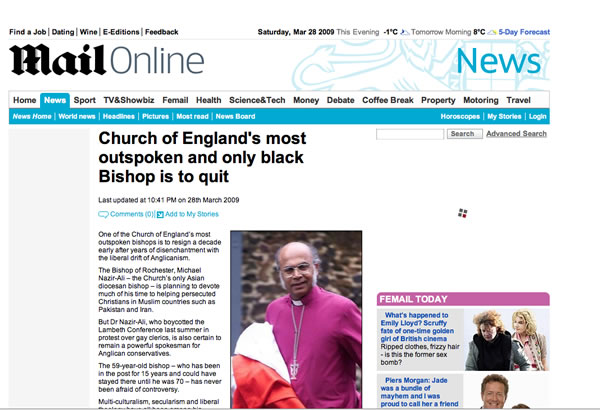
Mail on Sunday Church of England’s most outspoken and only black Bishop is to quit
Note This headline was changed some time after 8 am Sunday, but here is the evidence of the earlier version.
The new headline is Bishop Nazir-Ali, scourge of Church liberals, steps down.
Independent Bishop of Rochester retires
United Press International Pakistani bishop in England resigns
Sunday Mirror I quit: Islam row bishop headline changed to Islam row Bishop of Rochester to step down.
Associated Press of Pakistan Bishop Ali to quit his post: a report
George Pitcher Telegraph Bishop Nazir-Ali retires; a rebellion fizzles out
Riazat Butt Guardian Michael Nazir-Ali steps down to focus on helping persecuted Christians
Ekklesia Anglican bishop resigns and announces plan to support harassed Christians
Melanie Phillips Mail When a bishop has to leave the Church of England to stand up for Christians, what hope is left for Britain?
and a Mail Comment article, We’re losing our faith in a desperate bid to appear inclusive and tolerant
There was still no sign of this release on the Rochester diocesan website at 6.00 pm Saturday, last website update was on 20 March, it says.
Monday lunchtime
A copy of the press release has at last appeared on the Rochester diocesan website, as a PDF file.
——
PRESS ANNOUNCEMENT EMBARGOED UNTIL 10 a.m. 28 MARCH 2009
Bishopscourt, Rochester, Kent ME1 1TS
01634 814439 / 07791 968819
Bishop Michael announces his intention to step down as Bishop of Rochester
Bishop Michael Nazir-Ali has announced his intention to step down as Bishop of Rochester as from 1st September 2009. He will have been Bishop in the Diocese for nearly 15 years and during this time has played a major part in the life of the church.
Bishop Michael is hoping to work with a number of church leaders from areas where the church is under pressure, particularly in minority situations, who have asked him to assist them with education and training for their particular situation. Details of this arrangement are still being worked out.
Bishop Michael, who will be 60 in August, is the 106th Bishop of Rochester. He is originally from Asia and was the first non-white Diocesan Bishop in the Church of England. He was appointed to Rochester in 1994. Before that he was the General Secretary of CMS from 1989-1994 and before that Bishop of Raiwind in Pakistan and theological Assistant to the Archbishop of Canterbury. Since 1999 he has also been a member of the House of Lords where he has been active in a number of areas of national and international concern.
Bishop Michael says, “We thank God for his blessings and for friends we have made in the Diocese in the past 15 years. I am so grateful to God for the friendship and loyalty of those around us and ask for people’s prayers as we take this step of faith ‘not knowing where we are going’ (Heb 11:8).
7 CommentsFirst, several British churches, but not the Church of England, published a statement this week, in advance of the G20 conference meeting in London next week.
Churches challenge G20 leaders on real leadership:
Baptist, Methodist and United Reformed Church leaders have challenged the G20 heads of government, meeting in London next week, to show real leadership and ensure that solutions to the current economic crisis lead to action on global warming. They want the G20 nations to grasp the opportunity for investment in new technology, which will save energy and reduce carbon output. In particular, they are urging the richer nations to agree generous support for developing countries, so they can afford the initiatives they need to take.
Second, in connection with the Put People First rally in central London for jobs, justice, climate, there will be a Church Service at Methodist Central Hall, Westminster on Saturday 28 March at 11 a.m. Speakers include Richard Chartres, Bishop of London.
Church Times blogger Dave Walker will be reporting on the day’s events.
Third, Archbishop Rowan Williams delivered the Ebor Lecture earlier this week in York Minster, on the subject: Renewing the Face of the Earth: Human Responsibility and the Environment. Full text and audio here. Press release here.
Dave Walker reported it as Religious communities “failing profoundly” in climate change response. and he has comprehensive links to secular press coverage of the lecture, which was extensive.
Jim Naughton criticised the archbishop in The Archbishop of Canterbury’s own shortcomings on climate change:
4 Comments…Until he states clearly that powerful people in his own Communion don’t believe human activity contributes to global warming, and that he appeases these people so that they won’t split the Communion over the issue of homosexuality, he has little credibility on this matter.
If one examines the funding sources of the organizations behind the attempted Anglican schism, and the funding sources of the organizations that deny human activity contributes to climate change, one finds that they are sometimes one and the same…
Inclusive Church is delighted to announce its next residential conference on Monday 5th – Wednesday 7th October 2009.
“Word on the Street – reading the Bible inclusively” will be a three day conference at the Hayes Conference Centre, Swanwick, Derbyshire to help us see how Holy Scripture does indeed:
With Workshops, Bible studies, Worship, Plenary, Meals and Bar
The keynote speakers are:
The cost is £195. Students and those on low income £130. Residential ordinands and stipendiary curates £90.
For a flyer and booking form follow this link. Book early to avoid disappointment!
2 Comments