General Synod – Thursday's business – press reports
updated Friday morning
Ruth Gledhill in the Times Methodists declare ‘we’re ready to merge’ with CofE
Maria Mackay in Christian Today Methodist Church ‘prepared to go out of existence’ for mission
Martin Beckford in the Telegraph General Synod: Methodists likely to merge with Church of England
Jerome Taylor in The Independent Leader signals end of Methodism
Steve Doughty in the Mail Methodist church ‘prepared to go out of existence’
Note The above items refer to an address by the President and the Vice-President of the Methodist Conference to the General Synod on Thursday morning. The Methodist Church of Great Britain have released this press release.
President and Vice-President address General Synod
The text of the address is available here.
Stephen Bates in The Guardian Church of England General Synod extends pension rights for gay partners
The BBC has Synod votes to give gay clergy equal pension rights
Maria Mackay in Christian Today Church grants full pension rights to gay clergy
Ruth Gledhill in the Times Partners of gay clergy win same pensions as spouses
Martin Beckford in the Telegraph General Synod: Church of England backs equal pension rights for gay clergy partners
Stephen Bates in The Guardian Anglican church calls for tighter regulation of violent computer games
Martin Beckford in the Telegraph General Synod: Church expresses ‘concern’ about effects of computer games on children
7 CommentsGeneral Synod – pensions for surviving civil partners
This afternoon General Synod voted in favour of providing pensions to the surviving civil partners of clergy on the same basis as they are paid to surviving spouses. At present, and in accordance with the minimum requirements of the law, service before 5 December 2005 does not count towards the level of pension for surviving civil partners.
The private member’s motion, text below, was proposed by the Revd Mark Bratton, and was passed without amendment.
That this Synod request the Archbishops’ Council and the Church of England Pensions Board to bring forward changes to the rules governing the clergy pension scheme in order to go beyond the requirements of the Civil Partnership Act 2004 and provide for pension benefits to be paid to the surviving civil partners of deceased clergy on the same basis as they are currently paid to surviving spouses.
The vote was taken by houses and all three houses voted in favour; here are the detailed voting figures.
| for | against | abstentions | |
| bishops |
12
|
2
|
3
|
| clergy |
97
|
23
|
10
|
| laity |
78
|
59
|
9
|
There were two unsuccessful proposed amendments. One, from the bishop of Ripon and Leeds, would have reworded the motion to:
That this Synod recognise that it will be some considerable time before surviving civil partners’ pension rights reach parity with those of spouses, and in the light of that note the helpful confirmation from the Pensions Board that surviving civil partners of deceased clergy are eligible to be considered for hardship grants if they meet the same qualifying conditions as apply to surviving spouses.
This amendment was defeated with 110 votes in favour, 154 against and 15 recorded abstentions.
A second amendment, proposed by Dr Philip Giddings, would have added a long list of dependent relatives, as well as civil partners, to those entitled to pensions; this was defeated on a show of hands.
Background papers
GS 1770A paper prepared by Mark Bratton
GS 1770B paper by the Rt Reverend John Packer, Chair of DRACSC (The Archbishops’ Council Deployment, Remuneration and Conditions of Service Committee)
General Synod – Thursday morning press reports
Reports of Wednesday’s broadcasting debate are linked here and of the ACNA debate here.
On other matters there is this.
Martin Beckford in the Telegraph Church of England warned against thoughtless criticism of Armed Forces by senior padre
4 Commentscriticism of the presidential address
At Ekklesia there is some analysis of what Rowan Williams said on Tuesday, in Archbishop says sorry to gays but defends Church’s discrimination.
In Cif: belief Savi Hensman gets more explicit: Rowan’s apology falls short.
And, I wrote a piece for Cif:belief which is headlined Rowan’s speech and the equality bill.
Also, Kelvin Holdsworth has written Still Shocking.
4 CommentsGeneral Synod – press reports of the ACNA debate
Updated Thursday morning to include more details of the motion and amendments and further press reports
Stephen Bates in The Guardian Church of England keeps distance from breakaway US conservative Episcopalians
Jerome Taylor in The Independent Church sidesteps gay issue at Synod debate
Avril Ormsby at Reuters UK Church stops short of communion with U.S. conservatives
For the record, the original motion proposed by Lorna Ashworth was
That this Synod express the desire that the Church of England be in communion with the Anglican Church in North America.
Synod amended this to
That this Synod
(a) aware of the distress caused by recent divisions within the Anglican churches of the United States of America and Canada;
(b) recognise and affirm the desire of those who have formed the Anglican Church in North America to remain within the Anglican family;
(c) acknowledge that this aspiration, in respect both of relations with the Church of England and membership of the Anglican Communion, raises issues which the relevant authorities of each need to explore further; and
(d) invite the Archbishops to report further to the Synod in 2011.
The amended motion was largely the proposal of the bishop of Bristol, on behalf of the House of Bishops, but paragraph (a) was added on a proposal from the Revd Andrew Dow (diocese of Gloucester).
The amended motion was carried by 309 votes in favour to 69 against, with 17 recorded abstentions.
There was an attempt to amend the motion to read:
That this Synod
(a) express the desire that the Church of England be in communion with the Anglican Church in North America;
(b) recognise and affirm the desire of those who have formed the Anglican Church in North America to remain within the Anglican family;
(c) acknowledge these aspirations, in respect both of relations with the Church of England and membership of the Anglican Communion, raise issues which the relevant authorities of each need to explore further; and
(d) invite the Archbishops to report further to the Synod in 2011.
This was defeated by 166 votes in favour to 223 against with 2 recorded abstentions.
During the debate there were two procedural motions, one to move to next business and one to adjourn the debate, but both were defeated. If carried either would have brought the debate to an immediate end without a vote.
11 CommentsGeneral Synod – business done Wednesday
Summaries of Wednesday’s business at General Synod are online.
morning General Synod – Summary of Business Conducted on Wednesday 10th February 2010 AM
afternoon General Synod – Summary of Business Conducted on Wednesday 10th February 2010 PM
The second of these will not be complete until after the close of business at 7.00 pm.
9 CommentsGeneral Synod – Wednesday's Broadcasting debate
Synod debated this private member’s motion on religious broadcasting, proposed by Nigel Holmes, this (Wednesday) morning:
That this Synod call upon the BBC and Ofcom to explain why British television, which was once exemplary in its coverage of religious and ethical issues, now marginalizes the few such programmes which remain and completely ignored the Christian significance of Good Friday 2009.
An amendment was moved by the Bishop of Manchester, and carried by Synod, which reworded the motion to read:
That this Synod
(a) express its appreciation of the vital role played by those engaged in communicating religious belief and practice through the media, at a time of changes within the industry; and
(b) express its deep concern about the overall reduction in religious broadcasting across British television in recent years, and call upon mainstream broadcasters to nurture and develop the expertise to create and commission high quality religious content across the full range of their output, particularly material that imaginatively marks major festivals and portrays acts of worship.
The amended motion was carried by 267 votes in favour with 4 against and 2 recorded abstentions.
Here are some press reports.
Stephen Bates in The Guardian Synod rejects motion attacking broadcasters over lack of religious programmes
Martha Linden of the Press Association in the Independent Church concern over religious broadcast hours
Avril Ormsby of Reuters UK Church of England laments drop in religious TV programmes
The BBC has Church of England concerned by ‘religious TV cuts’
1 CommentGeneral Synod – Wednesday morning press reports
updated Wednesday lunchtime
We covered most of these last night, but here are a couple looking forward to some of today’s business.
Ruth Gledhill in the Times Anglican Church in North America ‘should be in communion with C of E’
The BBC has BBC accused over a lack of religious broadcasts
The Guardian has BBC religious coverage to come under fire at Church of England debate
7 CommentsGeneral Synod – press reports of Archbishop of Canterbury's presidential address
updated Thursday morning
We link to the text of the Archbishop of Canterbury’s presidential address here. Here are some early press reports of what he said.
Stephen Bates in The Guardian Archbishop of Canterbury appeals for unity over gay clergy and women bishops
update The Guardian has issued a correction to the above article. The online version appears to be correct.
A story reported Rowan Williams’s appeal for Anglicans to show mutual tolerance over issues of gay equality and female bishops. The story also noted a statement put out by the head of the church in Uganda, Henry Orombi, supporting his country’s proposed anti-gay legislation. Contrary to our headline – Archbishop’s plea for tolerance undermined by attack on gay people at General Synod, 10 February, page 4 – the Orombi statement was issued in Kampala. The statement also insisted: “The church is a safe place for individuals to seek help and healing.” This was changed in editing to “Williams’s church”, when the Ugandan archbishop was referring to his own.
Martin Beckford in the Telegraph Relaxing assisted suicide laws a ‘moral mistake’ – Archbishop of Canterbury
Ruth Gledhill in the Times Rowan Williams issues ‘profound apology’ to gay Christians
Steve Doughty in the Mail Archbishop of Canterbury says changes to assisted dying laws will ‘cross a moral boundary’
Avril Ormsby at Reuters UK Archbishop warns over restricting religious freedoms
27 CommentsGeneral Synod – business done Tuesday
updated Tuesday evening
Summaries of Tuesday’s business at General Synod are online.
morning General Synod – Summary of Business Conducted on Tuesday 9th February 2010 AM
afternoon General Synod – Summary of Business Conducted on Tuesday 9th February 2010 PM
2 CommentsGeneral Synod – Archbishop of Canterbury's presidential address
The Archbishop of Canterbury gave his presidential address to General Synod this afternoon. A press release is online, followed by the text of the speech.
Archbishop’s Presidential Address
In addition there is Word document of the speech linked from here.
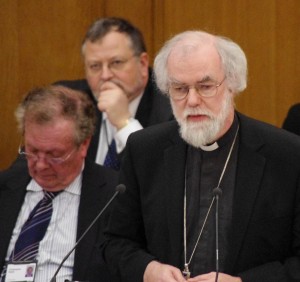
The Archbishop delivering his address.
13 CommentsGeneral Synod – Tuesday morning press reports
Stephen Bates in The Guardian New split in Church of England over women bishops
Martin Beckford in the Telegraph General Synod: Church of England exodus feared unless women bishops plans changed
Andrew Hough in the Telegraph General Synod: Church of England suffering from ‘testosterone deficit’
George Pitcher in the Telegraph The Church is full of women – so obviously what we don’t need is women bishops
Jonathan Wynne-Jones in the Telegraph Church of England is ‘living in the past’, says BBC’s head of religion
Ruth Gledhill in the Times Dr Rowan Williams to challenge infighting over gays and women bishops
Steve Doughty in the Mail Where have all the men gone? asks the Church of England
Jerome Taylor in the Independent Evangelicals in warning over women bishops
Many of these articles refer to this press release from Reform Reform highlights ‘huge practical problems’ with women bishops and an attached letter sent to Synod members.
6 CommentsACNA: another critical view
A critical view of the ACNA resolution is contained in an article published on Fulcrum and due to also appear on Religious Intellligence written by the Bishop of Sherborne, Graham Kings.
Read General Synod Motion concerning the Anglican Church in North America.
2 CommentsACNA: some other views
The Church of England Newspaper reports that one episcopal signer of the original resolution has had new thoughts. In Controversial American vote defused by House of Bishops it is reported that:
The Bishop of Winchester, the Rt Rev Michael Scott-Joynt, said: “My name is on the original motion of Lorna Ashworth’s, and I’m happy that it was and is, but I realise that it is more practical to ask the Synod to do something that it really is in a position to do. “It is not in fact the role of the Church of England to make these kind of decisions, nor is it for Synod to make these kind of decisions. Therefore, to enable the archbishops and the bishops and others to vote positively, there needs to be an amendment like that which the Bishop of Bristol will be bringing.
“It does two things. It brings the motion in line with the constitutional role and the canonical realities as to who actually makes these decisions. At the same time it is a clear and positive affirmation of the character and intentions and standpoint of the ACNA.”
Somebody who left the Church of England quite a while ago, Charles Raven, now a major force in the Fellowship of Confessing Anglicans says this, in a piece published on Anglican Mainstream titled The English General Synod: The Centre Cannot Hold:
9 Comments…it is as much about the English Church as the Church in North America.
She poses precisely the sort of question that the Church of England’s leadership wants to avoid because the ACNA represents a choice which must be made between two incompatible forms of religion – historic biblical Anglicanism and that pseudo- Anglicanism being promoted by TEC and its allies which derives its energy from the spirit of the age rather than the Spirit of Christ.
ACNA: questions on a postcard
Tobias Haller has composed some pithy questions that member of General Synod might care to ponder about ACNA:
18 CommentsPlease consider the following for a moment:
1) What would be done in the Church of England if a bishop from the convocation of Canterbury were to announce one day that he no longer considered himself to be under the authority of the Archbishop of Canterbury and had transferred his allegiance to the Archbishop of Tanzania, but intended to remain in his present location and exercise episcopal functions as a representative of his new archbishop?
2) What would be done in the Church of England in the case of a priest who announced that he no longer recognized his diocesan bishop as having any authority over him, but refused to relinquish his cure? And if he invited bishops from other dioceses or provinces to do parish visitations there?
3) What would be done in the Church of England if the clergy and parish council of a parish in, shall we say, Dibley, announced that it was no longer part of the Church of England, but considered itself now to be a congregation of the Church of the Province of the Sudan, altered all of their signage and other public information to reflect this change, purporting now to be part of “The Anglican Church in England” and invited bishops from the Sudan to function in the parish, refusing to have anything more to do with their C. of E. diocese or its leadership?
These are the kinds of things The Episcopal Church is having to deal with, as facts on the ground. Any depositions, inhibitions, or lawsuits are a result of and in response to precisely these sorts of actions. Consider carefully how you vote on the motion to come before you. You may soon be dealing with just such situations yourself.
General Synod – business done Monday
A summary of Monday’s business at General Synod is online.
General Synod – Summary of Business Conducted on Monday 8th February 2010 PM
There are links to audio of the proceedings.
1 CommentGeneral Synod Questions
The questions to be asked at General Synod next week are now online.
General Synod February 2010 Questions
The answers will be given in the last item of business on Monday 8 February.
1 CommentACNA – some more stuff
Today’s Church Times carries a news report by Pat Ashworth Accuracy of briefing paper on ACNA challenged.
This mentions a press release from the American Anglican Council, which you can see here: AAC Tracks Episcopal Church’s Canonical Abuse – Plight of Orthodox Anglicans.
This article from almost a year ago may be useful: 16 February 2009 ACNA publishes statistics.
And there is this one from earlier, 12 December 2008 ACNA: 700 congregations?
Also, 12 December, revised 19 December 2008: church press covers ACNA
And there are other articles from last year:
April: ACNA does not expect recognition
June: more about ACNA
July: General Synod: Questions about ACNA and ACNA and FCA
6 CommentsEquality Bill: more articles
The Church Times today carries my report of recent events under the headline: Churches to keep their exemption from equality law, Harman confirms.
THE LAW covering church employment will stay as it is, the Minister for Women and Equality, Harriet Harman, said on Tuesday. She was speaking after the defeat in the Lords of an amendment to the Equality Bill (News, 29 January), which sought to clarify the exemption for religious bodies from the existing legislation, to ensure that it applied only to church ministers…
This report also includes two sections on more of the House of Lords debates from Monday and Wednesday of last week, including the one on Civil Partnerships venues.
Earlier on Monday of last week, the House considered a proposal from Lord Alli to to amend the Civil Partnerships Act to allow religious venues to be used.
Lord Harries, the former Bishop of Oxford, spoke in support. He said: “The Government were absolutely right to respect the religious sensitivities of the Church of England when the Civil Partnership Bill went through Parliament, but since that time a new situation has emerged. The Quakers, liberal Jews, and other religious bodies have made it quite clear that they want permission to conduct these ceremonies in a religious context with religious language. This is a fundamental issue of religious freedom…”
Cif: belief yesterday carried a comment article by Riazat Butt headlined More Catholic than the pope.
There is still much anger over the pope’s comments about UK equality laws. Part of me wonders why people are surprised by the nature of his observations – they are exactly what one would expect – and part of me also wonders why people are focusing on the equality bill, which was more about Anglicans than Catholics. The Catholic bishops did not turn a blind eye to the proposed legislation, but it was the Lords Spiritual who went to war over it. They won. Well done them. That the established church is trying to shut out people whose lifestyle is at odds with Christian ethos brings the words “stable”, “door” and “bolted” to mind. Their attempts to legitimise “sexual cleansing” also reminds me of the time that Katharine Jefferts Schori accused the C of E of double standards…
and she concludes:
4 CommentsWhile I accept the pope was out of order for passing judgment on equality legislation and UK attitudes towards homosexuality, the same level of anger and outrage must be directed at those Church of England bishops who fought tooth and nail to keep the status quo, to preserve their right to discriminate against gays and lesbians and to institutionalise and legitimise prejudice against anyone they deemed to be unfit for purpose because of their lifestyle.
Equality Bill – further reactions
Steve Bell in the Guardian had a cartoon, see Your equality laws are unjust, pope tells UK before visit.
Listen to Archbishop Peter Smith of Cardiff, speaking on Vatican Radio in Rome on Tuesday.
The Guardian published this editorial comment on Wednesday: Equalities legislation: The pope protests.
The Question of the Week at Cif:belief has been Does faith trump equality? (This was started on Monday, before the Pope spoke.)
- Jonathan Bartley wrote on Monday Did we forget about love?
- The Bishop of Winchester wrote The churches stand for pluralism.
In response to the Pope incident, Martin Pendergast wrote at Cif: belief All of us deserve equality.
And Simon Jenkins wrote An odious view, indeed. But I’m with Pope Benedict on this one.
The Chief Rabbi, Jonathan Sacks wrote in The Times The Pope is right about the threat to freedom.
The Archbishop of York gave a lecture, in Newcastle, titled Gracious Magnanimity vs. Tolerance. You can read the full text of that here.
8 Comments